
Self-Service Analytics 2.0: What's different for modern teams
Why most self-service analytics tools were really just guided dashboards
How agentic AI is redefining self-service analytics beyond what NLP achieved
What genuinely self-service data analytics looks like in 2026 and beyond
PUBLISHED:
UPDATED:
Self-service analytics was supposed to be simple: build your own dashboards, ask your own questions, and stop waiting on data teams for every insight. For most companies, that never happened.
Browse any BI forum, and you’ll find users calling self-service analytics ‘a myth,’ noting that most tools still require you to know how data is structured, which tables to join, and how to filter correctly. Sure, you can click around pre-built dashboards, but the moment you have a follow-up question, you’re back to filing tickets.
Two waves of AI are finally changing this. Natural language made analytics accessible. Agentic AI is taking it further—turning analytics from passive reporting into active investigation.
Self-service analytics was really guided analytics
True self-service analytics means you can explore data freely and follow your line of inquiry.
Guided analytics is different. You’re limited to pre-built dashboards and the paths your data team mapped out. If your question falls outside that scope, you file a ticket and wait.
Most ‘self-service’ tools were actually guided analytics with interactive experiences. They connected to your data warehouse. They let you build dashboards. They even gave you drag-and-drop interfaces so you didn’t have to write code.
But that didn’t solve the fundamental problem: you still need to know how the tool works before you can ask a question.
Take a sales operations manager trying to understand why revenue dropped last quarter. In a traditional tool, the workflow looks like this:
Find the dashboard with revenue data.
Filter to the right quarter and time period.
Segment by deal type (assuming that dimension exists).
Cross-reference pipeline data in a separate dashboard.
Manually figure out whether the drop came from fewer deals, smaller deal sizes, or longer sales cycles.
Repeat for every segment until something clicks.
This experience is not self-serve. That’s guided analytics.
How NLP made self-service analytics accessible
The first wave of AI analytics solved the interface problem. Using machine learning and Natural Language Processing (NLP), these systems let you ask questions in plain English and automatically translate them into SQL.
‘Why did revenue drop last quarter?’ became a series of queries that pulled the data, compared it to the previous period, segmented by source, and surfaced the trend. No more knowing which tables to join.
What NLP got right
Beyond speed, NLP changed a few things structurally:
Lowered the floor for data literacy. You didn’t need to know SQL, understand data schema, or know which table held what. The abstraction layer is genuinely new.
Freed analysts for real work. Fewer low-value “can you pull this for me” requests meant data teams could spend time on modeling and analysis, not translation.
Changed how people reasoned with data. The ability to ask a follow-up immediately, without re-filing a request, made exploration feel less like a process and more like having a conversation.
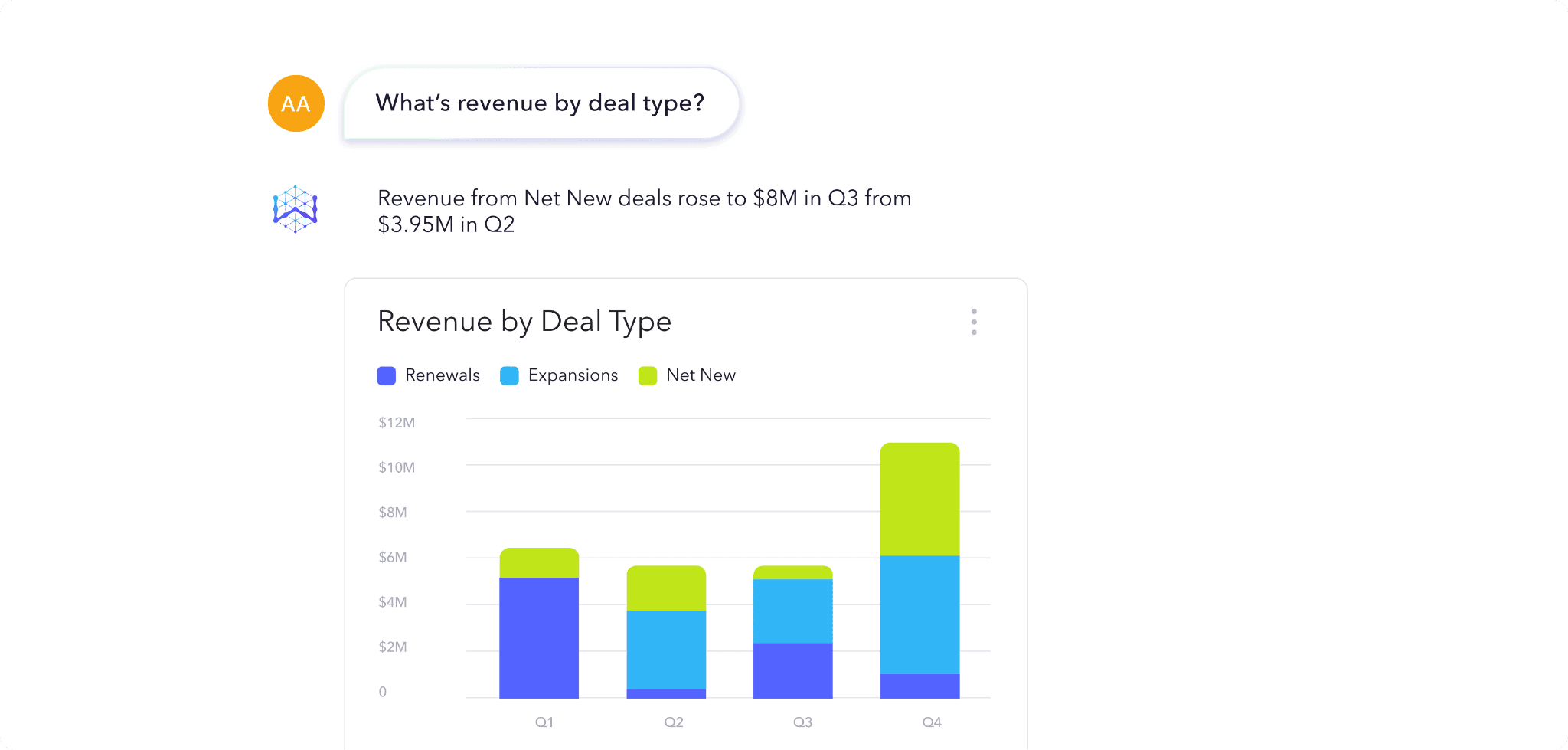
This was a real breakthrough for modern self-service analytics. You can simply ask ‘what’s our revenue by deal type’ and you can get answers in seconds. The technical barrier that kept most business users out of their own data is finally gone.
Where NLP fell short
NLP is still reactive in most data analytics tools. It answers your first question, then stops.
Three failure modes show up consistently:
Can’t reason across systems: Most questions are cross-functional. It requires joining CRM data, sales activity, marketing engagement, and product usage. Most NLP tools query one source at a time. You ask the question, get a partial answer, then have to manually piece together the rest.
Doesn’t follow a thread: The system often treats every follow-up question as a brand-new query, forgetting the context of the first question due to a limited LLM context window. Every conversation starts from scratch.
Faces difficulty with imprecision: NLP tools work well when the question maps cleanly to a metric. They struggle when the question is vague—exactly the kind of question business users actually ask. “How are we doing in EMEA?” returns nothing useful without specifying what “doing” means or which metric to look at.
Different outputs for the same question: You’d expect LLMs to give the same answer every time. However, these interfaces are not deterministic by nature. This means the same query asked by different users may produce slightly different SQL outputs.
NLP solved the interface problem. But complex, multi-step analysis remained untouched. You just couldn’t go deeper without doing the work yourself.
Rather than leaving teams to navigate these challenges, AI agents step in as intelligent, always-on collaborators—adapting to complex workflows without constant human oversight.
Agentic AI: From passive reporting to active investigation
Agentic AI monitors incoming data, analyzes patterns, generates insights, and autonomously triggers responses. Instead of producing static reports, it continuously evaluates data against your goals, reasoning across multiple data sources to determine what’s happening and decide what to do next.
Multiple autonomous agents—what we call Analytics Agents—work together to surface insights, take context-aware actions, and trigger workflows.
The difference between NLP and agentic AI is most evident in how each handles a single question.
Let’s go back to our previous example, you asked, ‘Why did revenue drop last quarter?’
With natural language processing: The system queries your data and returns: ‘Revenue dropped 25%. Enterprise deals stayed flat, mid-market dropped 40%.’ Now you know mid-market is the problem.
But ‘why it dropped’ lives outside the data model NLP can query—answering it would require connecting deal data, pipeline data, sales rep activity, and discounting patterns across systems. NLP can’t reason across those sources. The investigation stops at the symptom, not the cause.
With agentic AI: Same question, full investigation. Agents reason across systems—pulling deal data from the CRM, pipeline trends from the warehouse, and discounting history from billing—then connect the dots:
Identifies the drop (25%).
Segments by deal type (mid-market down 40%, enterprise flat).
Drills into drivers (deal volume down 30%, deal size from $50K to $35K).
Isolates geography (West region only).
Flags timing (started in Q2).
Recommends next steps (analyze win rates by region, review discounting patterns).
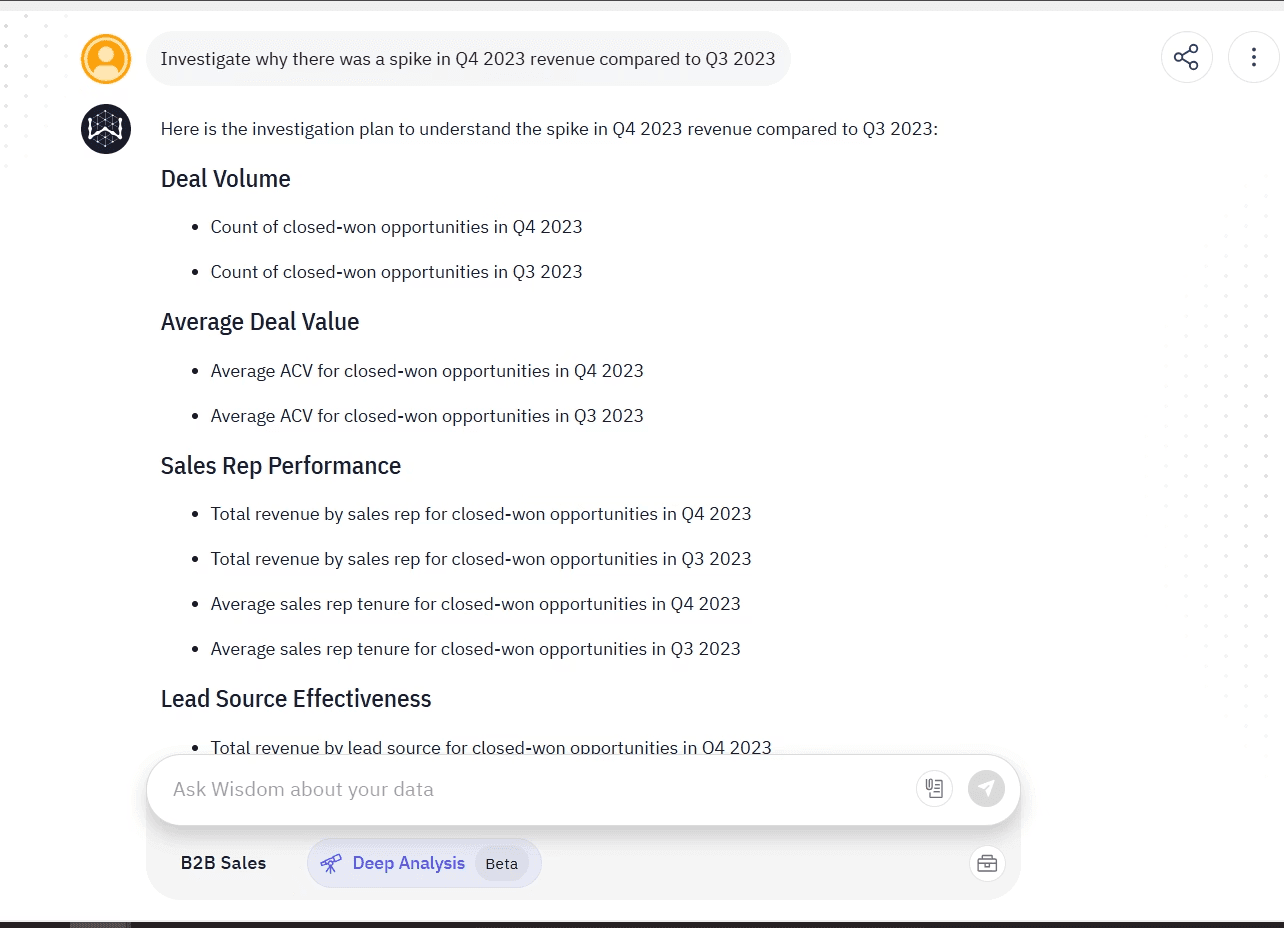
One question. Multi-source reasoning. That’s the shift from passive to active analytics. The platform doesn’t just answer your question—it investigates the layers underneath and points you to what’s next.
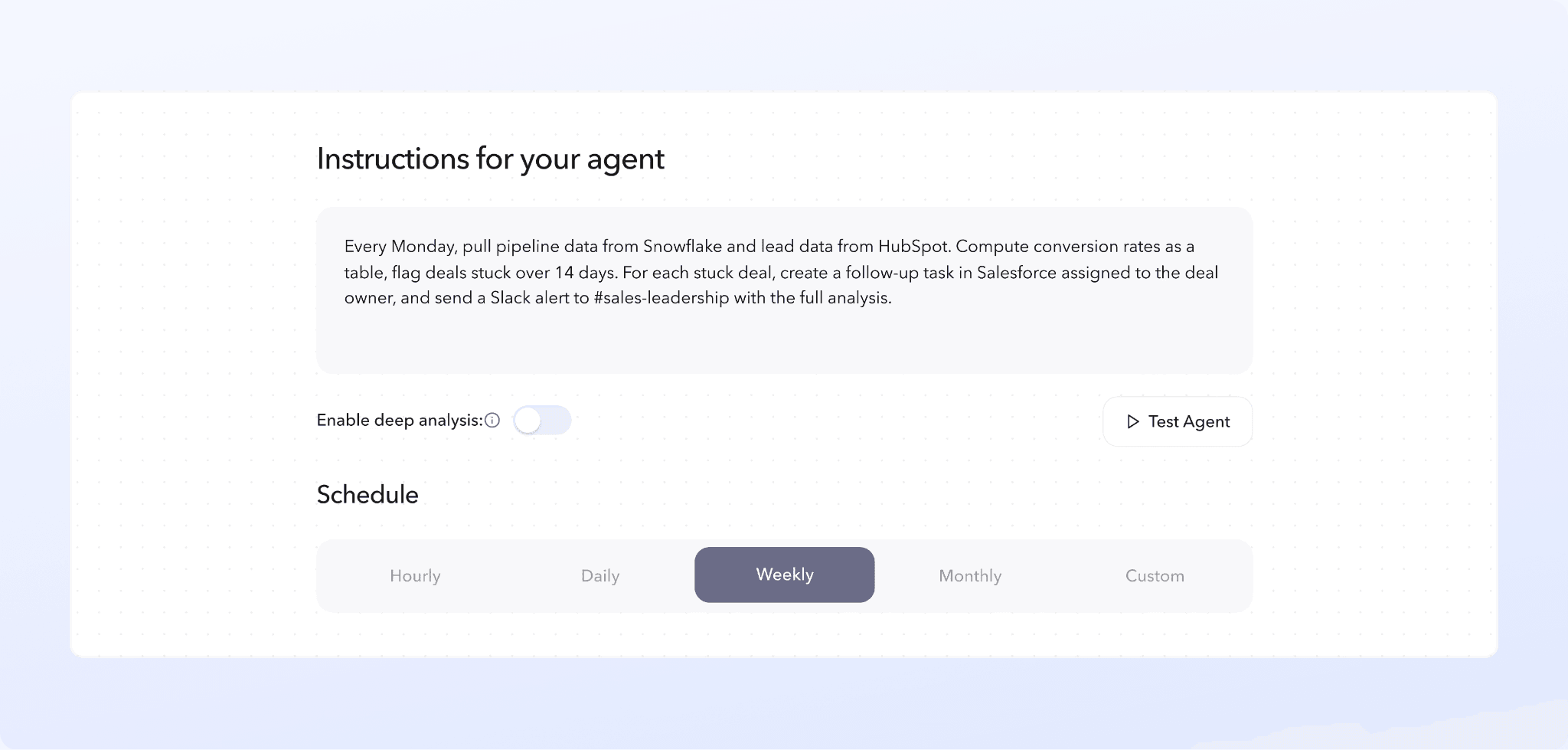
Agentic analytics platforms like WisdomAI take it further. Anomaly alerts, scheduled digests, threshold notifications—all triggered automatically and pushed to where your team already works. You don’t even need to open a dashboard.
What makes AI-powered self-service analytics different from legacy BI?
Here’s where the two approaches diverge:
Legacy BI | AI-powered self-service analytics | |
Interface | Requires SQL or proprietary query languages. Users must understand database schemas, joins, and filters to get an answer. | Understands plain English. “Show me revenue by region for Q2” automatically translates to SQL. Zero schema knowledge required. |
Depth of analysis | Top-line metrics live in dashboards. But deep drill-downs and multi-step analysis require filing a ticket with the data team. | One question triggers a full investigation: segmentation, drill-downs, time-based patterns, and root-cause analysis. Ask questions the way you’d ask an analyst. |
Handling vague questions | Fails without precision. Asking “Why are conversions down?” returns nothing without a specified timeframe and channel. | Infers context and fills the gaps. The system applies reasonable defaults (e.g., last 30 days) and only asks for clarification when ambiguity matters. |
Anomaly detection | Relies on scheduled refreshes. Silent shifts in critical metrics go completely unnoticed until someone manually checks. | Monitors in real-time. Alerts arrive with immediate context: what changed, when it started, and exactly where to investigate. |
Adaptiveness | Static. Same input, same output. Thresholds need to be reconfigured manually as the business evolves. | Continuously learns. The platform adapts to user feedback, learning which metrics matter most and automatically filtering out the noise. |
Look at Zoro, a B2B eCommerce company in the MRO space. Their data team was fielding 20–25 analytics questions a day, mostly through Slack. Leaders kept routing everyday exploration and validation through analysts—work that shouldn’t have required analyst involvement in the first place.
With WisdomAI, product and business leaders got answers from day one. The backlog that drained both teams cleared up instantly. That’s self-service, which lives up to its name.
How to pick the right AI-powered analytics tool for your team?
A recent McKinsey study found that by the end of 2025, nine out of ten companies had deployed AI in at least one business function. The catch: 94% of those companies aren’t seeing significant value from the investment. Self-service analytics is heading the same way.
Every analytics vendor now claims to have AI-powered capabilities. But how these capabilities are built determines whether they work for real-life use cases. Chat interfaces bolted onto traditional dashboards can’t deliver the same depth as platforms architected around agentic intelligence.
When evaluating platforms, look for:
Data connectivity across sources: The platform should connect to your data warehouse, CRM, marketing tools, and operational systems—and query them all in a single investigation. Siloed data access means siloed answers.
Complex analysis without SQL: The platform should handle multi-step, multi-dimensional analysis automatically. Asking ‘Compare revenue by product, region, and customer segment’ should return the full breakdown without requiring you to know SQL.
Contextual follow-ups: After asking ‘Why did conversions drop?’ you should be able to ask “Which segments were affected?” or “When did it start?” without restating the question. The system should maintain context across the conversation.
Anomaly detection with context: Alerts should include what changed, when it started, which segments are affected, and preliminary analysis of why—not just notify you that a number moved.
Adaptive learning: The platform should learn what’s normal for your business and adjust over time. The system should get better at separating signal from noise based on how your team actually responds.
Building trust in AI analytics
Self-service analytics was supposed to free business users from the data team. AI is finally making that possible. But speed alone doesn’t make analytics trustworthy.
Strip out context, and your AI hallucinates. Strip out governance, and every query is a compliance risk. The only way forward is getting both right. So how do you do that?
WisdomAI’s Adaptive Context Engine turns context and governance from a bottleneck into a foundation. It learns your business logic by understanding how your team works with data—which metrics matter, how they’re calculated, and which sources can be trusted. For governance, it inherits permissions from your data warehouse and enforces them at query time.
The result: Ask a question and get a clear, auditable, and contextual answer in minutes.
Ready to see self-service analytics actually self-serve? Start a demo.