
AI analytics: What it is and how it works at enterprise scale
Summary
What AI analytics actually does beyond traditional dashboards and BI tools
How enterprise AI analytics works end-to-end—from raw data to insights
Why Gartner predicts AI analytics will drive 10x growth in data adoption
PUBLISHED:
UPDATED:
Chances are you’ve already seen AI analytics in action. Maybe you’ve used it yourself, turning data into visualizations or generating data insights with a single prompt. What started as a novelty is quickly becoming the default. In fact, Gartner predicts natural language querying will drive a 10x spike in data adoption by 2027.But chatting with your data is just the surface. AI analytics tools can also proactively monitor for anomalies, trigger tickets in your most-loved workplace tools, and even build your next slide deck — with custom branding and detailed data analysis.You’ve seen what layer one looks like. Let’s dive into the rest.
What is AI Analytics?
AI analytics uses artificial intelligence to analyze data, surface insights, and support decisions faster than traditional analytics tools can. It combines natural-language querying, text to SQL, machine learning, and agentic automated workflows to let anyone on your team interact with data without waiting on the data team to support.Analysts and data engineers win here, too. AI in data analytics helps them process large volumes of data faster, spot patterns they’d miss manually, and generate predictive insights without spending weeks building models from scratch.
Traditional analytics vs AI analytics
Legacy data tools aren’t built for speed. They are built for storage, processing, and retroactive reporting. Think dashboards, reports, and fancy charts. AI analytics is the opposite — it gives you natural-language explanations of what happened and why, with industry benchmarks and future projections. Even better, it facilitates action, closing the gap between data and decisions.AI analytics changes how the entire data lifecycle operates. Here’s the breakdown:
The data lifecycle | Traditional analytics | AI analytics |
Data collection | Manual connections and fragile ETL pipelines that require constant maintenance. | Creates a direct feed to your data sources, slashing deployment time, data caching, and integration debt. |
Data preparation | Analysts burn hours cleaning, transforming, and structuring data before it’s even usable. | Automates the heavy lifting of data cleaning. Your team shifts from building from scratch to validating results. |
Data querying | Gated behind SQL and other technical data engineering languages, with many tools requiring custom language expertise. Business users are dependent on the data team. | Democratizes access via natural language. Business users simply ask questions and get instant answers in the form of text, auto-generated visualizations, or even custom action triggers. |
Data visualization | Dashboards are built manually and refreshed on a schedule. | Dynamic visualizations generated on demand with live, real-time updates. |
Reporting | Built by analysts, refreshed by analysts, and distributed by analysts. | User generated answers and dashboards, with optional automated scheduled delivery. Your analysts spend less time on tedious maintenance. |
Advanced analytics | Requires a data science team to build, test, and maintain models. High effort, high cost. | Lowers the barrier to entry. Rapidly deploys deep analytics with human-in-the-loop oversight. |
The technological layers powering AI analytics
Natural Language Processing (NLP)
NLP powers conversational analytics, allowing your team to ask questions in everyday language instead of writing SQL. You ask a question in plain English, and NLP figures out what you mean, resolves ambiguity, and deploys NLP to SQL to determine the right query. Then it delivers the answer back in your language through a written explanation, a chart, or a summary.
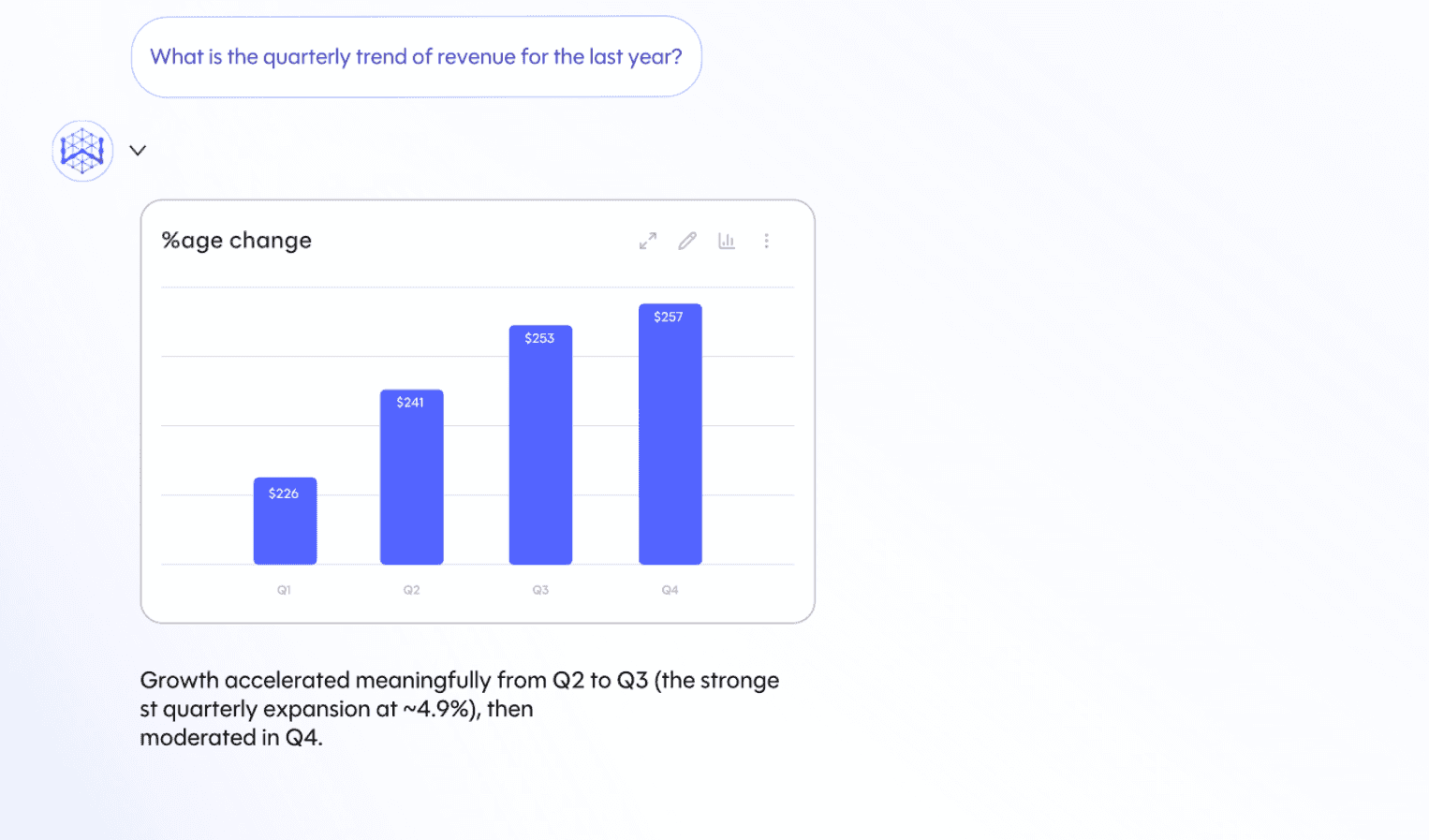
Shift: Data access becomes infrastructure for the whole org.
Machine Learning (ML) Algorithms
ML is the reason AI analytics doesn’t stop at answering questions. It is the engine that analyzes your historical data to find the answers you didn’t even know to look for.
Surfaces hidden patterns: Identifies trends, anomalies, and root causes that would take data teams weeks to discover manually.
Makes predictions: Uses historical learnings to forecast pipeline shifts and future outcomes.
Self-optimizes: The AI models aren’t static. They act as a living system, refining and getting smarter as fresh data flows through.
Shift: Instead of reacting to what happened, you start anticipating what’s next.
Statistical analysis
Statistical analysis works underneath ML to validate patterns, measure confidence, and confirm whether the predictions your team acts on are statistically sound. It lets your team model decisions before making them.Say your CS team thinks three major accounts might be at risk. With AI analytics, you can run a “what-if” scenario to understand the real impact. Statistical analysis can help you simulate the loss across contract values and NRR to see exactly how it would hit your annual target. This analysis turns a vague concern into a clear reason to reprioritize this quarter.Shift: Decisions move from intuition-driven to evidence-backed.
Agentic AI (The newest layer)
Agentic AI is the newest layer in AI analytics, and the one evolving fastest. Agentic analytics uses autonomous agents to explore data, find insights, and take actions with minimal human intervention. Think of it as giving your team a set of always-on analysts who handle the monitoring and investigation, while you focus on taking action.
Proactive monitoring: Tracks your metrics continuously and alerts you when something meaningful changes.
Autonomous investigation: When a metric shifts, AI agents dig into the ‘why’ and delivers an explanation.
Workflow automation: Chains multiple analyses together and pushes insights into the tools your team already uses.
Shift: Data analysis shifts from manual effort to continuous, always-on execution.
The business case for AI analytics
Technical capability without business impact is nothing. See how exactly AI analytics turns faster data into bottom-line growth:
Higher ROI
Analytics ROI has always been hard to defend because the value stays concentrated in one team while the cost is spread across the org. AI analytics changes this ratio. When sales, marketing, and customer success get trusted answers instantly, the investment pays dividends across every function that touches revenue.
Lower cost of misaligned decisions
Siloed data has a direct price tag. Important deals slip, budgets are allocated on outdated information, and problems go undetected until they become too expensive to fix. AI analytics unifies your stack into a single queryable layer. When everyone works from the same data, these gaps stop being a recurring expense.
Insights that compound market share
Predictive models surface churn risks, demand shifts, and competitive signals quarters in advance to help you understand underlying currents. Prescriptive recommendations convert those signals into immediate action. Over time, this edge compounds directly into market share that’s incredibly hard for competitors to close.
Faster time to market
Every week spent waiting on a model is a week a competitor could be moving. AI analytics compresses the modeling cycle from weeks to hours. Teams test assumptions against live data, validate faster, and ship with more confidence. The result is a product that reaches the market sooner.
How AI analytics adds value to your team
Sales and revenue operations
Pipeline answers shouldn’t take days. But right now, getting them means pinging an analyst, waiting for a dashboard refresh, and hoping the data is still relevant by the time it arrives. AI analytics removes that loop. Sales leaders ask a question and get real-time visibility into pipeline health, deal risk, and conversion shifts.Impact: The gap between data and decision shrinks from days to minutes.
Risk and compliance
Risk teams are monitoring exposure across regulations, markets, and internal controls using reports that are outdated the moment they’re assembled. AI systems connect compliance data, financial controls, and operational signals in real time and flag anomalies before they become violations.Impact: You spot problems before they become liabilities.
Operations and supply chain
Inventory decisions are still driven by spreadsheets and gut feel at most companies. With AI-powered analytics, you can analyze sales trends, seasonality, and customer behavior to determine the right stock levels, reducing overstock costs before they hit your margins.Impact: Better margins through smarter resource allocation.
Marketing and demand generation
Most marketing teams can tell you how many clicks a campaign got. What takes weeks to figure out is why one campaign drove pipeline, and another didn’t. AI agents connect spend to revenue across channels and automatically trace root causes, so the team knows what’s working, what’s not, and why.Impact: Spend gets reallocated in real time based on what’s actually driving the pipeline.
The AI Accuracy Trap (And How to Avoid It)
Hot take: Not all AI analytics tools can be trusted. When an LLM generates an answer about your business data, it doesn’t understand what the data means. It just produces the most plausible-sounding response, and your team won’t be able to tell the difference.This is why you can’t treat enterprise AI analytics as a generic LLM problem. The architecture matters. Equally important is the concept of a context layer, also known as a knowledge fabric. Think of it as the way machines understand your business data: what your metrics mean, how they relate, which definitions are canonical, and what context is relevant for different teams. Without this layer, AI analytics is just a chatbot querying your warehouse. For instance, WisdomAI’s Context Layer doesn’t just read your schema. It learns from support tickets, wiki pages, and usage patterns to understand how your organization actually talks about data. When you ask about “VIP customer churn”, it knows exactly what that means, which tables to hit, which filters to apply, even if the raw schema uses completely different terminology.
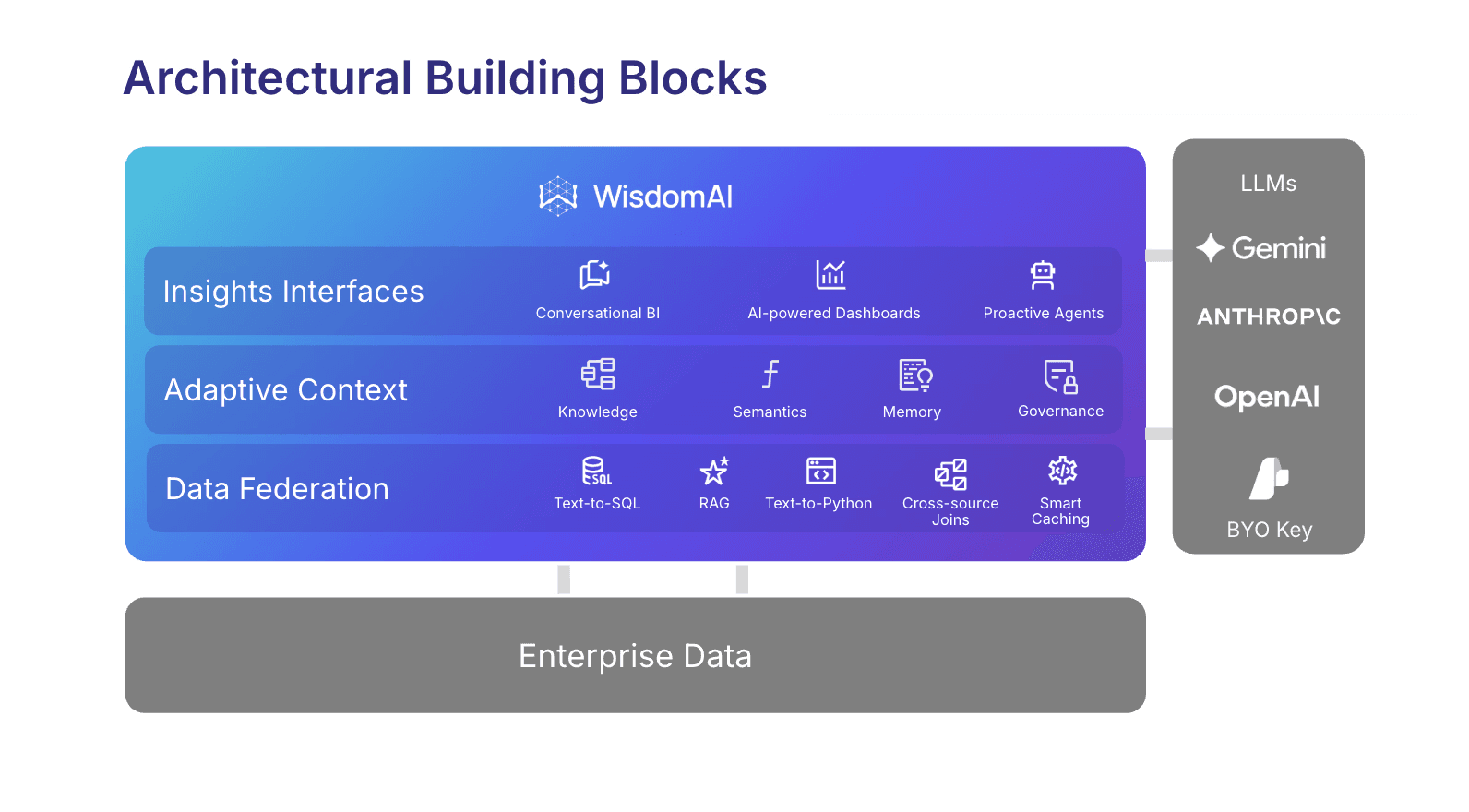
Turn fragmented data into trusted decisions
You already have the data you need. What you’re missing is a way to make that data accessible, contextual, and actionable for everyone who needs it.WisdomAI’s Agentic Analytics Platform solves for all three. Its adaptive context engine learns how your organization defines metrics, resolves ambiguity, and ensures every answer reflects how your business actually works. Paired with enterprise-level governance, every team gets trusted answers the moment they ask.When your team trusts the data, they act on it. Book a demo.