
Generative AI for Data Analytics: From charts to conversations
Why generative AI in analytics promises instant answers but stumbles on accuracy and trust
How analytics is shifting from dashboards to copilots, context-aware systems, and autonomous agents
What to stress-test in a demo before betting on an AI analytics vendor
PUBLISHED:
UPDATED:
Data analytics has always had a speed problem. You need a number, so you file a request. Days later, a dashboard shows up.
Generative AI fixed this almost overnight. Now, anyone could ask a question and get an answer in seconds. No backlog. No bottleneck. It felt like the breakthrough everyone had been waiting for.
Except it traded one problem for another. GenAI doesn't know your business. It doesn't know which metrics changed last quarter, why finance reports numbers differently, or that a divested subsidiary is still sitting in your database. It just answers confidently, even when it's guessing.
This guide shows you both sides of the coin.
What is generative AI in data analytics?
GenAI brings large language models (LLMs) into the analytics workflow. Instead of writing queries or building dashboards manually, you describe what you need in plain English and the AI generates the SQL, pulls the data, and delivers the answer, whether that's a number, a chart, a summary, or a full report.
6 use cases for generative AI in analytics:
Natural language querying: Ask questions in plain English instead of writing SQL or building dashboard filters.
Automated code generation: Generates SQL, Python, or transformation logic to retrieve, clean, and analyze data.
Data summarization: Turns large datasets or lengthy reports into key takeaways.
Data preparation and cleaning: Spot inconsistencies, missing values, and formatting issues.
Visualization generation: Creates charts, dashboards, and visual reports directly from natural language prompts.
Semantic interpretation: Attempts to understand the intent behind a question, not just the literal words.
In practice, GenAI acts like a copilot for your data. It helps business users explore data faster, reduces dependency on technical teams, and speeds up everything from ad hoc reporting to operational decision-making.
How generative AI is changing data analytics
The real question is how far this technology can take you. Because, depending on the tool, you might get instant answers you can trust or instant answers that quietly get it wrong. Let's look at how the landscape is evolving.
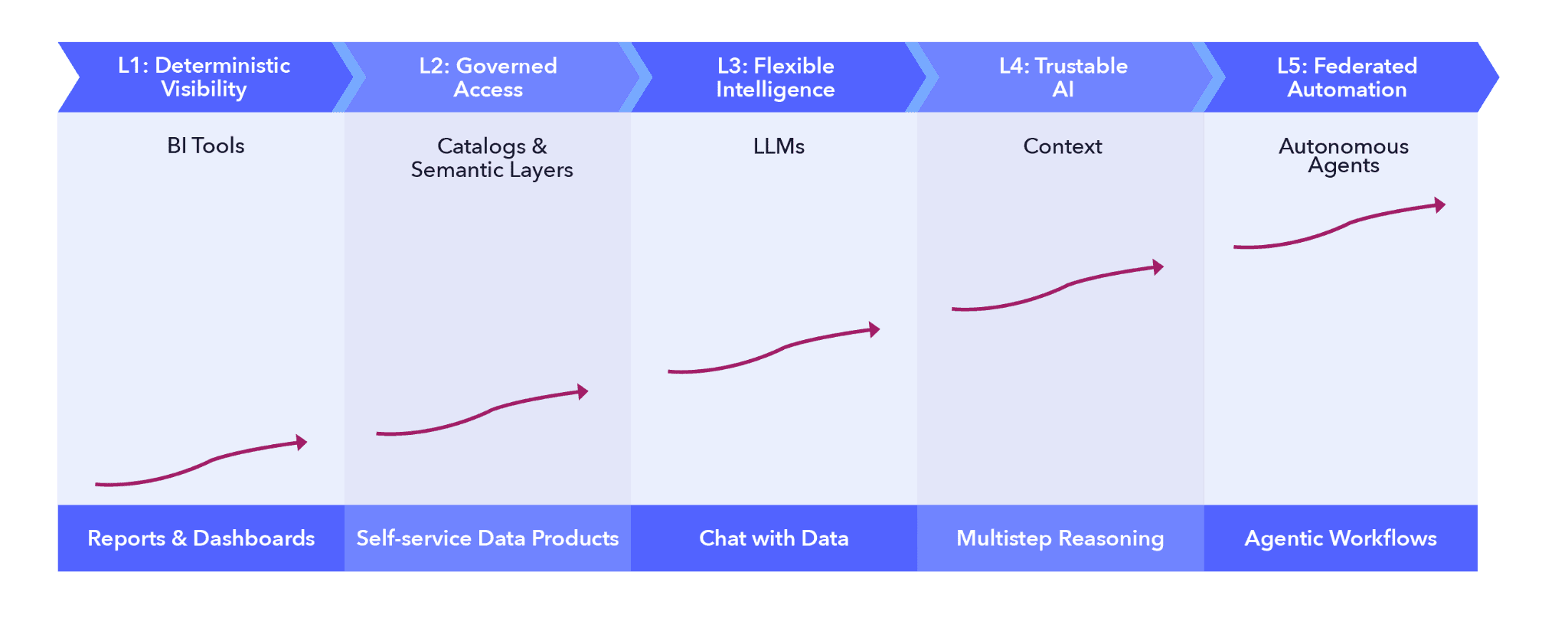
Traditional BI and dashboard analytics
Most teams use traditional BI tools like Tableau and Power BI to answer everyday business questions. Open a dashboard, filter by region or date, spot a trend, and share a report. For teams that previously had zero visibility into their own data, this is a huge step forward.
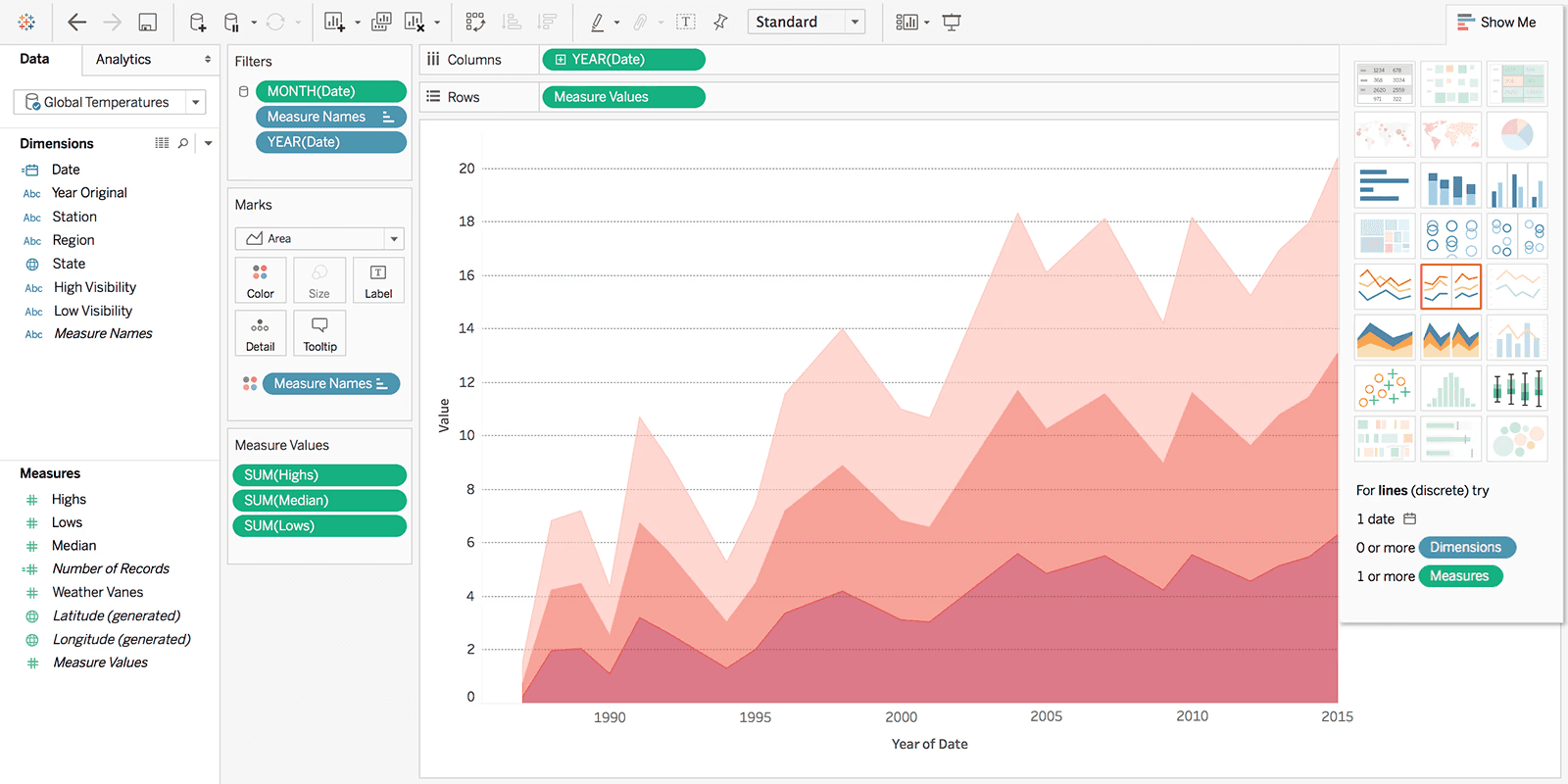
But because the logic is hard-coded and the views are predefined, you can only explore what someone already built for you. New question? New request. And without a shared context engine, two dashboards tracking "monthly revenue" could return completely different numbers depending on who built them and how they defined the metric.
AI copilots inside data warehouses
The data inside your warehouse is immensely valuable, yet getting answers out of it is painfully slow. Most data teams spend weeks writing queries, building pipelines, and maintaining reports just to keep up with the questions coming in. Databricks Genie and Snowflake Cortex use GenAI to change that—right inside your warehouse. Instead of writing SQL, you ask a question in plain English and get an answer back in seconds.
Big improvement. Until you hit these three ceilings:
Limited data scope
Although you have the flexibility to run multiple queries against your data warehouse, the data scope is locked to what's already in the connected platform. Genie lives in Databricks. Cortex lives in Snowflake. Every data source outside—other warehouses, SaaS applications, unstructured data—is either invisible or requires expensive data movement to access.
Lack of verification and consistency
These tools produce confident, well-formatted answers with no way to verify how they got there. Consistency is also not guaranteed. Ask the same question twice, and you may get completely different answers. Most importantly, your enterprise context and definitions are not used for disambiguation, so something like “revenue” gets interpreted based on pattern-matching against training data rather than your organization’s specific definition.
Lack of evidence chains
How do you trust an answer you can't trace? You can’t really verify whether the right tables, joins, or filters were applied. And importantly, LLMs are prone to hallucination: When it doesn’t know something, it typically fills the gap with any plausible-sounding answer.
Context-aware analytics systems
When you combine GenAI with machine learning and NLP, you can do a lot more than chat with your data or pull up visualizations. For example, you can ask questions like "what's our revenue trend and how does it compare to industry performance?" and actually get a reasoned answer — one that connects patterns across multiple data points and reflects how your business works, not just what's in the database.
But that kind of reasoning doesn't come from the model alone. Your analytics stack needs the context a skilled analyst would have — metric definitions, calculation rules, data structures, historical queries, team feedback, and the institutional knowledge that usually lives in someone's head, not in a schema. Once that foundation is in place, the AI stops guessing from training data and starts reasoning with your business logic.
Autonomous decision-making
GenAI is now giving way to a new model of analytics entirely—one where autonomous agents don't just answer questions but act on what they find. Say the agent notices customer churn spiking in a specific region, it automatically triggers a retention workflow before your CS team even sees the trend. No one has to check a dashboard or raise a ticket anymore.
What makes this practical at scale is federated automation. These agents work across your warehouses, SaaS tools, operational databases, and unstructured documents without requiring you to move everything into one place first. They go to the data instead of making you centralize it.
WisdomAI's Agentic Analytics Platform is built around this principle. An agent can correlate Salesforce pipeline data with warehouse inventory across systems, in real time, without connecting everything into a central platform. Data stays where it lives. Security boundaries and domain ownership stay intact.
Underneath it all sits the Adaptive Context Engine (ACE). Federation gives agents reach across your data. ACE gives them understanding. It encodes your metric definitions, business rules, and institutional knowledge so every action an agent takes is grounded in how your company actually works.
Real-world examples of GenAI in data analytics
Enabling self-service analytics
Patreon, the creator monetization platform, uses WisdomAI to give business users direct access to their data through conversational BI. Instead of filing a request and waiting for an analyst to build a report, teams ask follow-up questions in natural language, refine their understanding of creator trends in real time, and get answers on their own.
The result: over 80% of the everyday questions that used to land on the data science team are now fully self-serve.
Gaining real-time visibility across operations
Cloverleaf Analytics retired 95% of its traditional BI dashboards after switching to WisdomAI. Instead of teams manually checking reports and maintaining dashboards, Analytics Agents now monitor pipelines in real time, flag risks as they emerge, and push insights to the right people. Analysts went from spending their days maintaining reports to focusing entirely on high-value decisions.
Optimizing operations at scale
A global energy company had 2,000+ engineers across 14 countries, all bottlenecked by the same problem—every operational question required a manual SQL request that took days for an answer. After deploying Analytics Agents, engineers now query WellView and Snowflake directly in natural language. Insight delivery went from days to seconds, with 50% higher accuracy than the AI tools they had before.
Evaluating AI-powered tools for your business
Not all AI analytics tools are built the same. Some give you fast answers. Fewer give you trustworthy ones. Before you commit to a platform, you need to know what you're actually getting.
Here's what separates bolted-on AI chatbots from platforms built to handle real business decisions:
Bolted-on chatbots and copilots | Context-aware agentic platforms | |
Business context | None. Interprets queries from generic training data | Grounded in your metric definitions, business rules, and institutional knowledge |
Consistency | Ask the same question twice, get two different answers | Reproducible, governed results every time. |
Auditability | No evidence chain. The answer just appears. | Full audit trail showing sources, code, logic, and definitions used |
Data scope | Locked to one platform or silo | Federated access. Queries data across all sources in place |
Hallucination risk | High. Produces wrong, plausible-sounding answers | Low. AI admits to having limited context. |
The table tells you what to look for. The next step is testing for it.
Stress-test the platform during a demo
Give the system an ambiguous query and see if it flags the ambiguity or silently picks one and rolls with it.
Ask a question that can’t be answered with the available data, and see if it hallucinates an answer or admits that it can’t answer.
Ask the same question twice using slightly different wording and see if you get the same answer.
Ask it to explain how it got an answer and assess whether it can respond appropriately.
Go deeper
Ask the same question in 2 different contexts where the answer should differ, and see if it does.
Give it a query that requires it to roll up data from different contexts that use different definitions or calculations, and see if it gets it right.
Ask a question that requires combining data from 2 different sources and see if it is able to assemble the correct answer. Vary the types of sources to see if it can cover all the sources that are important to your business analytics.
Questions to ask the vendor directly
How does your system learn what our data means, and how does it stay current?
How is context versioned? Who can change it?
How does accuracy hold up as we add sources, users, and complexity?
How does your system handle conflicting metric definitions across teams?
Can we get insights across our full data landscape, and is data moved or queried in place?
Can the system show us exactly how every answer was produced?
What happens when the user corrects a wrong answer?
If you're evaluating agentic capabilities, add these:
Can the system take actions in external systems? What does the human oversight model look like?
Show me an end-to-end workflow where the system acts without a human initiating each step.
What happens when an agentic workflow hits something unexpected?
Can the system recognize when it's operating outside its confidence boundary?
How are your customers actually using agentic workflows in production today?
Bring agentic analytics to your data stack
Every day your team spends second-guessing AI answers is a day decisions stall, data teams get buried in verification work, and the whole promise of AI-powered analytics gets lost.
WisdomAI is built to end that cycle. Every answer is grounded in your business context. And every insight is governed, auditable, and ready to act on.
See what 95% accuracy looks like. Book a demo today.