
Collapse of the Modern Data Stack: What Does it Mean in 2026
What the modern data stack was built to do, and how its growing layers turned flexibility into cost and complexity
How AI analytics exposes the limits of the modern data stack
How agentic analytics simplifies the model with federation, agentic interfaces, and a context engine
PUBLISHED:
UPDATED:
Right now, your data team likely runs at least half a dozen tools to answer one question. A warehouse for data storage, pipelines to move it, modeling tools to shape it, and BI tools to visualize it — all stitched together to get you from insight to action.
This modularity was the promise of the modern data stack: Cloud warehouses connected to best-of-breed tools, each optimized for a specific job. Yet, the same unbundling that made the stack powerful has quietly become one of the biggest cost centers in analytics.
Every new tool adds more distance between your data and its destination, and vital AI context is lost along the way. That’s not to mention the individual costs each layer incurs, a truth that’s becoming glaringly evident as more people try to use general-purpose LLMs for complex, enterprise data analysis.
This is the collapse of the modern data stack. And here’s what comes next.
Understanding the modern data stack
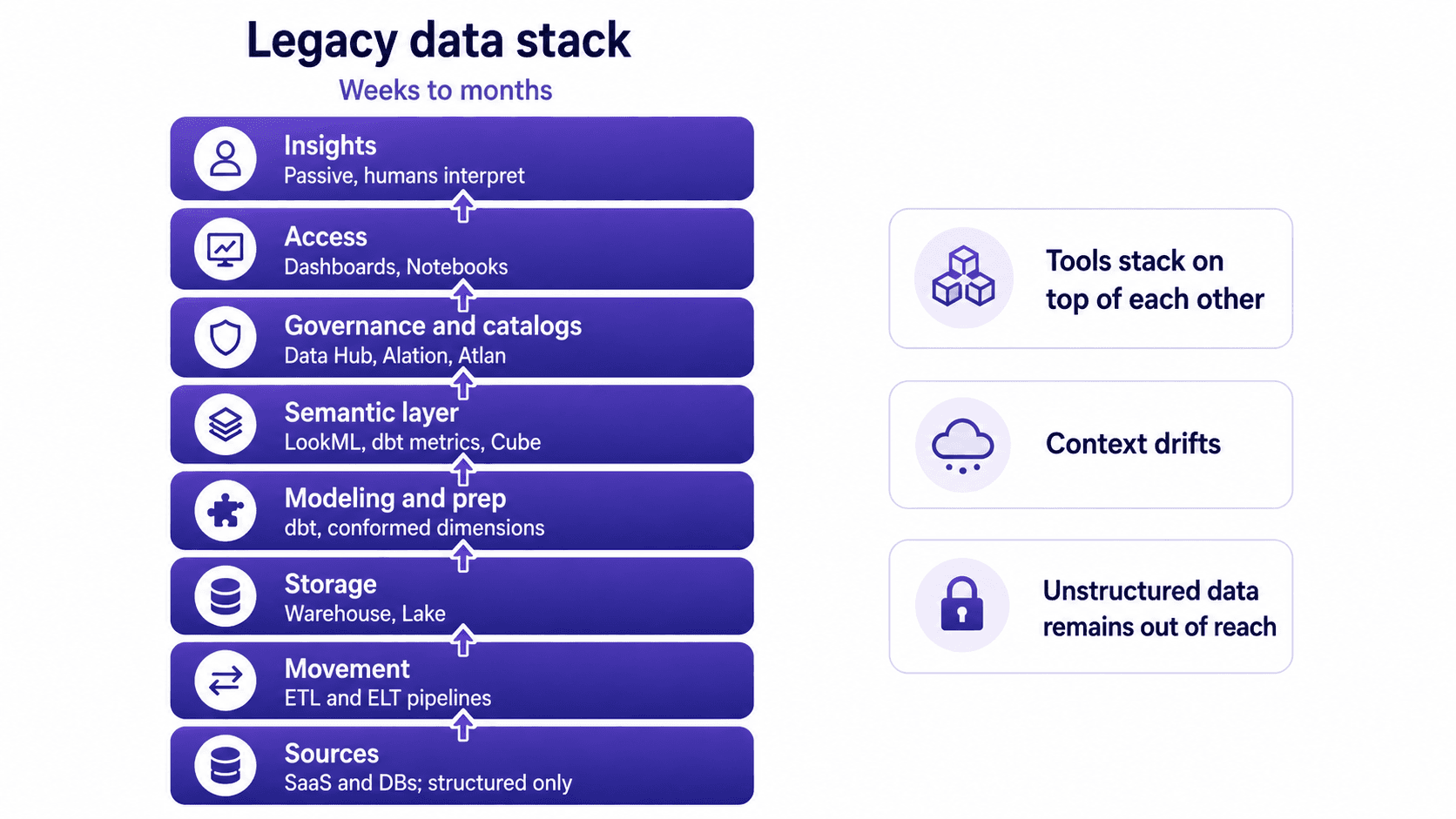
At a high level, the modern data stack works like this: collect the data from your data sources, bring it into one place using ETL/ELT, clean it up using data transformation tools, define how it relates using governance and semantic tools, visualize in your business intelligence solution, and finally, take action in a separate business tool.
The complexity comes from the layers that sit between those steps, with each tool having its own logic, metadata, permissions, and dependencies. Here’s how that plays out:
Ingestion: getting data into one place
Ingestion tools pull data from applications, databases, and APIs into a warehouse or lakehouse, replacing the custom pipelines teams once had to build themselves. They can also handle scheduling, incremental loads, schema mapping, and error handling so data arrives consistently.
Where it gets complicated: Costs grow as data volumes increase, yet the bigger gap is that your most important business data never gets loaded at all. Ingestion tools connect to databases and APIs, not to the unstructured data sitting in support tickets, contracts, and call transcripts. As a result, critical operational context stays trapped outside your analytical systems.
Transformation: turning raw data into a usable format
Transformation tools take raw data and make it clean and consistent. Teams can standardize formats, fix errors, deduplicate records, convert data types, and aggregate values, so what lands in the warehouse is reliable enough for further reporting and analysis.
Where it gets complicated: Heavy transformation logic and large volumes can slow execution and put more strain on the underlying data infrastructure. Complex scripts also leave more room for errors, such as incorrect joins, duplicate entries, and faulty aggregations that can further corrupt AI outputs. The more logic that gets layered in, the harder it becomes to trace where something went wrong.
Warehousing: creating a central data hub
Cloud warehouses separated storage from compute, so teams could store large volumes cheaply and independently scale compute as workloads grew. There’s no need for upfront capacity planning, and costs stayed mostly predictable.
Where it gets complicated: Storage got cheaper, but compute became the new cost center. Every question your team asks, every dashboard refresh, every transformation is compute you're billed for. The more the warehouse is queried, the more you pay — so costs climb right alongside adoption.
Modeling: creating relationships between data
Modeling gives the transformed data structure so it can be understood and analyzed consistently. This process typically occurs in the data warehouse, though it may spill out into other platforms like a BI tool. Modeling is the act of defining what each table or object represents, how fields relate, and how different pieces of information connect. A clean table may be technically usable, but without a model, it still does not explain what a row means or how it should relate to the rest of the business.
Where it gets complicated: Models multiply quickly across teams and use cases. The same entity, say a customer, an order, or an account, can get modeled once for finance, another for sales ops, and a third time for the churn dashboard. What starts as clarity can quickly turn into duplicated logic, conflicting definitions, and a web of dependencies that becomes harder to untangle.
Semantic layer: creating shared definitions
The semantic layer defines what your business metrics actually mean. It translates technical details like SQL logic, foreign keys, and database fields into familiar concepts, such as revenue, customer, or region, giving teams a shared set of definitions to work from.
Where it gets complicated: These definitions are not static. Metrics, dimensions, and business rules change as the business evolves, but semantic layers often have to be updated manually. Over time, that shared meaning can drift, leading to inconsistent answers to the same question.
Business intelligence: exploring and visualizing data
BI tools make modeled data easier to explore. They turn tables into dashboards, reports, and visualizations that you can navigate on your own to track performance and find answers.
Where it gets complicated: Dashboards only work when the underlying data has already been modeled to support them. New requests go back to the data team, and each iteration means another action item for the data team. Since most of the business context lives in tickets and transcripts that never made it into the data stack, any AI-generated answer offers an incomplete picture. That’s why 81% of analytics requests are handled through one-off data-team requests and dashboards, which means the average answer takes longer than a day to answer — this is according to our 2026 CDO Report.
Data orbit: reverse ETL, catalogs, and observability
This supporting ring closes the loops the modern data stack leaves open. Reverse ETL pushes “clean” data back into the tools your team works in, data catalogs track whatever data already exists, and observability helps you monitor pipelines to ensure they’re running smoothly.
Where it gets complicated: These tools exist largely to fix problems the unbundling created. Each adds another contract, integration point, and system to maintain, while governance and lineage remain scattered across the very tools meant to bring them together.
How AI analytics broke the modern data stack
The modern data stack could carry a lot of complexity when analytics were mostly centered around dashboards and reports. This approach wasn't foolproof, but it worked because an analyst sat between every question and answer, quietly resolving which definitions were wrong and which dashboards had gone stale. In a recent report, 56% of data leaders say enterprise context is undocumented, living primarily in analysts’ heads.
AI changes this narrative. When anyone can ask in natural language, and AI analysts investigate across systems, it’s impossible for one data team to catch every wrong answer at enterprise scale. As accuracy degrades, trust goes with it. That same report found that fewer than 1 in 5 leaders are fully confident in AI-generated answers.
Accuracy isn't the only thing taking the hit. Here's where else the cracks start showing:
Cost sprawl
The modern data stack already comes with a long list of costs. AI adds a new variable on top: usage-based inference costs. Platforms like Snowflake Cortex charge by usage, so the more you ask and the deeper you investigate, the higher the bill. Dashboards were comparatively predictable because you could control refresh schedules and workloads. AI exploration is open-ended.
One question can easily lead to five follow-ups querying across multiple tables and even multiple warehouses, making costs much harder to forecast as adoption scales. And those costs can vary dramatically depending on an increasing number of difficult-to-track variables — just take this one recent discussion on LinkedIn, for example.
Integration tax
Metadata, lineage, permissions, and business logic were already scattered across six or more tools. Agents make that fragmentation harder to manage because every system they touch brings another set of definitions, access rules, and dependencies to reconcile. Add unstructured data to the mix, and teams have to build a parallel pipeline, which then has to stay in sync with the rest of the stack.
Erosion of trust
56% of data leaders say they already have AI analytics in production, but only 7% have seen adoption spread across every line of business. Most of it comes down to complex infrastructure and accuracy.
Inconsistencies were easier to contain when an analyst sat between the data and the decision. Put the same inconsistency in front of a business user with no clear way to inspect the logic, and confidence drops fast. When users start manually verifying every answer with their go-to analyst, that too fails to scale. To build trusted AI, you need an AI-supported workflow that reports on confidence and systematically loops the data team in the context development lifecycle.
Limited context
LLMs have limited context windows. You can't load every definition, policy, and business rule into a prompt and expect an accurate answer. What matters isn't how many documents you upload into the model. It's whether the right context reaches the model.
That's why documentation-based approaches like data catalogs fall short. Most of them are positioning themselves as context layers, but cataloging information is not the same as applying it at query time. A catalog records that a definition exists. It doesn't decide which one is relevant to the question asked.
Analyst bottleneck
AI makes it easier to ask questions, so people naturally ask more of them. But someone still has to investigate the data, reconcile definitions, validate the logic, or connect a missing source. That work falls back to the data team, only now the requests are arriving at a far higher volume.
The ad-hoc bottleneck self-service analytics was meant to remove did not disappear. It simply moves downstream, where analysts become the verification layer for AI-generated answers.
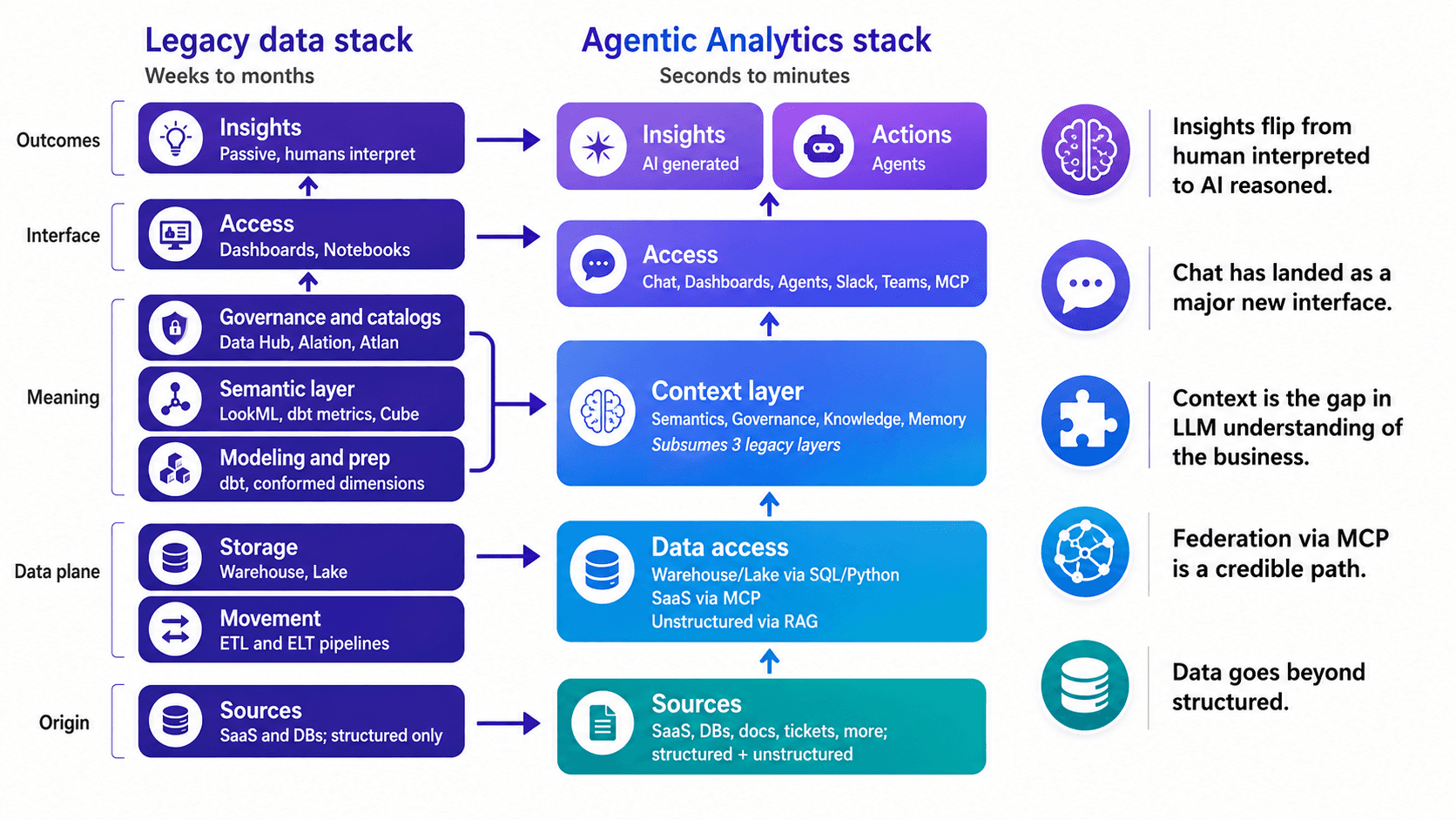
What comes next? Introducing the Agentic Analytics stack
Data federation
The old model required a clean, centralized, fully modeled warehouse before anyone could ask a question, which is why so many analytics programs stall in the preparation phase.
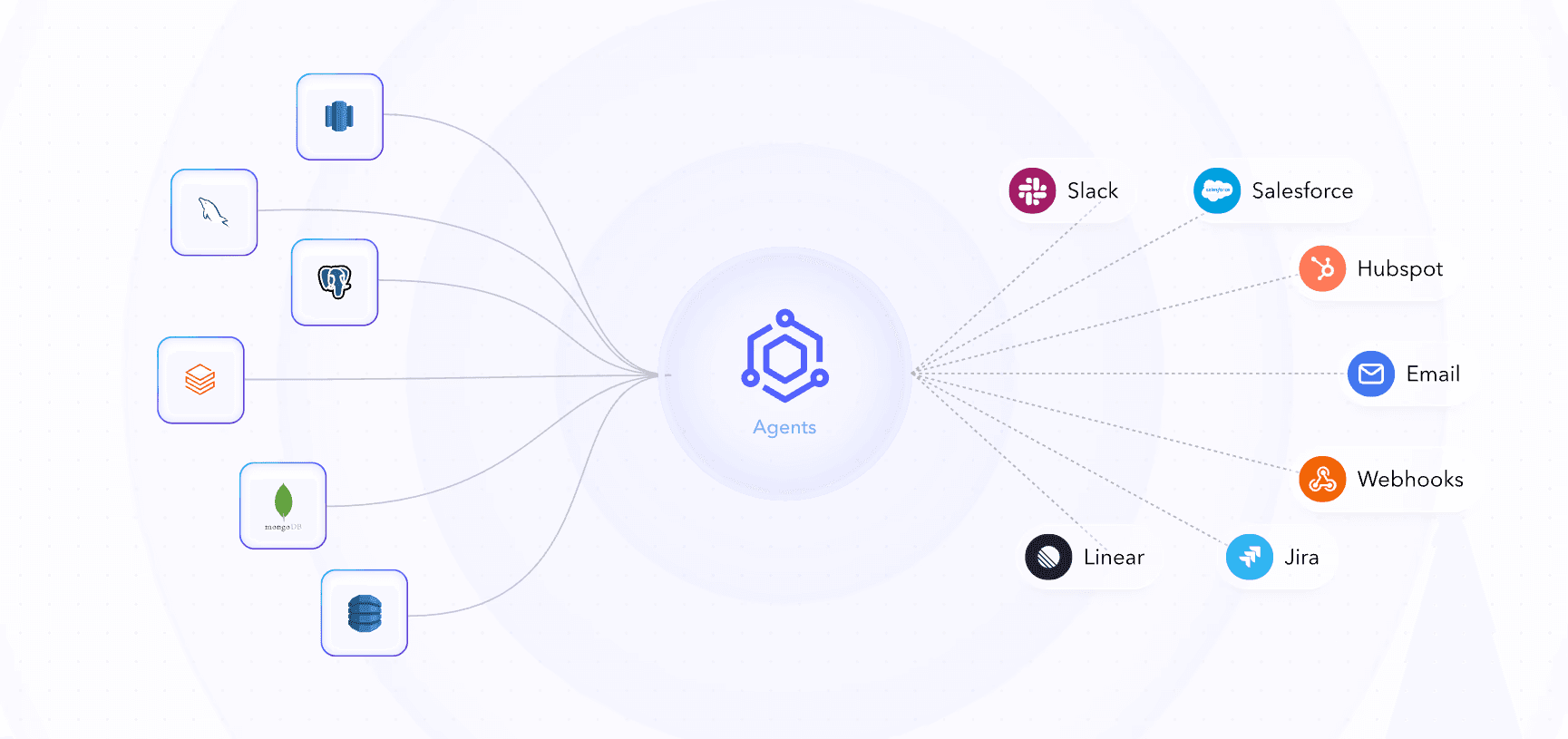
Federation lets you work across data where it already lives, without moving or copying it into a central store first. Instead of ingesting every source before it becomes queryable, a federation engine can connect to multiple systems and query in place, combining results across sources when the question is asked.
And the reach can extend beyond traditional warehouse data. Unstructured data such as documents, applications, and operational systems that were historically harder to pull into your analytics stack can increasingly become part of your analysis.
MCP servers, for instance, give AI applications a standard way to access data, tools, and workflows exposed by external systems, without requiring a custom interface for every integration.
Real-world example
Cisco’s procurement data lived in separate systems like Snowflake and Tableau, while critical supplier terms, contract language, and negotiation context sat in PDFs and spreadsheets. Answering a new question meant manually stitching those sources together or sending another request to the data team, where even simple follow-ups could take one to two weeks.
With WisdomAI, those sources were federated into the same analytical workflow. Procurement teams could ask questions across structured spend data and PDFs, without forcing everything into a centralized model first. Within three months, Cisco retired 95% of its BI dashboards, and adoption eventually grew to 90%.
Agentic interfaces
Legacy BI revolved around dashboards, an experience that is largely predefined. You can only explore the metrics, dimensions, filters, and drill paths someone anticipated in advance. The moment you want to ask a new question, follow a different thread, or investigate something in real time, you quickly reach traditional BI’s limits.
Agentic analytics removes that boundary, letting you ask a question, investigate the result, follow up in any direction, and trigger workflows in the same flow. Instead of waiting for every new question to become another SQL query or dashboard request, you can move from question to action in minutes. And you can even build time or trigger-based workflows to automate your regular reporting tasks.
Real-world example
At HomeStory Rewards, operational teams tracked enrollment rates, lead handling, and conversion through dashboards and ad hoc analyst pulls. The insights were trapped inside BI workflows, while the people who needed them were working in Slack and email.
Analytics Agents closed that gap. Instead of waiting for someone to build a dashboard, run the analysis, and send an update, Agents continuously investigate the data and deliver relevant findings directly to the people who need them. What used to take weeks for an analyst to pull, interpret, and package now happens in minutes. The result: HomeStory retired 95% of its legacy BI dashboards.
Context engine
AI models aren't going to get better at reasoning over bad context. Our recent Anthropic case study points in the same direction: the strongest AI infrastructure for analytics is one where enterprise context is continuously built, validated, applied, and improved.
Which is why the center of gravity is shifting. When the hard part was storing data affordably, the warehouse became the focus. But storage isn't the hard part anymore. Here’s what is: giving agents enough information to understand how your business truly.
Static metrics and definitions start aging the moment you encode them. You need a context mechanism that keeps learning from how people query data, which tables teams trust, and how definitions are corrected to produce reliable answers. In the agentic era, the new moats are proprietary enterprise context, trusted lineage, domain health, and reliable agent behavior.
How the agentic analytics stack works
For buyers
Consolidating your tooling means fewer vendors, integrations, and hidden costs.
It can also make AI token usage more efficient. An ungrounded agent burns tokens by pulling schemas, sampling tables, and testing which columns you meant. An agent grounded in governed context skips that work because the formula for the answer is already mapped out before the query runs. That means less token waste per question, more predictable AI costs, and better economics as usage scales across the business.
For data leaders
Roles like AI context engineer and analytics engineer barely existed a few years ago, and their emergence today says a lot about where analytics is headed. For years, data leadership was measured by the velocity of delivery: pipelines built, dashboards shipped, and requests closed. With agents answering directly, the queue itself becomes less important.
Agentic analytics platforms like WisdomAI make the reasoning traceable by showing which sources were used, which definitions were applied, and which filters shaped the result. So instead of rebuilding the calculation from scratch, you can review the trail and validate the answer in minutes, rather than days.
What matters now is the infrastructure behind every answer: defining business logic, governing, and carrying that context consistently across every surface — whether it appears in a dashboard, an agent, or a chat. You're not running a reporting function anymore. You're running the decision infrastructure for your business.
For business users
Getting an answer used to mean filing a ticket or learning SQL. Either way, you were waiting for answers. Conversational BI removes both steps. Because answers draw from governed context with built-in observability, you can trust the number without pinging an analyst to double-check it. That holds for follow-ups too. You can spin up visualizations, drill deeper, and keep exploring without starting the whole process over again.
From sprawl to substance
We built WisdomAI to solve a classic problem in analytics: making AI answers trustworthy at the scale of thousands of users.
WisdomAI federates across your sources, so self-service reaches the whole organization instead of the one team that holds the pipelines. You start exploring in days rather than spending months on deployment.
The Adaptive Context Engine is what makes every answer trustworthy. It captures your business rules, semantic relationships, and institutional knowledge, then keeps learning from how your teams actually query — so definitions stay current and agents don't fill the gaps with plausible guesses. They work from how your business actually operates, not how a schema describes it.
See it for yourself. Book a demo today.