Introducing Domain Health: Take control of your Context Development Lifecycle

There's a conversation happening in every data team right now. Someone in the business asks a question through your AI-powered analytics tool. The answer comes back wrong — or worse, confident even though it’s really wrong. Fingers are pointed. AI is blamed. A ticket is filed. Trust is lost.
Here's what most teams miss: the AI didn't fail. The domain context did.
Anthropic recently shared what it takes to build reliable analytics in Claude. The finding holds universally: AI context is the difference between an AI that answers and an AI that answers correctly. And context isn't a one-time configuration — it's a living system that needs to be built, monitored, and continuously improved.
The AI is only as reliable as the context you've built around it: The business rules you've codified, the questions you've reviewed, and the schema you've described clearly enough for a machine to reason over. When those things are incomplete, ambiguous, or in conflict — the AI guesses. And guessing at scale is how you lose trust fast.
This is the problem WisdomAI's Domain Health solves.
The question every data admin should be asking
There are two questions in AI analytics that sound similar but are profoundly different:
"Can the AI answer questions?"
"Is this domain healthy enough for the AI to answer questions reliably?"
The first is a product question. The second is yours to own. Domain Health gives you the information and the tools to answer it — and more importantly, to act on it.
Think of it as a code review for your domain context. WisdomAI audits your context and tells you exactly what's missing, what's ambiguous, and what's quietly sending the AI in the wrong direction. With a list of prioritized recommendations, you can codify accuracy and reliability into your AI analytics.
How Domain Health works
Every time you run an analysis, WisdomAI executes continuous assessments across 6 dimensions of readiness — evaluating your schema, curated queries, business context, and real user behavior to produce a single readiness score and a prioritized list of recommended fixes for you to review, edit, and accept.
Dimension | What it measures | Why it matters |
|---|---|---|
Schema Quality | Unclear names, overlapping identifiers, missing join relationships, confusing table/column descriptions etc. | AI accuracy relies on correct joins and relational understanding |
Context Quality | Accuracy of curated queries tested against live queries | Ensures validated queries return accurate results |
Context Coverage | How relevant are your examples & references to the questions asked by the insight consumer (human/agent) | Reveals gaps in AI context |
Generalizability | Accuracy on novel questions the system wasn't explicitly trained on | Monitors accuracy on unscripted questions |
User Feedback & Failure Signals | Negative feedback rates, query failures, and re-ask patterns | Surfaces missing or conflicting context that needs real-time attention |
Usage | Active users, query volume, and table hit distributions | Lets you cut context and sources that aren't driving value, reducing query costs |
Prioritization that actually means something
Not all recommendations are equal. WisdomAI prioritizes Domain Health suggestions based on three characteristics:
Impact: does the recommendation unblock broader user access?
Reach: does it affect a high- vs low-trafficked table?
Effort: is this a quick fix or heavy lift?
Domain Health recommendations are then organized by priority, enabling domain admins to focus on things that have the highest impact on context quality.
Example below:
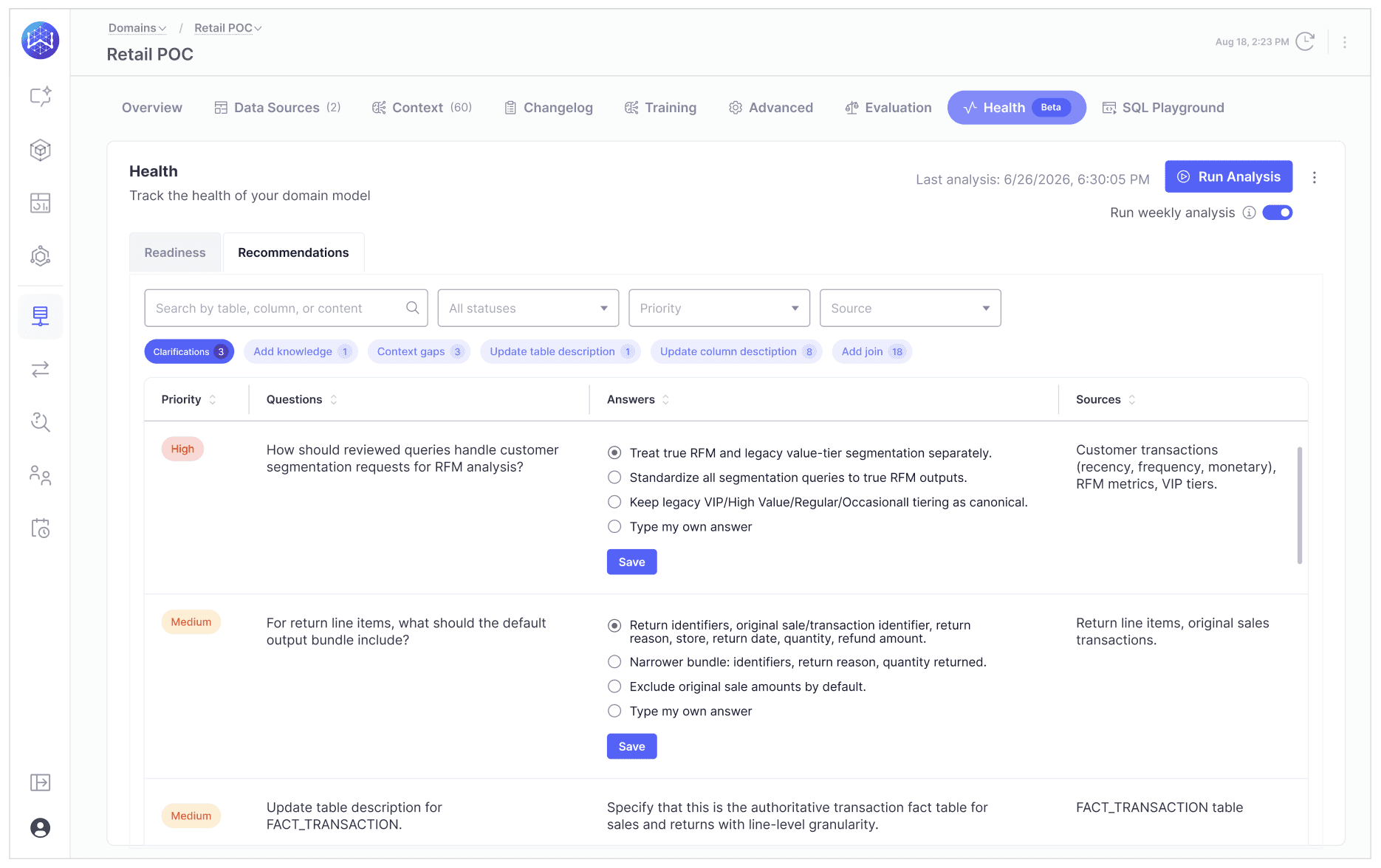
To avoid overwhelming domain admins, recommendations tagged as high priority are significantly more likely to improve the quality of your context.
Domain readiness, for all users
Domain Health isn't only an admin tool. It also solves one of the most damaging failure modes in AI deployments: lost trust before context is built in.
When a domain falls below the readiness threshold, end users see a plain-language banner in the chat interface that sets the right expectations before they ask their first question. Domain Readiness tracks whether your domain meets minimum quality, coverage, and usage thresholds, setting business user expectations before the first query.
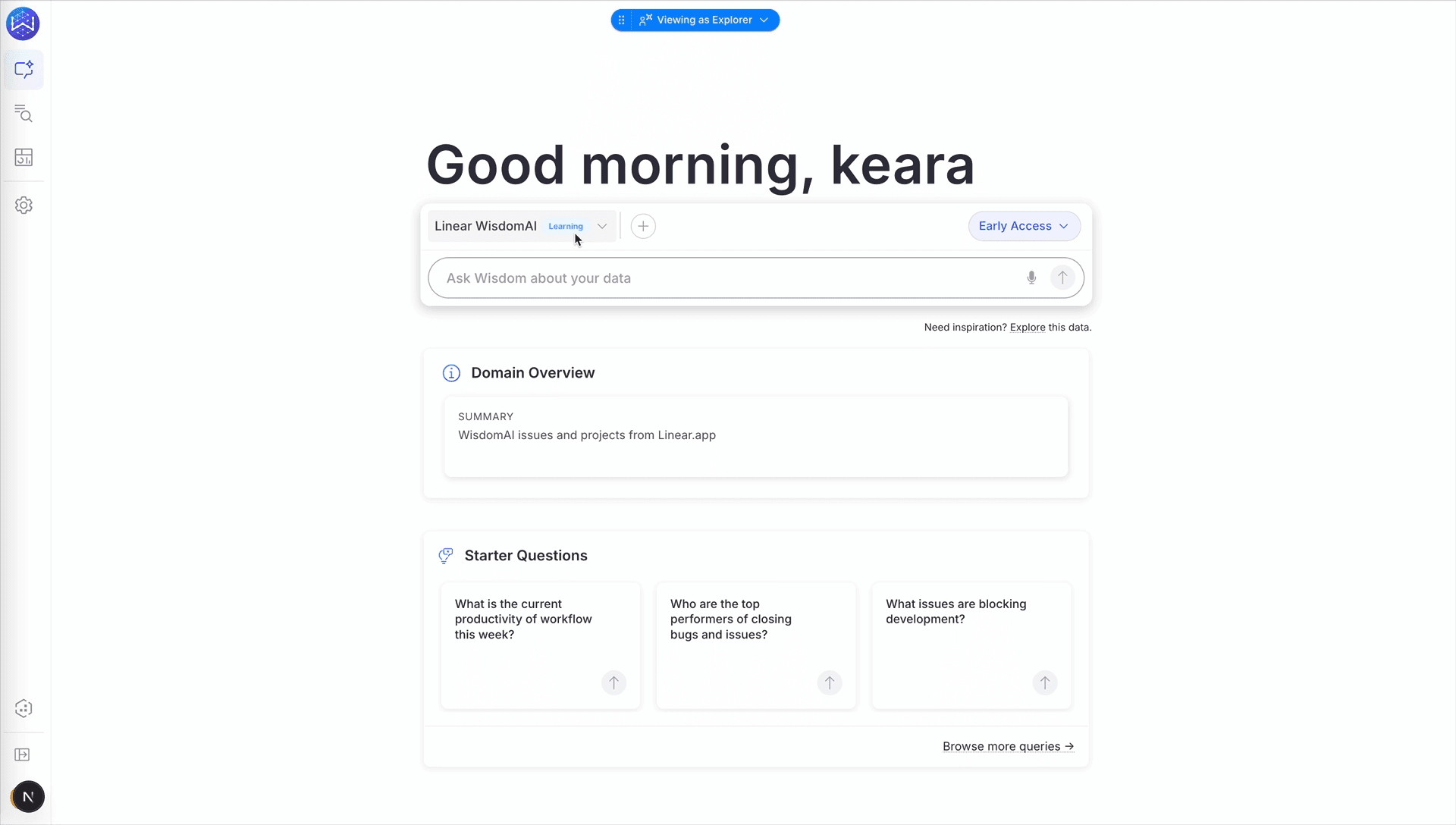
The banner tells users that the domain is being prepared and improving. That framing preserves end user confidence during the configuration period while simultaneously creating accountability for admins to act on these signals. This is vital because context can’t be maintained by a one-time audit — it’s a feedback look maintained by AI, business user feedback, and domain admins all working together in the Context Development Lifecycle.
"We knew our context needed work, but we didn't know where to start. Domain Health changed that. Within our first session we knew what needed help and had a prioritized list of specific things to fix — not vague recommendations, but actual changes we could review and accept on the spot. In a lot of cases it was a single click. WisdomAI is the first product I've seen that gives you this kind of diagnostic and the tools to act on it in the same place. For a team building out the company's AI practice, that kind of clarity and speed is invaluable — and ultimately, it's what gives end users the confidence to actually trust the answers they're getting."
Robin Laskowski, Senior Vice President & Chief Information Officer at Woodforest Acceptance Solutions
What comes next
Domain Health is in beta today, with general availability beginning July 2026. With recommendations that meet you where you're working — not just when you run an analysis — and a Domain Co-pilot that doesn't wait for something to break before telling you how to fix it, you can shift from diagnostic to proactive context.
The goal has always been the same: no data experts within organizations should ever have to guess whether their domain context is ready. Soon, they won't have to ask at all.
The AI isn't going to get better at reasoning over bad context. But with Domain Health, you can give AI better context, delivering more reliable, accurate answers across your organization.
Ready to get started? Ask your WisdomAI account team for early access.
New to WisdomAI? We help data teams build AI analytics that their business actually trusts. See for yourself. Schedule a demo today.