
Financial Analytics: How Agents Deliver Faster Answers
How agentic analytics moves finance beyond dashboards to continuous monitoring, investigation, and action
How finance teams use AI across credit risk, payments, portfolio analysis, reporting, and other high-stakes workflows
What it takes to scale AI analytics without losing trust
PUBLISHED:
UPDATED:
Finance teams have always walked a tightrope: move the business forward under strict regulatory scrutiny, with little room for error. This tension isn’t new. What’s changing is the widening gap between how fast the business moves and how long financial analysis takes.
Closing and reconciliation still take days. Variance analysis can stretch into weeks. By the time you get to why, the window to act has closed. Legacy BI is built for scheduled reporting. Ask something unexpected, and you’re back in the dreaded queue.
Now picture the alternative. Ask why margins slipped in a region, and AI agents can identify the drivers, break down the segments, and explain what changed. Days of work compress into minutes, whether that’s closing the books, prepping for audit, or analyzing performance. That’s agentic analytics, and the rest of the guide covers how finance teams are using it.
What is financial analytics?
Financial analytics is the practice of using financial and operational data to understand what happened, why it happened, and what to do next. It brings together statistical methods, machine learning, and analytics tools to turn data from statements, ERP systems, and other sources into insights your teams can act on.
Most financial analysis tells you what happened. Explaining why is harder, because the investigation often happens manually. Each follow-up means another round of pulling, filtering, and reconciling data, so you either wait or settle for what the dashboard already shows.
Agentic analytics tools remove the tradeoff. Teams can now ask questions directly, follow the thread, and keep digging without restarting the analysis. AI analysts go further, tracing a change back to what caused it.
Core components of modern financial analytics
Financial analytics tools have become far more agile. Rather than relying on fixed reports and periodic analysis, finance teams can now combine real-time data, AI, and automation to analyze changes as they happen. Here’s what makes that possible:
Data integration: Brings structured data from your ERP, CRM, and budget systems together with unstructured sources like contracts and invoices, so you can work from one view of the business.
Statistical modeling: Uses regression and machine learning to surface patterns, evaluate risks, and predict outcomes.
Performance monitoring: Tracks revenue, profitability, liquidity, and other key metrics, helping you see how the business is performing and where financial health is shifting.
Scenario planning: Applies sensitivity analysis and predictive modeling to test what-if scenarios and how they’d affect future performance.
Visualization and dashboards: Translates complex datasets into interactive charts and executive dashboards you can read at a glance.
AI agents: Run open-ended, multi-step explorations across financial data. They can detect a change, figure out what drove it, and route the findings to the right person.
Governance and access controls: Apply permissions, approval workflows, and data policies, keeping sensitive information protected.
Auditability and lineage: Tracks the data sources, calculations, queries, and transformations behind an AI-generated answer, helping you verify how a result was produced.
Modern financial analytics turns reporting into a continuous loop of monitoring, investigation, and action, so finance teams can move faster without giving up control.
Traditional analytics vs AI-powered financial analytics
AI analytics gives finance teams a broader, more connected way to work with data. Here’s how it differs from traditional analytics:
Traditional analytics | AI-powered financial analytics | |
Data coverage | Mostly structured, modeled data. | Structured and unstructured data across systems. |
Analysis | Drill through static dashboards, filters, and predefined reports. | Dashboards are generated around the question you asked, and the view updates as the analysis moves. |
Speed | Every new question is a new report to be built. | Ask follow-ups and keep exploring without stopping. |
Monitoring | Check dashboards periodically and rely on predefined alerts to spot changes. | Monitor live KPIs in one view and ask follow-up questions when something changes. |
Workflow automation | Analysis and downstream action are usually separate. | Agents take action: create tickets, escalate incidents, and notify your team |
Scale | More questions often mean more work for data teams. | Agents run concurrent questions and recurring investigations so data teams can focus on work that actually requires their expertise. |
Benefits of agentic analytics for financial services
Every bank, insurer, and fintech already has data, dashboards, and a BI tool. What most of them lack is a short path between a question and an answer. Here’s how agentic analytics changes that.
Conversational BI for open-ended exploration
Analytics in financial services still runs through the data team, which is why a third of enterprise data leaders name slow speed to insight as a top challenge. Most finance tools are often too complex for business users to navigate alone. Even simple questions require specialized knowledge, technical skills, or another trip through the data team.
Conversational BI removes that barrier. You ask a question the way you’d ask a colleague and get an answer in seconds, with the tables, filters, and logic behind it visible. Follow-ups are just as easy.
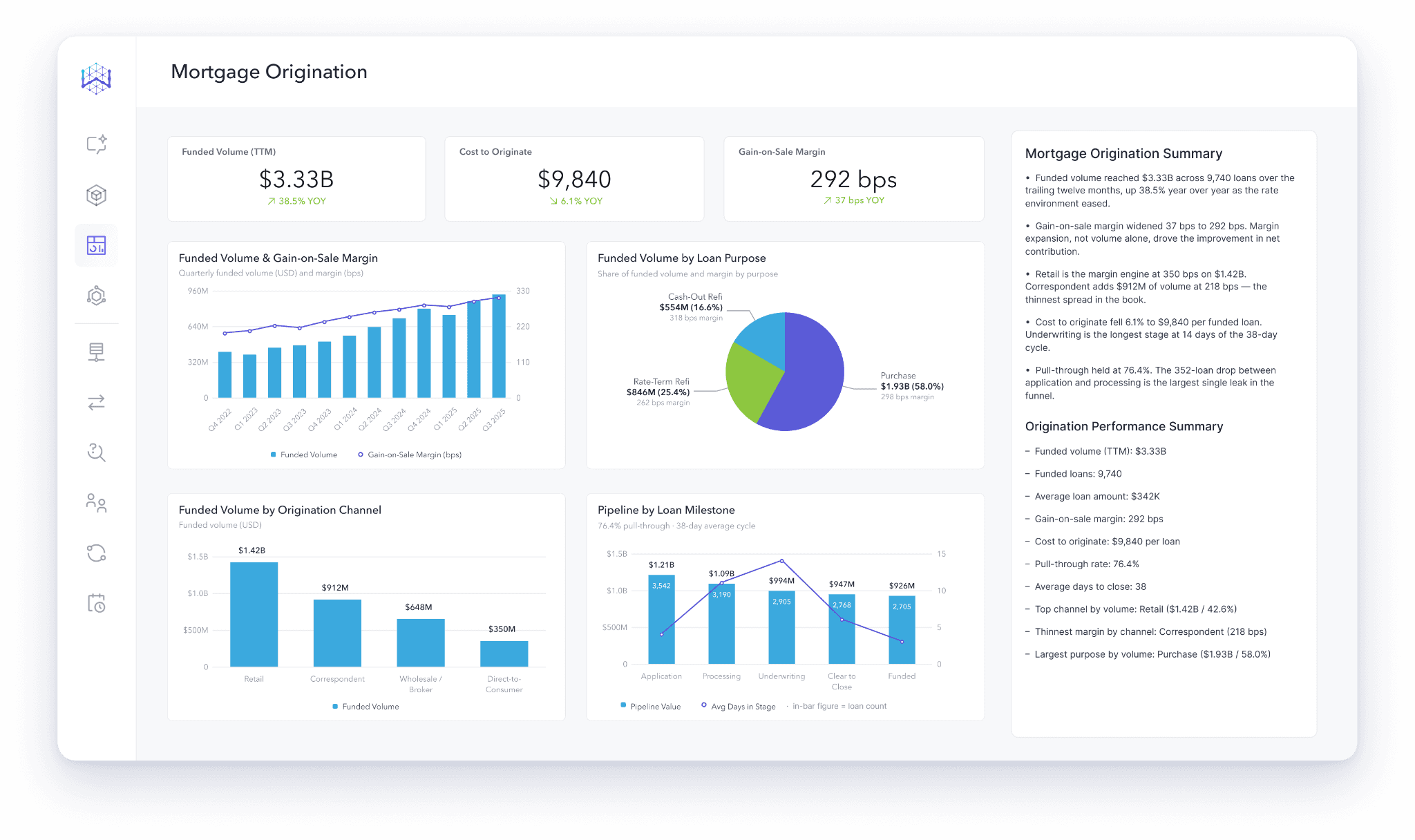
This was the case with Blend. Ad-hoc requests for deeper insights used to land on CSMs and the product data team, where a question about loan-officer-level profitability or pull-through rates could take 7 days or more to answer. By embedding WisdomAI directly in its platform, Blend turned that week-long wait into a near-instant answer.
AI dashboards for faster reporting
AI dashboards make financial reporting self-serve, and every one comes with a written summary of what changed, what drove it, and why it matters. You don’t have to scan rows or do the mental math to work out which number moved — the read is already there. And because queries run live against source data, the view stays current as the underlying numbers change.
Trumid works this way today. It’s a FINRA-regulated electronic trading platform for institutional credit markets, where clients expect their coverage to know what’s moving in the market before they ask. With WisdomAI, Trumid surfaces daily market insights for clients twice as fast, and its sales team is seeing record-level engagement on the platform.
AI agents that trigger workflows
Banks and insurers have long relied on threshold- and rule-based monitoring to flag suspicious transactions, risk limit breaches, counterparty exposure, and other exceptions. But these systems are rigid by design. They can tell you a KPI crossed a line — not why it moved or who should act. At scale, this investigation becomes a cost line of its own, with alerts piling up faster than any team can clear them.
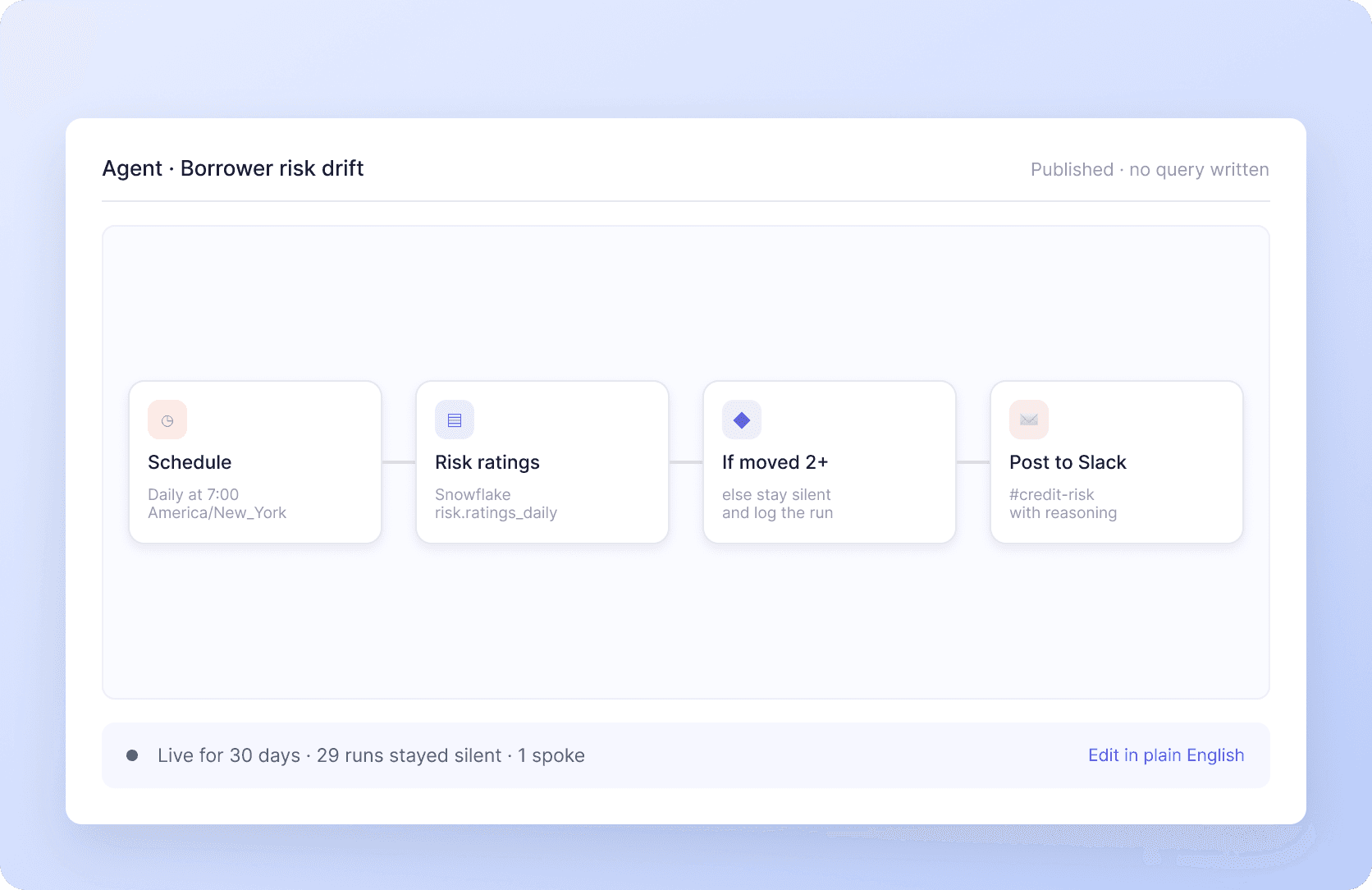
That’s the gap AI agents close. They monitor data continuously, find out what changed, and send each finding with its context to the person who owns the decision, in the tools they already use.
Look at HomeStory Rewards, a mortgage referral network. They deployed WisdomAI’s Analytics Agents to take recurring pipeline analysis off analysts’ plates. Agents monitored key metrics on a schedule and delivered the findings directly to operations leads. That gave analysts 30 minutes back on every request and helped the team retire 95% of its legacy dashboards.
Access controls and audit trail for compliance
Every number in finance carries weight, so you should be able to say where it came from, how it was calculated, and who had access to the underlying data. In a regulated environment, traceability is what makes the number usable.
Agentic analytics tools log the trail behind every answer: the tables and sources they read, the filters and joins they applied, and the query they ran. For agents that take action, you can trace the full decision path: how the agent reasoned, what it concluded, and what action it took. Access controls are part of that record too, so you can also see who was authorized to view or act on the underlying data.

Key financial analytics use cases and examples
Credit risk analytics
Credit risk analytics answers three questions: how likely is a borrower to default? How much will still be outstanding if they do? And how much of that exposure can you recover?
Banks and mortgage companies estimate all three through predictive modeling and scenario analysis. The problem is that the data those models depend on is often scattered across origination platforms, servicing systems, financial documents, and other sources. The traditional approach is to centralize it first: build pipelines, move the data into a warehouse, reconcile it, and then analyze. That’s months of work, and it repeats every time your sources change.
A federated approach removes that dependency. Agentic analytics platforms like WisdomAI read data across multiple sources at once and bring relevant signals into a single view, without moving loan-level data out of the systems that already govern it. Lenders spot emerging risk earlier and act on it — adjusting credit lines, tightening underwriting, or prioritizing outreach to the borrowers most likely to default.

Payments analytics
For payments businesses, cost leakage often hides in reconciliation. Interchange, scheme fees, processor markups, cross-border assessments, and chargeback costs are usually rolled up into month-end totals. By the time reconciliation is complete, thirty days of transactions have already cleared, and you still don’t know what each transaction actually cost. A blended rate can show that costs went up, not which fees, processors, transactions, or routing decisions caused the increase.
With self-service analytics, you can analyze costs in real time and drill down from the overall increase to the processor, card type, geography, and transaction route. From there, you can keep narrowing the view until you find the source of the change and act before the increase turns into a larger margin problem.
Portfolio analytics
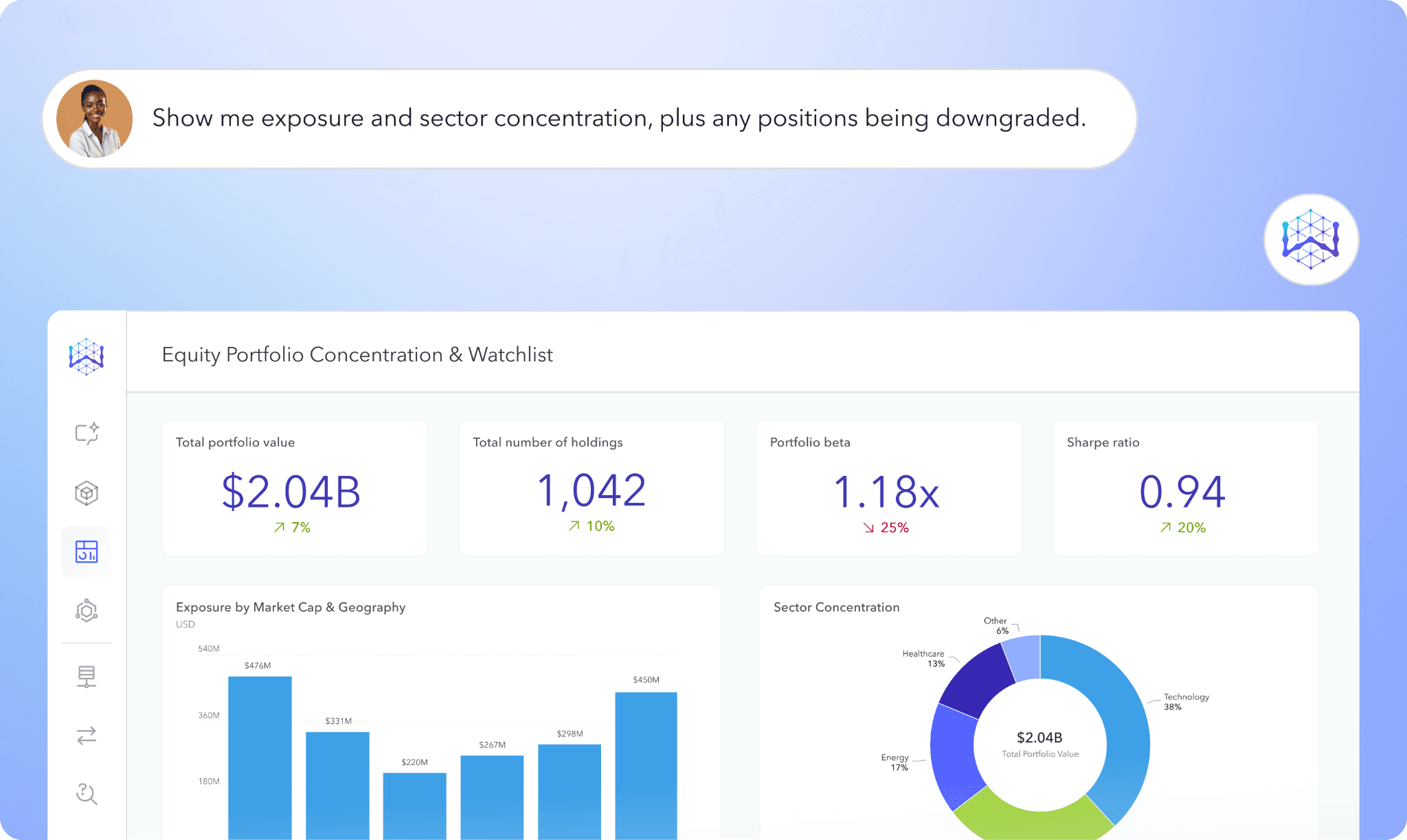
When a stock moves, portfolio managers need to understand what changed before deciding whether to buy, sell, or hold. Is the move specific to that company, or is the entire sector moving? Have other holdings been downgraded at the same time? How much exposure does the firm have across all portfolios? This context matters more around IPOs, earnings, and ratings actions, when decisions need to happen quickly.
AI agents can resolve that chain of questions in one workflow. They can trace the move from the individual security to the broader sector, check recent ratings changes, calculate exposure across portfolios, and compare it against investment limits. Portfolio managers get the full picture and make the call based on the actual exposure.
Challenges in financial analytics (and how to get past them)
Despite high investment in AI analytics for finance, business impact is still shallow, and an overwhelming lack of trust is stunting scale. Here are the top challenges in financial analytics and how to move past them:
Accuracy
Our research found that only 1 in 4 data leaders trust the answers their AI tools produce. In finance, where one wrong number can affect a forecast, risk decision, or regulatory report, this accuracy gap can stop adoption cold.
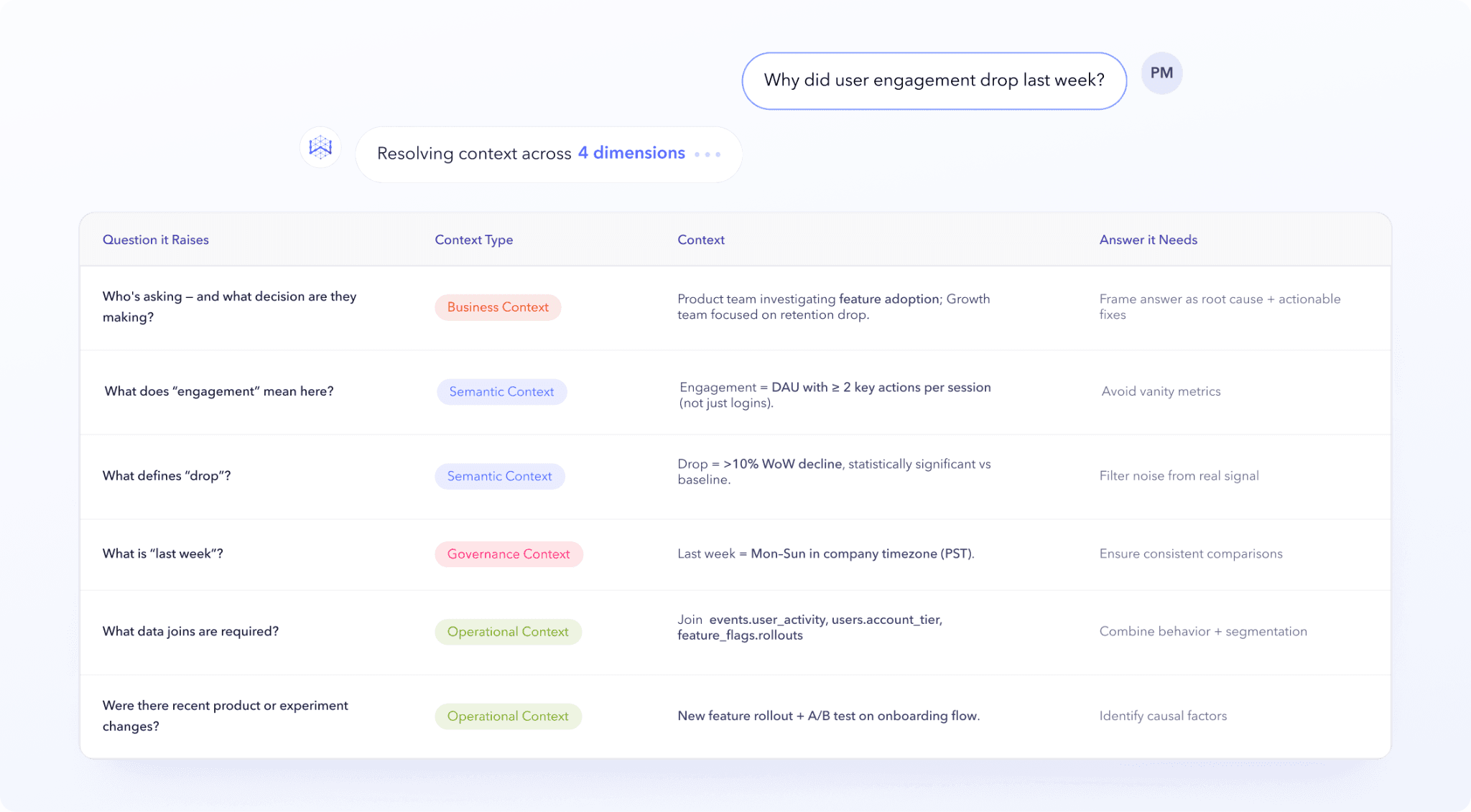
Here’s what’s happening: the model computes directly against wrong definitions. Say finance defines net sales one way, sales carries its own set of exceptions, and the warehouse reflects neither change. So the model decides which one you meant on its own, and returns a number that’s internally consistent yet wrong.
Getting accurate answers takes AI context the system can read: how metrics are defined, which sources are authoritative, which filters apply, and when exceptions matter.
WisdomAI’s Adaptive Context Engine builds that from your enterprise data and usage patterns, then keeps validating it as definitions and systems change — so the same question returns the same answer, grounded in the business logic your teams actually use.
Fragmented tooling
When finance teams ask one question, the answer has to travel through an entire stack first. Data needs to move through ingestion tools, warehouses, transformation layers, and BI platforms before anyone can analyze it. Each system adds licensing costs, maintenance, and another handoff between teams. Over time, this fragmentation makes analytics more expensive to run and slower to use, even for relatively simple questions.
An agentic analytics platform that reasons across sources directly shortens the path. Nothing has to be staged, modeled, and republished before a question can be answered, which leaves fewer systems to manage, fewer places for a definition to drift, and less distance between asking and knowing. Your data team spends its time on analysis instead of on the plumbing that makes analysis possible.
Data has to be perfect
The most common reason finance teams delay AI analytics is the belief that their data isn’t ready. A chart of accounts carries fifteen years of amendments, and half the mappings live in someone’s head. So when will it ever be ready?
A better approach is to start with relatively simpler use cases and improve gradually. When your analytics platform has built-in observability, teams can trace a bad result back to the source, join, mapping, or definition that caused it. Data quality becomes something you improve alongside analysis, focusing first on the issues that are blocking the questions people actually need answered.
Bring agentic analytics to all your financial data
Financial services has long been a request-and-wait business. That’s ending now.
With WisdomAI, structured and unstructured finance data comes together from every source your business runs on — no need to build extensive pipelines first, and nothing moved out from under the governance you have today. Analytics Agents make financial analysis faster: they can monitor metrics, reason over data, trigger workflows, and deliver findings where decisions get made, in Slack, email, or the tools your teams already work in.
Behind it all, the Adaptive Context Engine continuously builds and governs the enterprise context that Agents need to interpret your data correctly. Even when definitions, systems, and usage change, context evolves with them — keeping answers accurate, trustworthy, and explainable over time.
Get more value from your financial data. Book a demo.