
Data Domains: A Modern Approach to Enterprise Data Ownership
Summary
What is a Data Domain, and how does it differ from centralized data ownership
How Data Domains give AI a clearer boundary to reason within
How to build, govern, and maintain Data Domains as your business changes
PUBLISHED:
UPDATED:
For decades, enterprise data programs relied on one central team to define business logic, enforce standards, and keep everyone aligned. That model worked when the volume of incoming questions was manageable.
Natural language querying broke the math. When anyone can ask questions in natural language, manually verifying each answer is no longer realistic. Accuracy has to be built in from the start, with the right AI context encoded and applied consistently at query time.
Yet our CDO survey found that even among organizations with defined enterprise context, 40% of data leaders still manage it on an ad hoc, case-by-case basis. No single team can maintain an entire company's business logic fast enough to feed modern, agentic systems.
Context has to become a shared responsibility. That’s where Data Domains come in. They move ownership of context closer to the teams that understand it best, while data teams keep it governed, consistent, and usable across the organization.
What is a Data Domain?
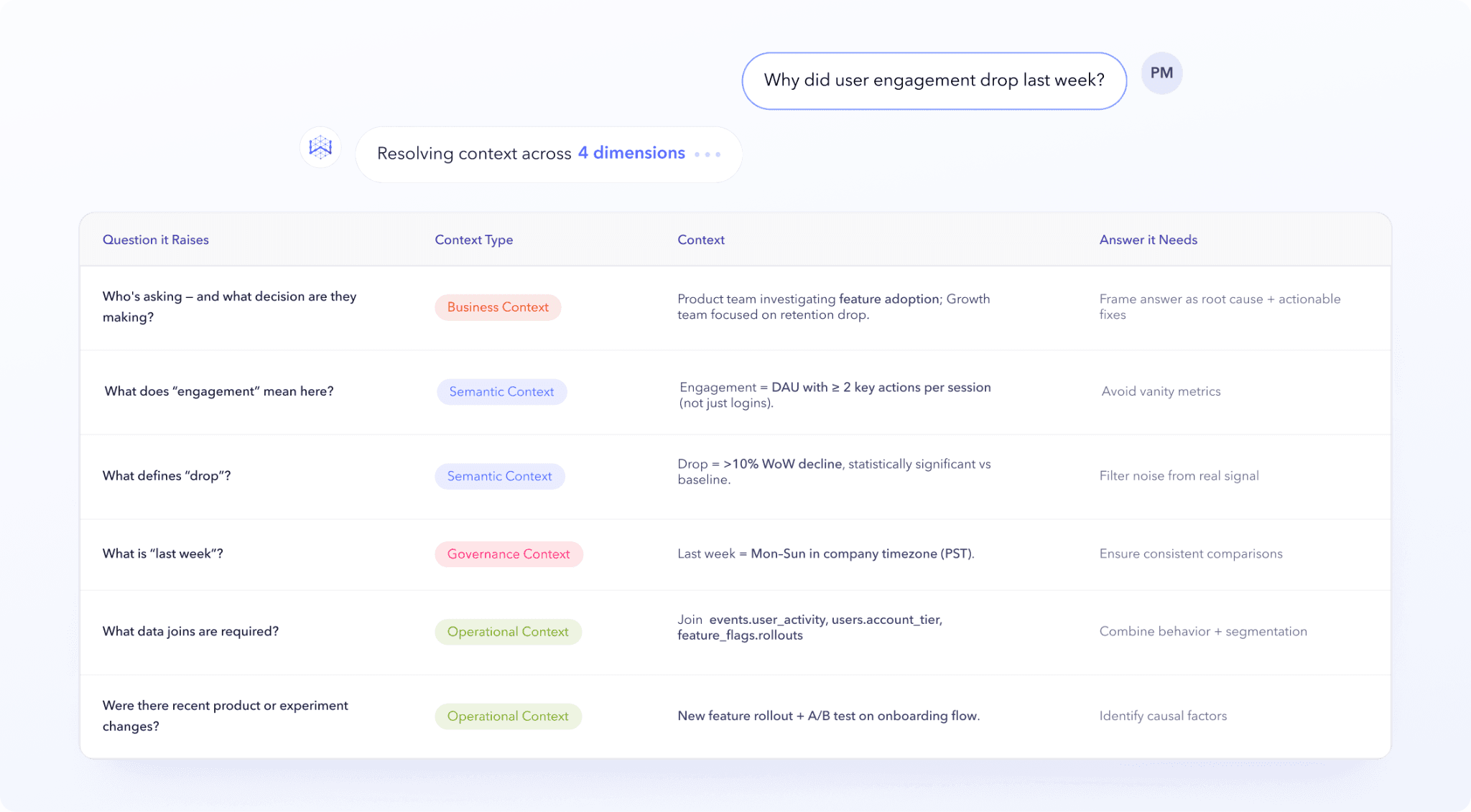
A Data Domain is a dedicated, configurable space built around a specific area of your business, like HR, sales, and finance. Inside that boundary sit the data sources, enterprise knowledge like semantics and metric definitions, reviewed or verified queries, and governance frameworks.
Now picture your enterprise data estate: thousands of tables, hundreds of sources, and dozens of teams working across different systems. A Data Domain draws a boundary around a specific slice of that ecosystem and hands it to the people who know it best. They decide how the data is defined and used, and fix the underlying logic that gives it meaning.
This division of responsibility is what makes co-ownership work. Business users stay inside their domain where they can ask questions, build AI dashboards, and flag answers that do not look right. Data administrators then turn that feedback into reusable AI context by refining knowledge entries, metrics, definitions, and reviewed queries.
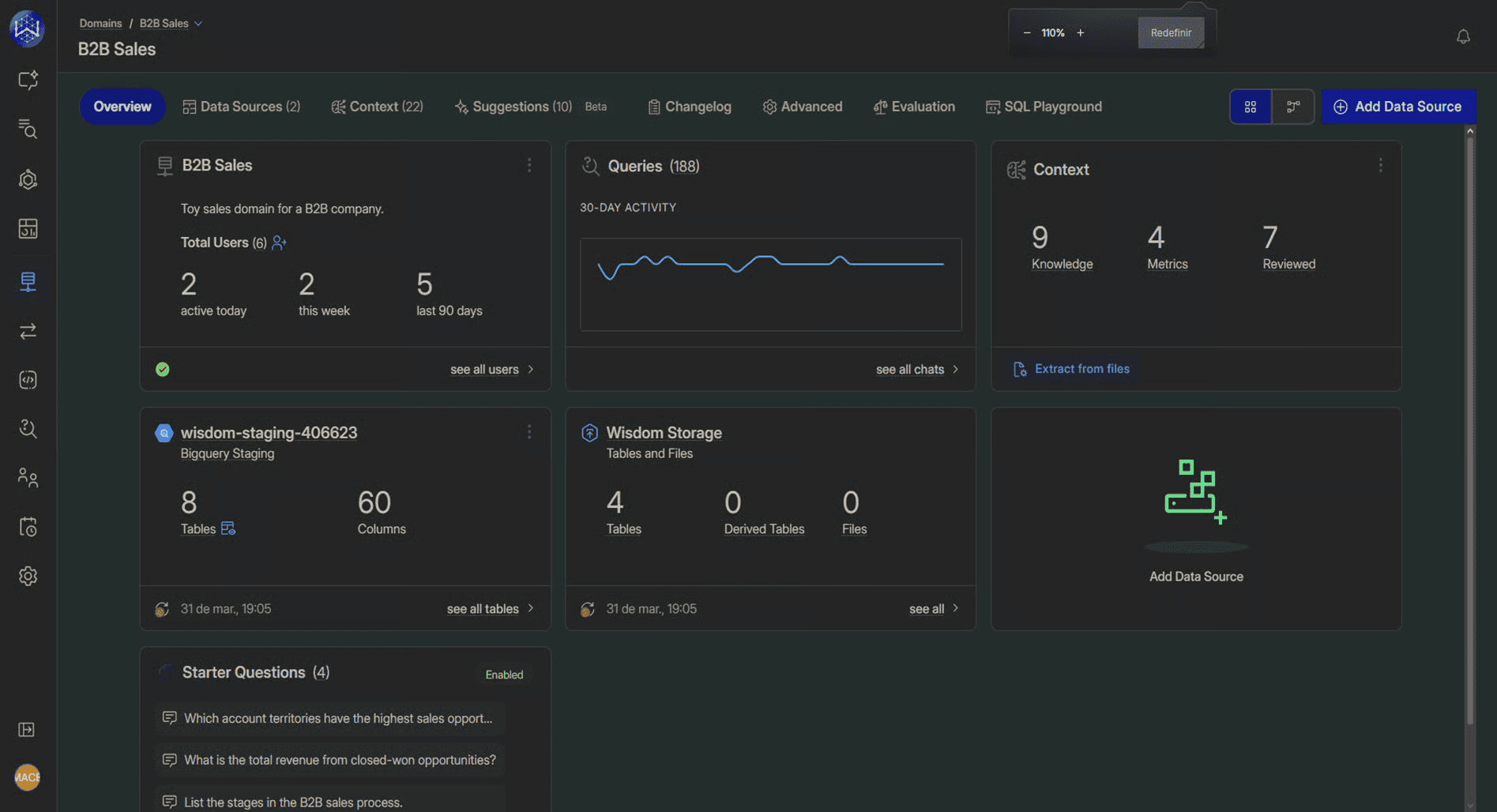
Key components of a data domain
A useful data domain has to give AI the data, context, controls, and feedback loops it needs to answer questions reliably and keep improving over time. Here are the core components that make this possible:
Domain overview: A single view of the domain’s structure, usage, coverage, and overall health. It helps teams catch issues like stale context, unmapped tables, and missing definitions.
Data sources: Governed connections to the warehouses, databases, applications, APIs, and other systems relevant to the domain.
Changelog: A historical record of all updates made to the domain. This feature creates accountability by showing changes made to metrics, context, permissions, and configuration, so your admins can see what changed, when, and by whom.
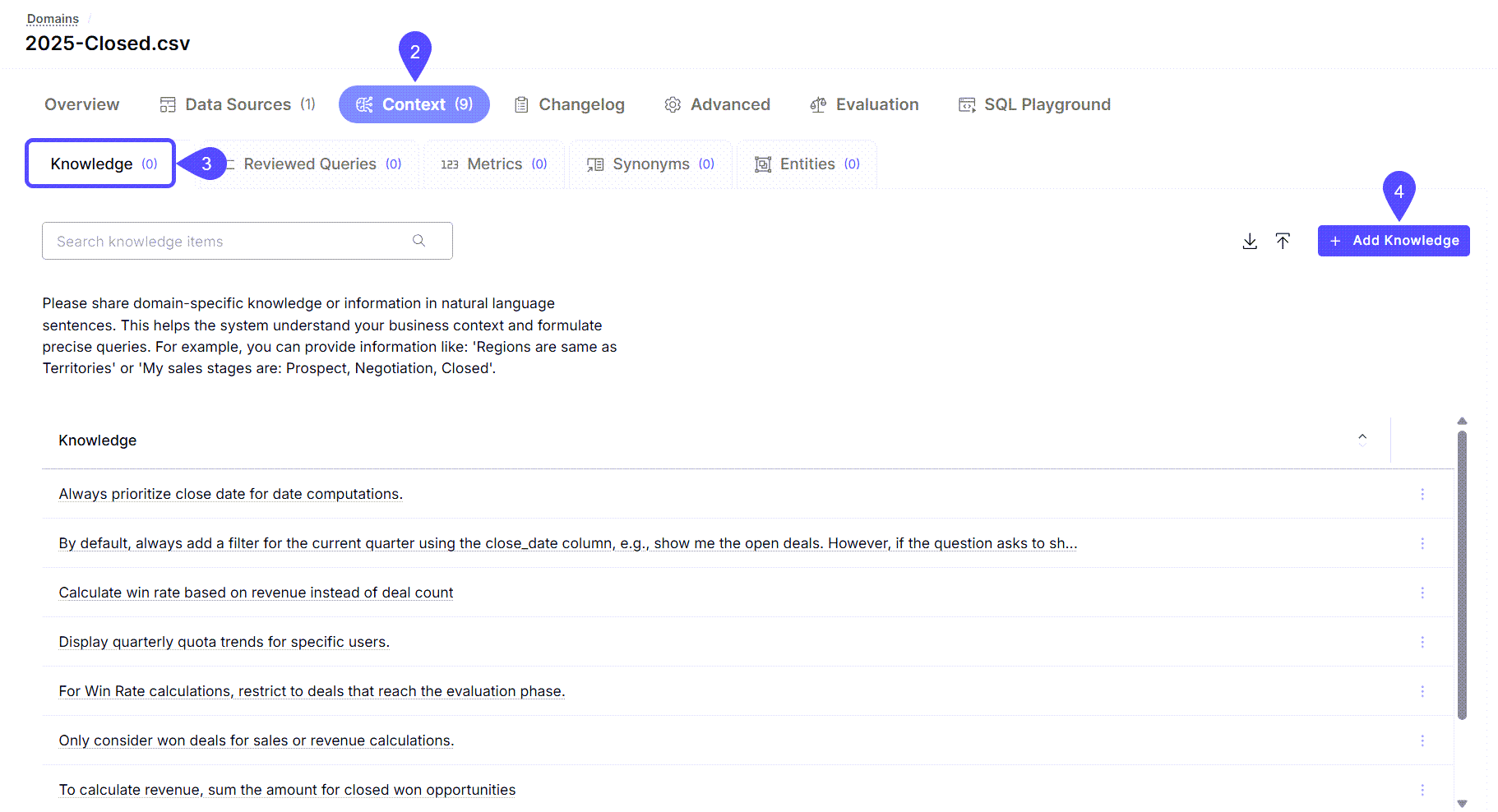
Enterprise context: An ever-evolving layer of key enterprise knowledge. It spans metrics, entities, business rules, and reviewed queries, capturing how your organization defines its terms and which logic applies to a given question.
Evaluation: A structured test to measure whether AI is producing expected answers. Prompt sets, expected SQL, and other established benchmarks help your data teams catch regressions and improve accuracy over time.
Access controls: A security layer that governs what each person can see within a domain. It applies row- and column-level permissions at query time, so everyone can work from the same domain while only accessing the data their role allows.
Domain settings: Configuration controls that are specific to each domain, including fiscal calendars, crawl schedules, and AI behavior, so different parts of the business can operate with the settings that fit them best.
Together, they make domains a governed operating environment for reliable AI analytics.
Data domains vs centralized ownership: What the new approach offers?
Centralized ownership ties business logic, definitions, and context to a single data team. By moving from single-player to multi-player, you give everyone a stake in developing and maintaining data accuracy — scaling analytics without losing governance.
Let's compare the two:
Centralized ownership | Data domains | |
Who defines the logic | One team for every area of your business. | Shared responsibility: business users bring in the knowledge and provide feedback, while data teams govern the standards. |
Where does the logic live | Fragmented across SQL, dashboards, and Slack threads. | Well-defined, reusable context attached to the domain. |
What AI reasons over | The broader data estate, where it has to determine which assets are relevant. | A bounded area with the relevant data, definitions, and business rules already scoped. |
Context management | One team is responsible for keeping a growing body of enterprise context current. | Each domain can maintain its own context while reusing shared definitions where needed. |
Business nuance | Edge cases have to be communicated to and encoded by the data team. | Subject-matter experts can contribute the exceptions and operational knowledge directly. |
Why do data domains matter for enterprise AI?
Data Domains group the right data, context, settings, and controls around a specific business area, giving AI a clearer boundary for answering questions. Here’s how Data Domains make self-service analytics more trustworthy:
Shared ownership
Legacy BI made analysts the gatekeepers of crucial enterprise context. Your analyst builds a model, applies their understanding of what the numbers mean, and produces an answer. Some of that logic gets documented, but much of it remains buried in SQL, dashboards, PDFs, or Slack threads. For your agentic analytics tools to answer accurately, context has to be explicit, reusable, and open to correction.
Data Domains create a feedback loop between the people who use the data and the teams that govern it. Business users flag an answer that looks wrong, clarify a definition, or encode missing context. Data teams then turn that feedback into governed business logic. The correction is captured once and applied to every question that follows.

Everyone can explore data on their own
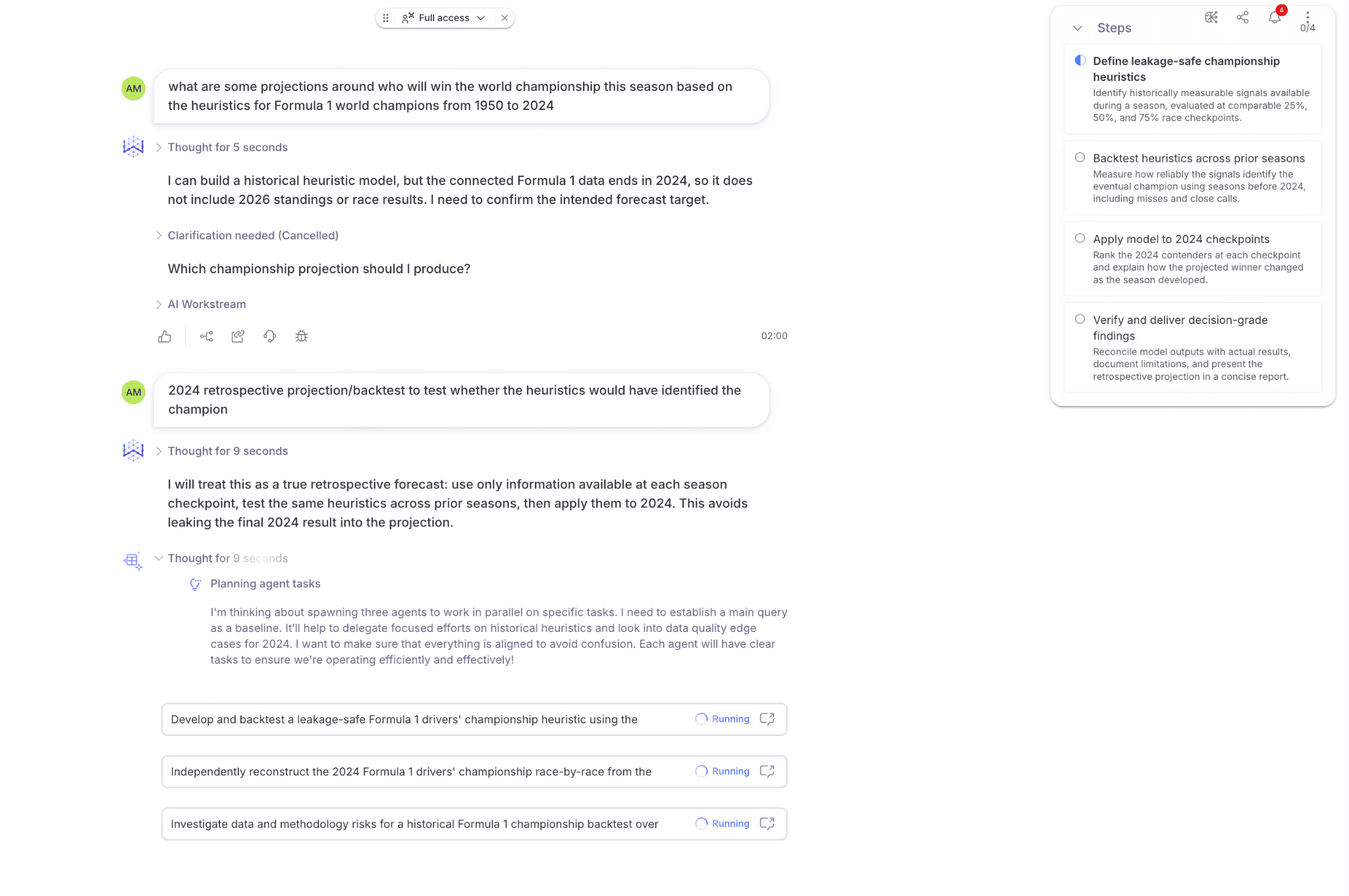
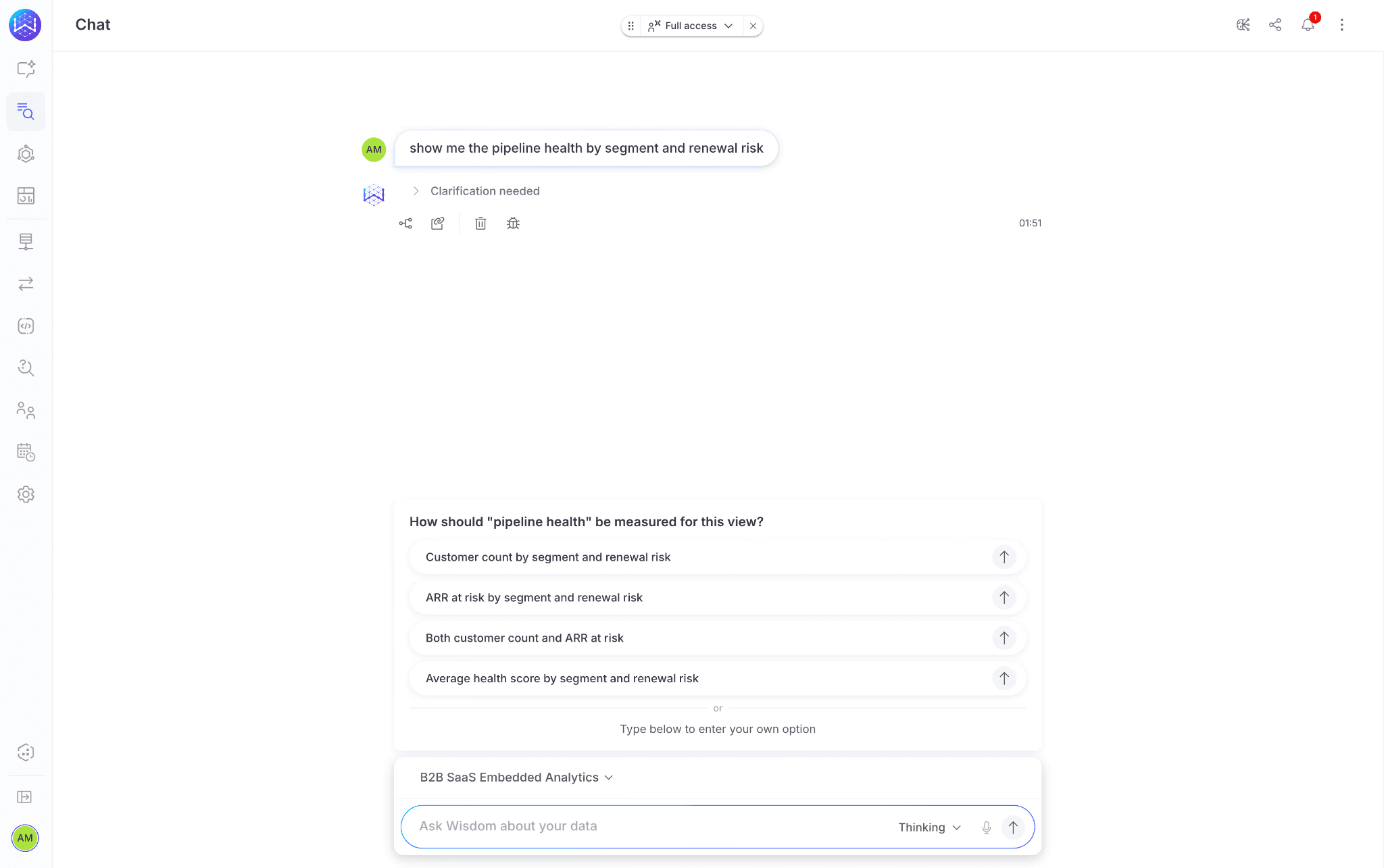
Paired with a conversational interface, a Data Domain gives non-technical users a governed space to explore data on their own. They can ask questions in natural language, drill into results, and keep investigating without relying on the data team for every follow-up.
WisdomAI’s Chat experience works the same way. It can run long, open-ended analysis from a single natural-language question. Users can give feedback, clarify definitions, and refine the direction of the analysis as they go. These interactions also surface gaps or ambiguities that data teams can turn into better context for the domain, improving future answers for everyone who uses it.
Business users become explorers, while data teams spend less time answering repetitive questions and more time improving the underlying architecture.
Federated data sources
With domains, you can connect and query data across multiple systems without moving everything into one central store. This is called data federation. It allows a domain to include all the data relevant to a business area, regardless of where it lives.
Together, these two approaches shorten the path from question to answer. Instead of waiting for your data team to build pipelines, join datasets, validate the output, and create a report, you can analyze structured and unstructured data within the same domain.
Look at Arm, the semiconductor company that powers billions of chips worldwide. To analyze their total non-cancellable commitments, the team had to manually skim through thousands of multi-page supplier agreements and stitch them together with PO and invoice data from the ERP.
With WisdomAI, Arm could bring structured ERP data and unstructured contract data into the same Data Domain, creating one governed space where everything related to non-cancellable commitments can be analyzed together.
Accuracy
Our evals show that adding knowledge files and a semantic layer moves AI accuracy from 20% to 50%. Better, but still a long way from what you need to trust AI-generated answers.
Part of the problem is that context goes stale. A definition written last year describes a business that has reorganized since. A rule about discount thresholds stops matching how pricing works now. AI still applies this knowledge so you get a confidently wrong number that someone makes a decision on.
Data Domains narrow the reasoning space and make that decay visible. Each domain holds the data, metrics, entities, relationships, and business rules for one area of the business, so agents work within a defined scope rather than the full estate. When something inside that scope goes stale, the damage is contained and you can see what it touched. And because the scope is bounded and owned, keeping it current is a job someone can actually do, instead of an audit nobody has time to run across the whole data estate.
Transparency
In a Domain, every answer is traceable. With observability built around the domain, teams can inspect the data, definitions, business rules, and context that shaped an answer instead of treating AI output as a black box.
Say an agent reports that customer churn increased 12% this quarter. An audit trail can show which data sources were queried, how “churned customer” was defined, which business rules were applied, and what context influenced the final answer. If something looks wrong, the data team has a clear trail to investigate rather than reverse-engineering the entire agent workflow.
Over time, audit trails give teams a record of how context is being used, where errors or inconsistencies originate, and how changes to a domain affect downstream analysis.
How do you build a Data Domain?
Building a Data Domain starts with setting the scope, connecting the right sources, and assigning clear ownership. Here’s a practical way to do it:
Start with a business area: Pick a domain such as sales, marketing, finance, or customer support, and create a set of questions that it should be able to answer.
Connect the relevant data: Add the tables, files, and other sources the domain needs, then define how those sources relate to one another. All of this is documented in the domain, rather than through multiple, fragmented sources.
Add relevant context: Capture business meaning across systems and tools, such as important entities, metric and terminology definitions, and known business rules. You can also add validated queries to show the system how specific questions should be interpreted.
Test and evaluate: Run prompt sets against expected outputs to see where the domain gets things wrong.
Refine and maintain: Review feedback, update definitions as they drift, and adjust configuration as your business evolves.
Real-world example
Our Solutions Engineer Ayushi Shah walks you through a sample retail domain. See how WisdomAI connects structured and unstructured sources, pulls context automatically from different sources, and shows how teams can review that context before any of it reaches an answer:
How to manage Data Domains: 5 best practices
To truly manage a domain, you have to treat context as something you continuously develop — not something you configure once. Here are five practices that help you keep your domains fresh and accurate:
Monitor Domain Health
Look for gaps in context coverage, schema issues, and patterns in user feedback and usage. Most teams audit their domain health manually and often only after someone has already flagged a wrong answer. By then, trust has already taken the hit.
You don't have to work that way anymore. WisdomAI’s Domain Health audits your context and tells you exactly what's missing, what's ambiguous, and what's quietly sending the AI in the wrong direction. With a list of prioritized recommendations, you can codify accuracy and reliability into your AI analytics.
Build a context development lifecycle
Experienced data pros carry context like muscle memory. They know which table is applicable and which definition has an exception buried in it. The problem is that none of it is written down, and by the time you've encoded it all, the earliest entries have already started to decay.
In fact, a recent survey found that over half of data teams manage context through institutional knowledge. This strategy doesn’t scale. And worse, you lose all that knowledge every time a team member moves on to a new opportunity.
Context needs to be treated like a lifecycle: capture new knowledge, validate it, put it to use, observe how it performs, and refine it as new questions and edge cases emerge. Build that loop into how your team works, so domains evolve alongside the business instead of becoming another semantic layer that quietly falls out of date.
Keep domain experts involved
Your data team shouldn’t have to translate every piece of business logic on their own. Finance knows the exceptions behind its cost estimation rules, while sales knows how pipeline stages actually get used, as opposed to how the playbook says they should. Bringing those experts into the loop keeps domains closer to how your business really operates.
Create a shared vocabulary
Some context belongs to a single domain. Shared definitions and business rules don't. A fiscal calendar, a customer definition, a geographic hierarchy, a core metric — these make up your company-wide vocabulary so they should be used across dashboards, AI agents, and conversational BI.
Maintain those definitions in one place so every interface inherits the same meaning. This work saves duplicated effort and, more importantly, keeps answers consistent across the org.
Delete as often as you add
Simply stuffing a model to its limit does not guarantee perfect recall. Old definitions, duplicate rules, outdated examples, and unused sources can confuse the AI. The more conflicting information it has to weigh, the likelier it is to reach for the wrong answer.
Review what's actually being used and cut what no longer earns its place. The aim isn’t to build the biggest possible context layer. It’s to create a meaningful one that stays accurate, relevant, and governed as the organization changes.
The Adaptive Context Engine for your Data Domains
Everything above points in the same direction: Data Domains need to evolve as your data, business rules, and user needs change. WisdomAI's Adaptive Context Engine is what makes that Context Development Lifecycle sustainable. It bootstraps context from the sources you already have, resolves conflicting definitions, monitors Domain Health, and keeps learning from every interaction, so agents stay accurate, trustworthy, and explainable as the business moves.
Take Patreon, a digital-native app connecting creators and fans. As the platform scaled, routine questions piled up on the data science team and took away their focus from the projects that actually needed their expertise.
With WisdomAI, they scoped four datasets — growth, retention, engagement, and revenue — grounding them in shared enterprise context. The result: 95%+ query accuracy, 9x growth in adoption, and more than 80% of questions now answered through self-service.
If you want the same level of accuracy on your own stack, book a demo today.