Guide
Procurement analytics: From transactional to strategic
Think about the questions that actually drive your procurement strategy: Which suppliers are becoming a risk? Where are costs quietly climbing? Which contracts should we renegotiate first? In the AI era, you should be able to ask these and get answers in seconds, not spend days stitching together reports.
That is exactly why we sat down with Arm’s procurement team during a recent webinar. Not to talk about AI transformation in theory, but to understand what it actually took to make the shift: the operational changes, governance decisions, and lessons that came with rebuilding procurement around AI Analytics for faster, more contextual decision-making.
What follows are the practical insights from that conversation.
The challenges: Why is procurement analytics so transactional?
If you've worked in procurement, ops, or finance, you've probably felt at least one of these problems.
The most important data gets left out
Procurement data is messy. Even the structured data in your ERP is rarely clean. Metadata is inconsistent, teams fill in fields differently, and process maturity varies by region and category.
But the bigger problem is what gets left out. Critical procurement context lives in unstructured data, the documents most BI tools can't read: supplier agreements, contract clauses, policy PDFs, renewal terms, and internal approvals. Most analytics tools can’t connect to this information, so it never makes it into the analysis. You're making decisions on half the picture and calling it a source of truth.
Arm learned this firsthand. To analyze their total non-cancellable commitments, the team had to manually work through thousands of multi-page supplier agreements and stitch them together with PO and invoice data from the ERP. One reporting exercise took days, and even then, it only captured a fraction of what they needed.
Here’s the take from Bharat Rajan, Director of Source to Pay and Transformation at Arm:
Sticking with the status quo
Most procurement analytics track standard KPIs: cost savings, spend under management, and cycle times. These metrics matter, but they are table stakes.
The real issue is that nobody steps back to ask: What should procurement analytics actually be focusing on? Because all the bandwidth goes into tracking what's easy to measure, the use cases that would genuinely change how savings are operationalized never get prioritized.
That’s especially true with metrics like risk, financial exposure, contract intelligence, and supplier patterns, which are trapped in unstructured data sources. Because legacy BI tools couldn’t analyze these patterns, many teams aren’t aware AI analytics can help, so they maintain their manual, one-off analysis.
Insights aren't self-serve
Most procurement teams aren’t short on reporting. Look at Arm — they had Power BI dashboards and pre-built reports across 8 or 9 systems. The problem was what happened after someone reviewed a report.
Every follow-up turned into a request to the data team, who had to manually stitch data across systems while business users waited for days for a one-off analysis or a dashboard to be rebuilt. Arm’s team wanted to be strategic but they were stuck in transaction mode. All the time they spent working through the reporting queue prevented them from helping the procurement team self-serve their own insights.
Context and governance are afterthoughts
Even with viable data infrastructure and dashboards built, there's a deeper problem: the analytics lack business context. What counts as a non-cancellable commitment? How should each metric be interpreted across different product lines?
That knowledge lived in people's heads, not in any system. As Tom Smith, Arm's transformation lead for procurement data and insights, explains: Simply uploading raw enterprise data into your AI system and expecting accurate, repeatable answers isn’t realistic. Without a context development lifecycle, AI produces answers that seem plausible but are misleading.
The blueprint: Arm’s transformation journey to AI procurement analytics
Start by defining what success looks like
Arm's first move wasn't a vendor evaluation or AI strategy session. Instead, they focused on setting the right goals. They started by asking themselves a simple question: What impact do we need our analytics platform to deliver? The answer steered every conversation and strategy throughout their AI transformation.
Risk management
Procurement data carries enormous exposure: erroneous financial reporting, missed related-party transactions, and non-cancellable commitments hidden in contract language. Arm needed a faster, secure way to identify and interpret all of that data. They also needed automated monitoring across their supplier base, empowering their procurement team to react swiftly to unexpected events.
Stakeholder experience
For Arm, customer-grade experience meant three things: business users can dig deeper without filing a request, ask follow-up questions across all their data in one conversation, and get insights they didn't even think to ask for. That last one is the big shift.
As Tom puts it, a dashboard shows you what you thought you needed to know. An AI agent tells you what you actually need to know and lets you act on it right there.
Financial impact
As with any business project, it was vital that there was a monetary gain attached to the transformation effort. In Arm’s case, they needed analytics that could help them move beyond reporting metrics — a solution that would help the team actively find cost-saving opportunities.
This included reducing cycle times, surfacing process inefficiencies, and identifying cost drivers. PR-to-PO cycle time was the first target. The core transformation team worked with stakeholders to model multiple scenarios and derive root causes. Then, they began working to reengineer the workflow for operational cost savings.
Scalability
Last but not least, the team needed to scale. They knew their team was understaffed in both depth and breadth — and headcount wasn’t the answer. To succeed, they’d need to extend trusted analytics beyond their first use case.
Once the team understood their criteria, they started their search. This framework led them to WisdomAI, an Agentic Intelligence Platform that could reason across structured and unstructured data, retain business context, and deliver answers grounded in how their procurement teams actually work.
Here's how Tom Smith, procurement governance and reporting lead at Arm, explains the shift:
The results: 4 lessons for leading AI transformation in analytics
Arm didn't do a textbook rollout. They got a meaningful POC running in about 3 weeks—dramatically faster than a typical enterprise analytics program. There was no long cycle of requirements gathering, pipeline creation, and dashboard builds. With WisdomAI, they were able to easily connect their data, establish AI context, and users could explore from day one. From there, the program grew organically.
Four lessons shaped how they work today:
Stop waiting for "AI-ready” data
There's a persistent idea in the market that your data needs to be perfectly clean and fully harmonized before AI analytics can add any value. This whole narrative is wrong.
If Arm had waited for perfectly structured, AI-ready data, they'd still be waiting. Their data landscape is imperfect—different systems, inconsistent AI metadata, varying process maturity, and enormous amounts of operational nuance that no system of record captures. If that sounds familiar, don’t feel like you’re behind. Every enterprise data landscape looks like this.
The alternative isn't to ignore data quality. It's to take a managed and governed approach to enterprise context and improve accuracy iteratively over time.
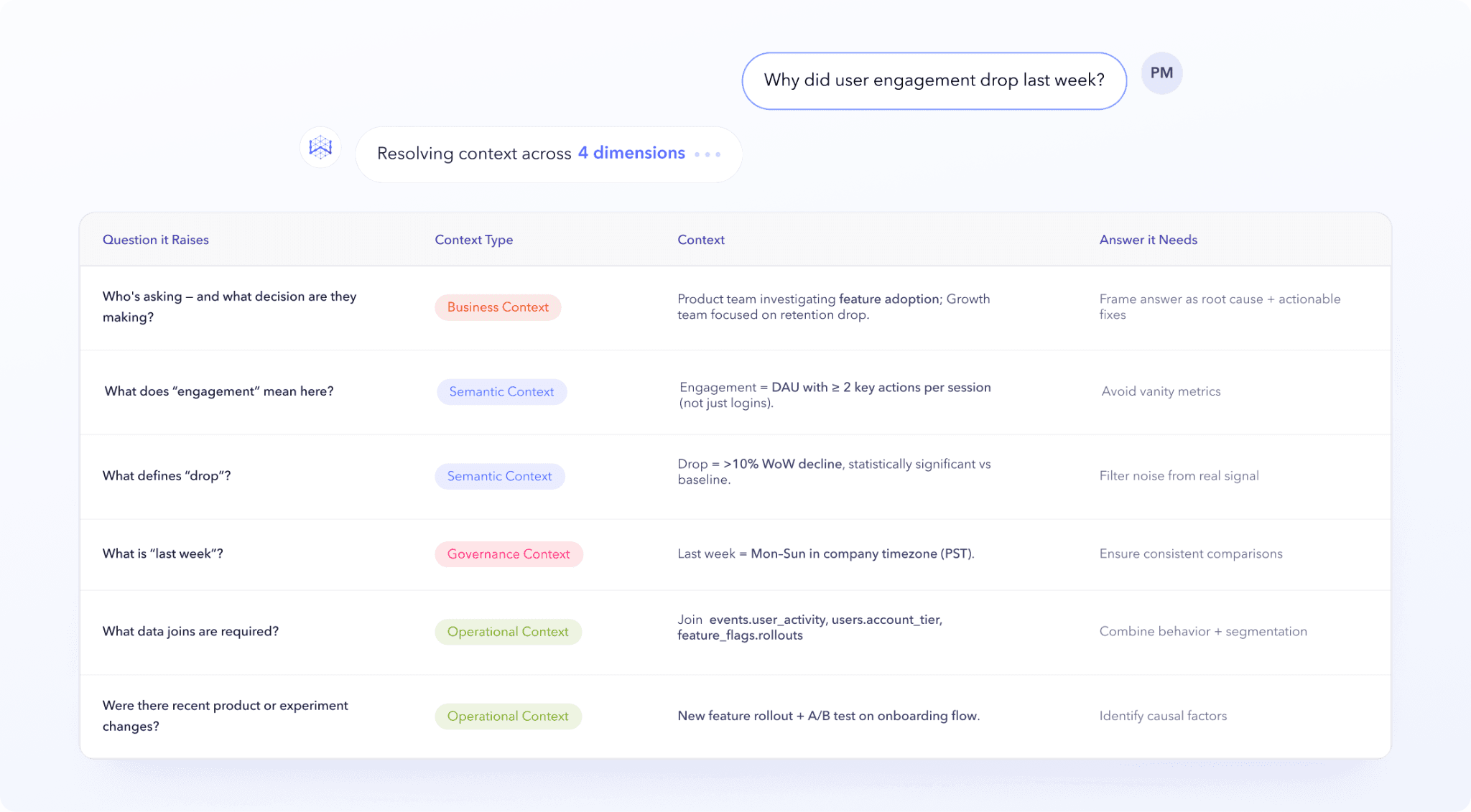
Using WisdomAI's Adaptive Context Engine, Tom codified business knowledge that lives outside the data. Things like: why certain suppliers need longer onboarding, how a specific metric should actually be read given the process behind it, or what exceptions are normal versus worth flagging. Each round of refinement sharpened WisdomAI's understanding of how Arm's procurement function actually works.
Key takeaway: Don't let your data readiness program become a gate to getting started. Identify where the essential context is missing and start building it step-by-step with the Adaptive Context Engine.
Put analytics agents to work
Arm’s team started with Conversational BI and then moved to Analytics Agents. Take supplier risk as one example. Their team programmed agents with a simple condition: flag any supplier where total spend exceeds $10 million. The agents fetch publicly available risk signals, filter for what's actually actionable, and route only the relevant findings to the teams who need to act. No one ran a report. The agents did the work on their own.
That's the difference between a dashboard and an AI analyst. A dashboard waits for someone to look at it. An Analytics Agent is already monitoring thresholds, identifying patterns, and surfacing risks as conditions change.
Key takeaway: Pick one analytical workflow where your team spends a large portion of their time. Ask whether that workflow can be automated or whether a context-aware agent can watch, reason, and surface what matters without being asked.
Rethink data roles
Arm’s procurement team sees a permanent shift in what data roles will actually look like. The traditional model is what they call "clean, create, and give". The cycle is the same: prepare the data, build the report, and hand it over. Repeat. This model doesn't scale when every new question means a new build cycle.
What Tom does now is fundamentally different. Instead of fielding ad hoc reporting requests, his time goes toward building a contextual foundation. Each refinement he makes inside WisdomAI sharpens accuracy for every user and every use case simultaneously. The work compounds instead of competing.
Key takeaway: Look at how your data team spends their week. If most of it is building and rebuilding reports, that's the role that's about to change. Start investing in context engineering skills now.
Be intentional about your use cases
The temptation with any AI platform is to try to answer every use case at once. Arm’s advice is the opposite: start small, prove accuracy on one use case, then expand. As Tom puts it, you can "get drunk on the possibilities," but trust is built slowly.
Early on, the instinct was to add all their information at once — more data, more documents, more use cases. However, this strategy can create ambiguity. With the help of WisdomAI’s built-in context drift detection, the team reintroduced standards about what gets introduced, how semantics are structured, and what information should or shouldn't be exposed to the model.
From there, they became intentional about sequencing. They started with contract intelligence, got the context right, validated the accuracy, and only then expanded into spend analysis and operational reporting. Each use case inherited the contextual foundation from the one before it, which is how they scaled without sacrificing accuracy. And humans stayed in the loop throughout.
Key takeaway: Start with one well-defined domain, build context deliberately, and build trust one use case at a time. The strategy is to go narrow first and gradually broaden the scope.
Ready to transform your procurement analytics?
Arm's journey points to a broader shift in how enterprise teams should think about analytics: context over cleanliness, self-service and proactive agents over dashboards, and governed feedback loops over one-time context injections.
WisdomAI is the Agentic Analytics Platform that made this possible for Arm. It reasons across structured and unstructured data, explains the why behind the metrics, and automatically surfaces insights buried in your operational workflows that were previously untapped.
Watch the full webinar to hear Tom, Bharat, and Sean tell the story themselves. Or, book a demo to see the difference in your own data.