
AI Business Context Refinement: How to Prevent AI Drifts
What AI context refinement is—and why more context isn’t always better
How stale, conflicting, or poorly structured context undermines AI answers and agent performance
Why context is a continuous development lifecycle
PUBLISHED:
UPDATED:
Walk into a specialty coffee shop and ask for "a latte," and you'll probably get a few questions back. What size? How many shots? Oat or whole milk? Any flavors? Every shop has its own language, preferences, and way of doing things. Without shared context, even a simple coffee order leaves room for interpretation.
LLMs have the same problem, except the stakes are much higher. You can pack a prompt with schemas, definitions, business rules, documentation, and examples and still get the wrong answer. More context doesn't automatically mean better answers.
Which is why AI context isn't something you write, load into a prompt, and call finished. It requires continuous refinement: updating as the business evolves, reconciling definitions when they drift, and constantly testing to ensure the model still applies the logic correctly
In this article, we'll explore the emerging discipline of AI business context refinement, the failure modes that cause context to drift, and how to keep your AI aligned as your business grows.
What is AI business context refinement?
AI business context refinement is the ongoing process of curating and structuring the information a model draws on, so the answers it returns are accurate and specific to your business. Rather than tweaking prompts, you shape the model's working memory and data environment: adding what's missing, updating definitions as they change, and maintaining the engine that carries context from one question to the next.
Most companies already have plenty of context. The problem is that it lives in warehouse schemas, corporate wikis, and Slack threads nobody has time to hunt through. Or, as is the case in 56% of data teams, it likely is all living in your data team’s heads — undocumented, institutional knowledge that fails to scale. What's missing is a way to translate that scattered knowledge into something an AI system can retrieve the moment a question is asked.
Refinement closes that gap. It captures what's changed, removes what no longer applies, and organizes enterprise knowledge so the model can retrieve and apply the right context at the right time.
How AI context refinement works across the four context types
Context isn't a monolith. In an AI system, it typically falls into four distinct types, and each one needs to be refined differently. Here’s how they work:
AI context layer | What it means | How refinement works | The outcome |
Data context | The structural knowledge of your data: which tables exist, what columns mean, how datasets join, and where the authoritative data lives. | Track schema changes, renamed columns, broken joins, and deprecated tables, then update mappings before the model starts relying on outdated structures. | Queries continue hitting the right data even as your underlying stack changes. |
Business context | The semantic knowledge of how the organization defines its metrics, how those definitions have changed, and differences between teams. | Domain experts capture changes as they happen, while governance resolves competing definitions and determines which one applies to each team, domain, or use case at runtime. | Every team gets the definition that applies to them. |
Historical context | The institutional memory of what's been asked before, which answers were accepted, and which were quietly corrected. | Reinforces useful patterns while pruning incorrect answers, assumptions, and corrections you don't want the system to repeat. | The system gets sharper with each interaction instead of repeating mistakes. |
Presentational context | The preferences and conventions that determine how an answer should be delivered: format, terminology, level of detail, visualizations, and audience expectations. | Learn from user preferences and feedback, then update how answers are shaped without changing the underlying business logic. | Users get trusted answers in the format that's most useful to them. |
TL;DR: AI context refinement doesn't mean simply adding more context. Sometimes you add what's missing. Sometimes you update what changed. And sometimes the most valuable thing you can do is remove context that's stale, conflicting, or no longer useful.
Why context refinement matters for your business
Removing ambiguity
An out-of-the-box model understands language. It doesn't know the unwritten rules your business runs on. And because different teams operate with different assumptions, most business questions have more than one defensible answer. Removing that ambiguity means settling on the definitions your team actually uses, encoding them, and pointing the model at a single source of truth.
Take a simple question: "Which region grew fastest last quarter?"
The model aggregates the data and reports EMEA, up 22%. What it can't see is that your CRM assigns accounts by billing address while the warehouse assigns them by sales territory. A Singapore-headquartered account managed out of London sits in APAC in one system and EMEA in the other. Both records are live. Neither is marked canonical.
An analyst would have stopped and asked which version of EMEA you meant. The model sees one field name, finds no conflict, and answers with total confidence.
That's the trap refinement fixes. It replaces ambiguity with verified enterprise context, grounding the model's reasoning on a solid, reliable foundation.
Preventing context rot
Context windows are enormous now, so it’s tempting to just dump everything in. You can throw in every table, Notion calendar, and Slack thread explaining some undocumented exception, on the assumption that the model will sort out crucial knowledge.
However, overloading the prompt makes the model worse, a failure mode known as context rot. When Chroma tested 18 frontier models, output quality degraded as input grew, well before the window came close to full.
The culprit is attention. Your model has a finite pool of it to spend parsing information, and every token you add demands a share of it. Every piece of irrelevant data you feed it is attention stolen from the facts that actually answer the user's question. Therefore, the goal isn't to load your entire business into the model. It's to give the model only what the immediate question requires.
That’s the true purpose of refinement. It’s a ruthless, ongoing cycle of deciding exactly what earns a spot in the context window, and stripping out everything that doesn't.
Keeping context consistent across agent handoffs
A stale semantic layer doesn’t stop at one bad answer. Under agent orchestration, one mistake can travel through an entire workflow. It is passed from agent to agent until the final output is completely corrupted.
The problem is the handoff itself. An orchestrator can verify that a task was completed, but not whether the answer was accurate or grounded in the right business logic. If a retrieval agent returns a well-formed number and the forecasting agent accepts it, the workflow keeps moving. A bad answer quietly becomes the next agent's input.
So the challenge isn't getting every agent right in isolation. It's making sure every agent works from the same definitions, rules, and trusted context — and that those assumptions survive every handoff.
Very few context engineering approaches are designed for that. Manual prompt engineering, semantic layers, and one-time configuration start to break when agents need to share, validate, and update context continuously across teams, tools, and data sources.
That's why context infrastructure matters now. Companies building governed, refined context management systems today will be able to scale agentic analytics without small inconsistencies compounding into failures nobody can trace.
Detecting hidden biases
The way we interact with AI systems introduces its own layer of bias, entirely separate from the underlying data. These biases typically show up in three ways:
Prompt-induced bias. Vague or leading questions force the model to fill the blanks with statistical averages. Instead of analyzing your business, it returns what's generally true of businesses like yours.
Contextual drag: Recent research found that flawed premises and uncorrected errors left inside an active context window act as an anchor, later pulling outputs that lean towards the same mistakes.
Usage Reinforcement: The system learns from past queries and behaviors, so frequently used context becomes the default context. The most-queried table wins out over the authoritative one, and after enough cycles, popularity and truth begin to diverge.
The only way to counter this is continuous refinement. With an active feedback loop, you can see which sources the model relied on, trace anomalies back to their origin, and test the same question in different ways to check whether the underlying logic still holds.
Which is why observability is important. WisdomAI's Agentic Analytics Platform, for example, surfaces the sources and definitions behind each answer, along with a record of what changed, who changed it, when, and why.
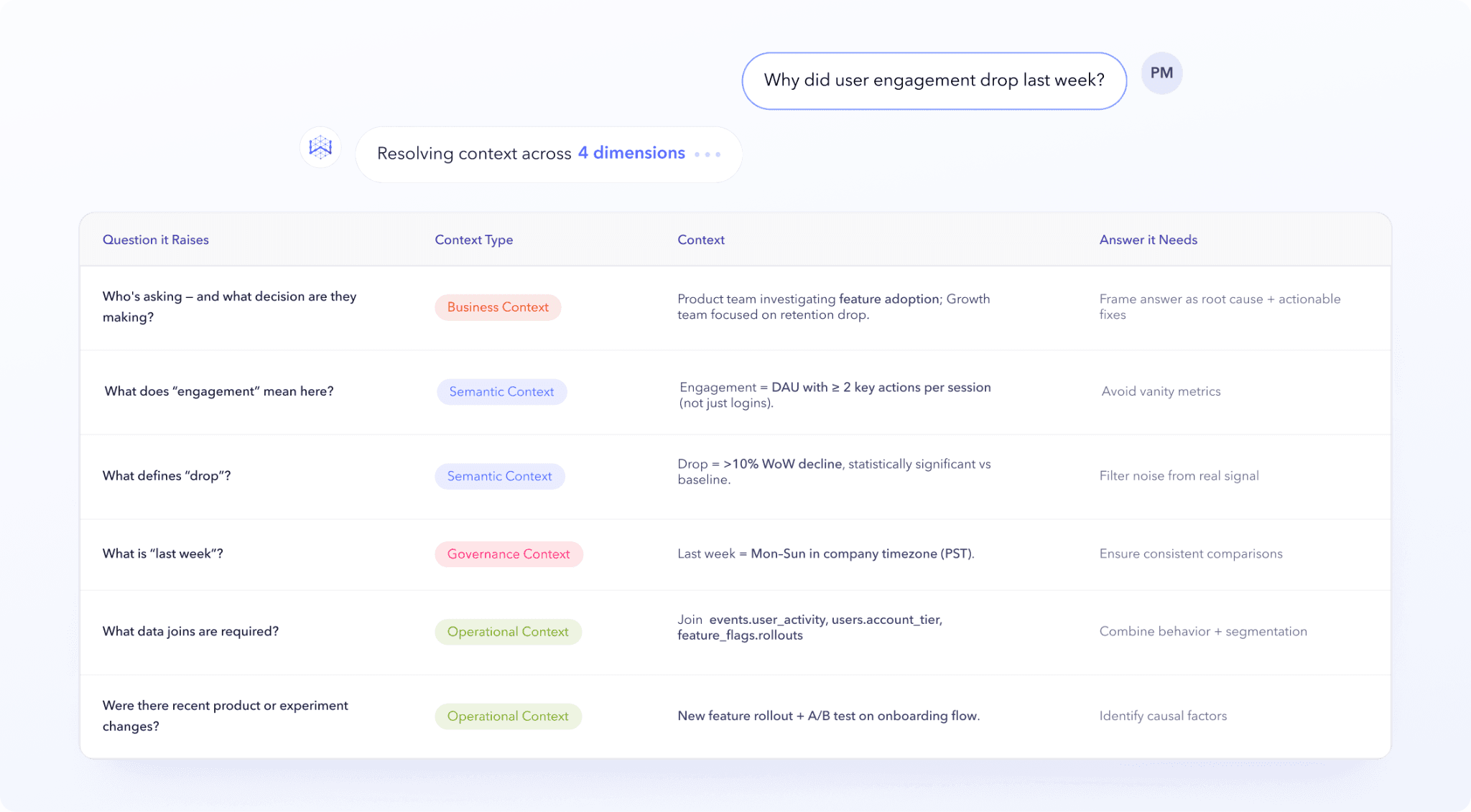
How does AI context refinement work in practice?
AI business context refinement works best as a continuous operating system. That means structuring context clearly, keeping it current, testing it against real questions, learning from usage, and governing how it changes over time.
Structuring context into clear layers
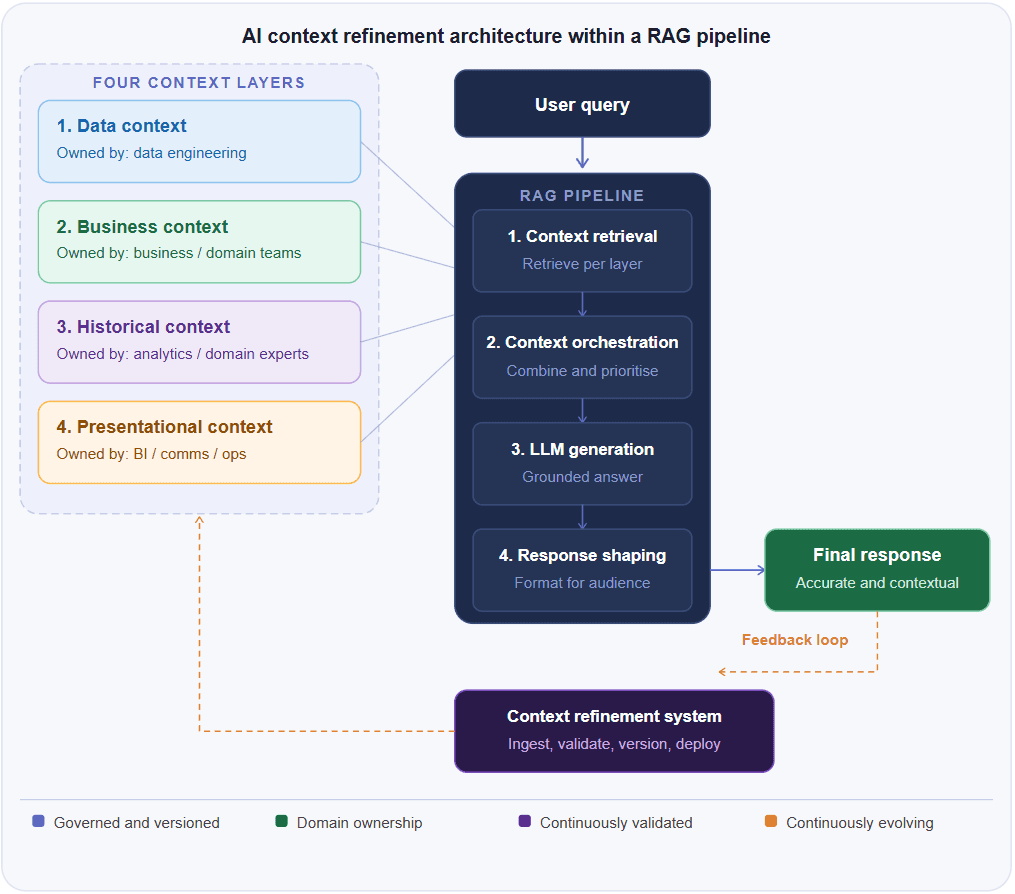
Separating context into distinct layers makes it much easier to manage, retrieve, and refine. A schema relationship, a KPI definition, and a preferred output format are fundamentally different kinds of knowledge. They come from different owners, change at different speeds, and should not all be treated the same way.
That separation becomes especially important at query time. Instead of pulling from one large pool of enterprise knowledge, a retrieval-augmented generation (RAG) pipeline can assemble context from the specific layers a question actually needs.
The flow looks like this:
Retrieve and orchestrate. When a question comes in, the system identifies which layers are relevant, retrieves the right information from each one, and ranks what matters most.
Generate and shape. That context grounds the model’s reasoning, while presentational context determines how the answer should be delivered for the person asking.
Refine and redeploy. Corrections and feedback are validated, versioned, and routed back to the layer they belong to, so one change doesn’t unnecessarily affect everything else.
The advantage is precision. Instead of making the model sift through schemas, business definitions, historical decisions, and formatting preferences all at once, you give it the specific context required for the task.
Treating context as a living system
Context isn't something you deploy once and walk away from. Data pipelines get rebuilt, business units get reorganized, metric definitions change, and operational rules evolve. If the context layer does not keep pace, the AI gradually drifts away from how your business actually operates.
The better mental model is to treat context the way you treat a codebase:
Version control: Every change to a business rule, metric definition, or schema mapping must be documented with an owner and a timestamp. When someone updates the definition of "churn," there should be a trackable diff, not a silent overwrite.
Monitoring: Audit outputs against current business rules, or build automated checks that flag anything relying on deprecated terms. Either way, you need a system that catches a drift the moment it happens so downstream logic stays intact.
Ownership: Engineering and product teams can't maintain context alone. The domain experts closest to the data, such as finance, marketing, and operations, have to own the definitions that drive it.
With an adaptive context management system, changes get versioned as they're made, drift gets flagged as it appears, and ownership is enforced rather than assumed.
Validating context against real queries
Test your context against the questions your team actually asks. Instead of relying entirely on synthetic test cases, pull real queries from your analysts and business teams, document the correct answer for each one, and capture the reasoning or business rules behind each question. Every test becomes a baseline benchmark for evaluating future context changes, similar to how WisdomAI evaluates text-to-SQL accuracy.
This benchmark cannot remain static, though. As users become comfortable asking complex questions, new query patterns, edge cases, and business definitions emerge. The evaluation set therefore needs frequent updates during deployment and regular audits afterward.
Otherwise, accuracy can deteriorate quickly. Anthropic's data team reached 95% accuracy after months of context engineering, then watched it fall to around 65% in a single month when their skill documentation drifted out of sync with a changing data model. Without proper cadence, you learn about drift the way Anthropic did: after it has already happened.
Refining context from usage signals
The most valuable context improvements rarely come from scheduled reviews. They show up in the friction of everyday work. When users constantly retype corrections, manually apply the same filters, clarify what a metric means, or pull answers from PDFs, they are supplying context the system should already have.
Each workaround points to a gap: missing business rules, ambiguous definitions, disconnected data, or knowledge the AI cannot access. The catch is that most of these problems never get reported directly. They show up in usage instead. You have questions that get retried, answers that are repeatedly corrected, or domains that aren’t used anymore.
That makes usage your most reliable refinement signal. Once you capture those patterns and rank them by impact, you can see where context needs attention. WisdomAI's Domain Health does exactly that. It audits your context to identify what’s missing, ambiguous, or hurting accuracy, then surfaces prioritized recommendations you can apply to improve the reliability of your AI analytics.
Building governance into the workflow
As context evolves, teams need clear rules for who can change it, how updates are reviewed, and what happens when something goes wrong. Without governance, even well-intentioned changes can create conflicting definitions, cause unexplained shifts in metrics, and ultimately erode trust in the system.
Here are a few specific areas where governance matters most:
Managing metric changes: KPIs, reporting logic, and business rules change over time. The context supporting them needs to change at the same time, with a clear record of what changed and why. Otherwise, users may see different numbers every time they ask a question.
Resolving conflicting definitions: Governance determines which definition applies based on the user, domain, or business context, and makes that choice traceable. You can see which definition was used, who owns it, when it changed, and why.
Enabling safe rollbacks: Not every context update works as intended. Teams need version history so they can quickly return to the last stable version when something goes wrong.
Why context is a continuous development lifecycle
Everyone is investing in writing prompts and engineering better context for AI analysts. In fact, in a recent survey of enterprise VP and C-level leaders, 94% said they plan to invest in better context management systems over the next two years. Fewer are asking what happens after that context is encoded. What keeps it accurate?
This question becomes a real problem in agentic analytics, because manual context management simply doesn't scale. If you're working with a handful of definitions and a stable data model, documentation might be enough. But enterprise data is constantly moving: thousands of tables across multiple warehouses, schemas changing, and the same KPI defined differently across teams.
Agents don't know when something upstream has moved. They keep answering questions and triggering workflows on a definition that stopped being true last Tuesday. You can maintain context carefully and still miss the details.
Which is why context needs infrastructure around it, not just a semantic layer. Everything described so far in this piece is already a lifecycle: build the context, validate it against real queries, deploy it, watch how people work around it, improve it, and version every change so your agentic analytics tools can become more reliable. WisdomAI calls this loop the Context Development Lifecycle. The question is no longer whether to treat context as a lifecycle. It's how quickly you can adopt it.
Meet WisdomAI’s Adaptive Context Engine
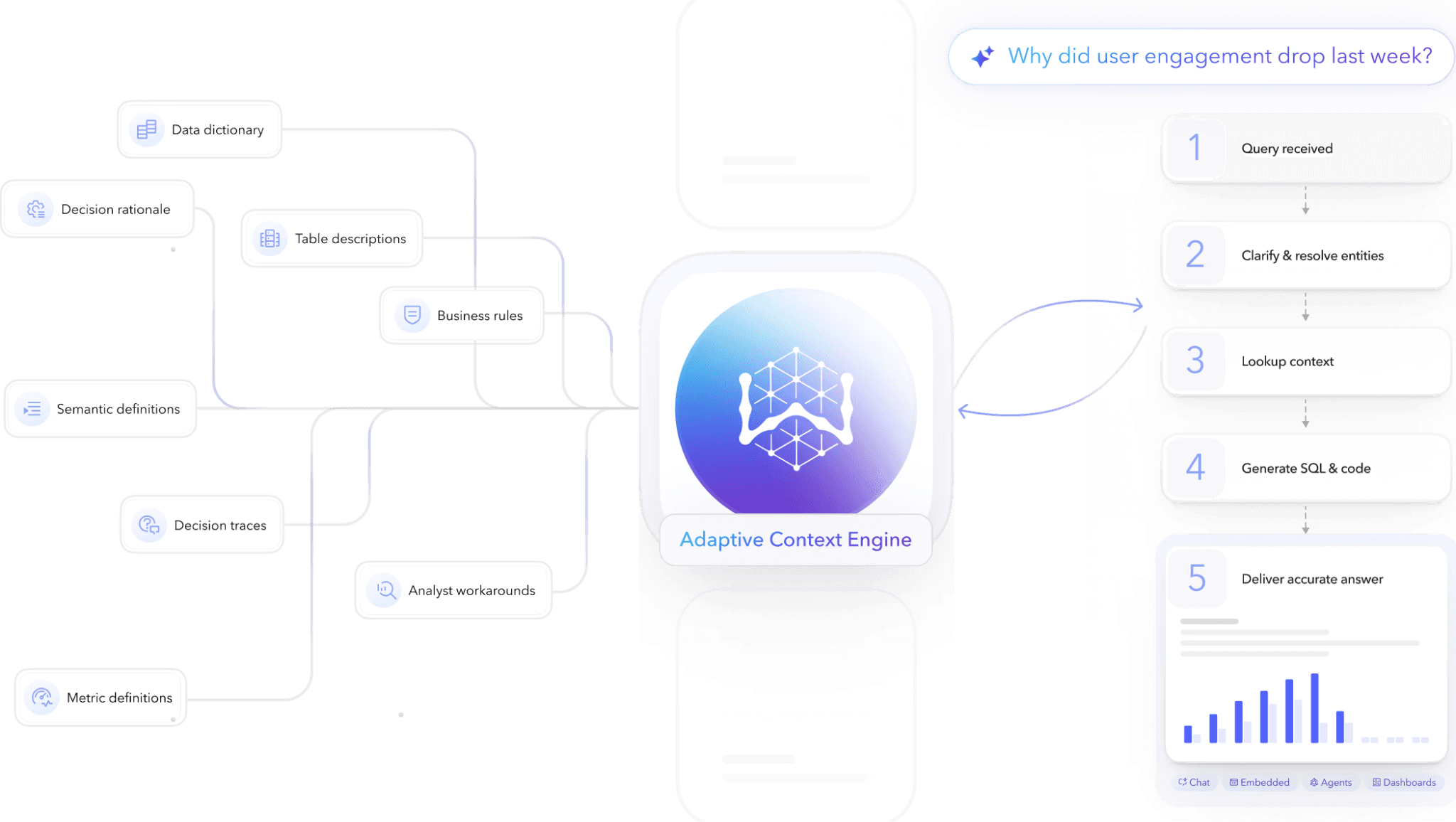
WisdomAI's Adaptive Context Engine runs that lifecycle as a product, built on five stages:
Build: Connects to your data sources wherever they live and bootstraps enterprise context automatically, pulling in unstructured data from docs, Confluence, Slack, and Jira along the way.
Govern: Flags clashing definitions across sources and routes them for human review before they can corrupt AI outputs. Enforces security policies at the query layer, so PII and sensitive business logic never surface to unauthorized users.
Adapt: Learns from queries, corrections, and usage over time, so your Analytics Agents get sharper with every interaction instead of repeating the same mistakes.
Version: Tracks every context change with full history. Stage, deploy, and roll back context the same way you ship code.
Publish: Serves as shared context infrastructure. AI Dashboards, Conversational BI, embedded analytics, and any MCP-compatible agent all draw from the same governed layer, so knowledge gets built once instead of rebuilt per surface.
If accuracy is the destination, context is the mechanism to get you there. That's how Patreon hit 95% answer accuracy and 9x self-service adoption in three months.
Context is your AI advantage
As agentic analytics becomes more capable, agents will take on longer workflows, more complex analysis, and increasingly important decisions. The more autonomy you give them, the more the quality of context matters.
With WisdomAI, Analytics Agents can reason across enterprise data, understand the business context behind it, and turn questions into trusted analysis and action, without requiring your teams to fill every gap.
See what accurate and reliable analytics looks like. Book a demo.