
Prompt engineering vs context engineering: What's the difference?
Why prompt engineering hits a wall at enterprise data scale and complexity
What context engineering is and the five components a full pipeline needs
How to move from clever prompts to governed, context-aware AI agents
PUBLISHED:
UPDATED:
We've hit a critical milestone in AI maturity: Whereas a year ago, most teams still argued about which model to use—today, the conversation is more focused on the architecture you're building around that model.
This shift is exactly what puts prompt and context engineering on the map. While both techniques steer models toward desired outputs, only one is designed to manage and maintain accuracy at enterprise scale and complexity.
Because let's face it, a clever prompt and a stuffed context window are table stakes. Sure, it can get you through a demo on a simple dataset, but it can’t handle the strain of real-world data complexity.
This guide is about what comes next: how to build context-aware agents, and the very different roles prompt engineering and context engineering play in successful delivery.
What is prompt engineering?
Prompt engineering is the craft of shaping prompts to make LLMs respond in a more meaningful or predictable way. It involves adjusting instructions, adding examples, defining roles, or specifying the structure of the response—all within a single interaction.
Ideal use case
The approach works well for lightweight tasks: summarizing a report, rewriting an email, explaining a piece of SQL. It's quick to prototype, easy to implement, and works fine as long as everything the model needs fits inside the prompt.
Prompt engineering limitations
Prompt engineering is great for quick, one-off tasks. The cracks start to show as soon as your workflow gets more complicated. What begins as a few simple instructions quickly snowballs into a giant, messy prompt packed with business rules, formatting requirements, and edge cases.
As one user shared in this thread:
"We made a small change to our system prompt, and it pushed average output from roughly 900 tokens to a little over 1.7k. That was enough to mess up our monthly budget."
That's just one part of a bigger problem. In practice, prompt engineering breaks down in three specific ways:
Inflexibility: Multi-step workflows need structural coordination like planning, sequencing, and dynamic tool use. Tweaking the wording of a prompt can't capture any of that. Once tasks start branching and adapting based on what earlier steps returned, the linear shape of a prompt becomes a bottleneck.
Scalability: Even a small edit can alter the output in ways you didn't expect. Over time, prompts become sprawling documents that are tough to audit and even harder to update.
Static context: A prompt can't pull live data, recall past interactions, or reflect changes in the systems it's meant to support. As your business evolves, static prompts drift out of sync with reality.
What is context engineering?
Context engineering translates institutional data knowledge into a governed context layer, making AI answers produced by LLMs accurate, explainable, and trustworthy at scale.
Shopify's Tobi Lütke framed it well, describing context engineering as "the art of providing all the context for the task to be plausibly solvable by the LLM.”
Core components of context engineering
This extends the scope of context engineering well beyond data provisioning. A full pipeline usually pulls together five components:
System prompts: Establishes the baseline. Helps you shape the agent's tone, its specific role, and exactly how it should navigate ambiguity.
Memory management: Extends the model's ability to recall information. Short-term memory keeps track of the immediate conversation, while long-term memory retains how the user prefers to work.
External data: Keeps the model grounded in what's happening now. Live retrieval from documents, databases, warehouses, and APIs lets it answer questions about the business as it exists today.
Tools: Gives the agent the ability to act. Defining the functions it can call gives it access to databases, APIs, and other systems of record.
Output structure: Keeps the response usable downstream. Enforcing a JSON schema or a specific table format makes the agent's output more structured
What people pick up through tone, body language, and shared history, machines miss. In this way, enterprise AI context is the secret language of your enterprise, and context engineering is the delivery method.

Context engineering also has its limits
While context engineering is a real step up from prompt engineering, it isn't the finish line. Even a well-built context-engineered system has a shelf life. Researchers call it context rot or decay.
Studies from Chroma, Anthropic, and independent practitioners have all documented the same pattern: LLM accuracy declines as context grows, especially when relevant information gets buried in longer inputs. A million-token window doesn't save you either. Ramming in too much conversation history, files, or background data dilutes the model's attention and pushes it toward hallucination.
And in a real business, context grows fast. Definitions change, reporting rules evolve, and new data sources keep adding up. Six months in, your context layer is bigger, staler, and less accurate than the day you shipped it.
Every time the business moves, someone has to go back and rebuild the layer from the ground up. That is, unless you stop treating context as a one-time build and start treating it as an adaptive, managed engine.
That is, unless you stop treating context as a one-time build and start treating it as an adaptive, managed engine.
Arm designs the chip architecture that runs most of the world's phones, and its procurement team deals with exactly this problem at scale. Here's how they think about it:
Differences between prompt engineering and context engineering
Area | Prompt engineering | Context engineering |
The workflow | The user carries the burden. Prompts are usually built by developers, with business rules and schemas baked inside them. | The backend pipeline handles the heavy lifting. Retrieval, orchestration, and query generation run behind a natural-language interface. |
Context stuffing | Forces you to guess the right amount of context in advance for every possible question. | The system retrieves only what the current question needs at runtime. |
Answer consistency | Every question is a fresh interpretation. Accuracy drifts. And maintenance compounds. | Metric definitions, semantic mappings, and business rules live in a shared context layer. Answers stay consistent because the definitions come from the same source. |
The ability to act | The model mostly generates text. Any execution (queries, API calls, pipelines) needs separate code. | The pipeline fetches, decides, calls, validates, and delivers in one coordinated flow. |
Let's break each of these down:
User-facing vs system-oriented

Prompt Engineering Diagram Flow

Context Engineering Diagram Flow
On the surface, the two systems look alike. When someone asks a question, the system returns an answer. But the workflows underneath and the outputs are completely different.
Prompt engineering is user-facing. Your team writes the business rules, schemas, and edge cases directly into the prompt, and the model's job is to return the answer as text, an image, or a summary. Anything beyond that — running a query, transforming data, investigating an anomaly — needs separate code that your team has to write.
In a context-engineered system, the workflow is richer and more deeply integrated. Say a merchandising manager asks, "Why did margins on rain jackets drop in the Northeast last month?" Behind the interface, the system parses the question, identifies the relevant data and context, builds a query through semantic matching, runs it against your warehouse or data source, and returns a verifiable result. Advanced context engineering systems might also handle permission checks, semantic layer lookups, and execution logs your team can later evaluate.
The workflow isn’t the only difference. The user experience between prompt engineering vs context engineering is night and day. While a prompt-centric setup is easier to build, the questions a user can ask are limited. Context-engineered setups can have a more complex setup and assembly, yet the payoff is a reliable, actionable answer.
TL;DR: Instead of the user carrying the burden through a massive prompt, the heavy lifting moves to the backend pipeline.
Information overload vs focused retrieval
AI models have a Goldilocks problem. Feed them too little context, and they hallucinate. Feed them too much, and they lose focus. Prompt engineering forces you to guess the perfect middle ground for every possible question. That's just one of the many reasons it fails to scale.
Some teams try to squeeze more accuracy out of prompts by moving to structured prompt frameworks or built-in features like Claude skills. While these systems can help, their efficacy doesn’t win out in the long run. WisdomAI's own benchmarks found that even sophisticated prompt setups with knowledge files can give you around 50% accuracy on real analytics tasks. Building reliable AI analytics requires a different kind of infrastructure.
With context engineering, the system retrieves only what the current question actually needs at runtime. Metric definitions, table relationships, semantic mappings, and business rules live in a dedicated context layer. Retrieval is focused, not exhaustive.
That does two things at once:
Output quality goes up because the model isn't drowning in noise or hallucinating around gaps.
Costs come down because you're not paying to send the same +8,000-token prompt on every request.
Fragile prompts vs shared context layer
Prompt-centric systems are fragile. If someone on your team rephrases a question tomorrow or asks the same thing through a different app, you get different answers. There's no shared foundation and no clean way to trace how any answer got produced.
Most context engineering systems work from a shared context layer. Business logic lives in one place: metric definitions, semantic mappings, and governance rules that every app pulls from. This single change fixes three things at once.
Prompt-centric | Context-engineered | |
Business logic | Rebuilt per prompt, per app. | Reused across every surface. |
Consistency across surfaces | Depends on identical wording. | Comes from a shared context layer. |
Auditability | The model is a black box. | Every retrieval, query, and execution can be logged. |
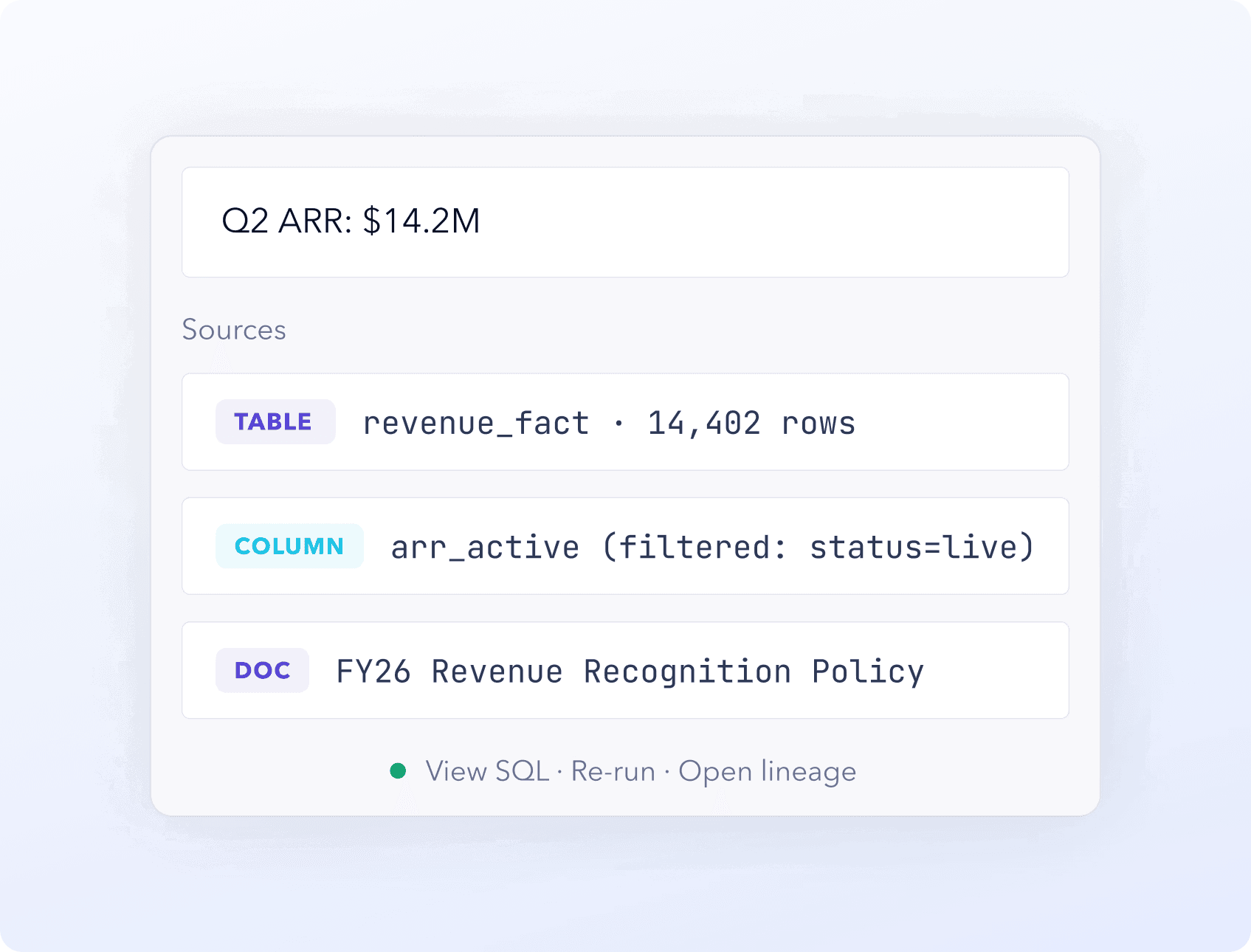
Say the head of finance asks, "What was our revenue last month?" and it reports $4.2M. Later, the sales lead asks, "How much did we book in November?" and gets $5.1M. Neither number is wrong. But "revenue" and "bookings" aren't the same thing. Now, two people who thought they were working from the same data are looking at different numbers.
In a context-engineered system, this only happens if intended — for instance, finance and sales have specifically defined these metrics differently. Otherwise, both questions resolve to the same governed definition of revenue, so the answers stay consistent. If you ask why, the system presents the verified definition, the data, and the exact query executed.
Text generation vs orchestration
Context engineering opens up a wider set of possibilities for your data team. You can layer in multiple AI agents, connect specialized tools for different jobs, and use MCP servers to plug the model into external systems like Salesforce, GitHub, or your warehouse. And you can orchestrate all of it, ensuring seamless handoffs between agents, tools, and systems.
Take a request like, "Show revenue by region." A prompt-centric setup generates a query from whatever the model can infer:
SELECT region, SUM(revenue) AS revenue FROM sales GROUP BY region; |
At first glance, the query looks fine. It isn't. The model doesn't know how revenue is defined, whether canceled orders should be excluded, or which table is governed.
A context-aware agent generates this:
SELECT region, SUM(net_revenue_usd) AS revenue FROM semantic_sales_model WHERE order_status = 'completed' GROUP BY region; |
The agent resolves "revenue" against the semantic layer, applies the completion filter, and runs the query against the governed context model. Each step is a deliberate tool call inside a coordinated pipeline.
And once the answer is ready, the orchestration can carry it forward. For instance, WisdomAI's Analytics Agents can push a revenue report into your team's tools or send a Slack notification when regional revenue drops below a threshold. No glue code required.
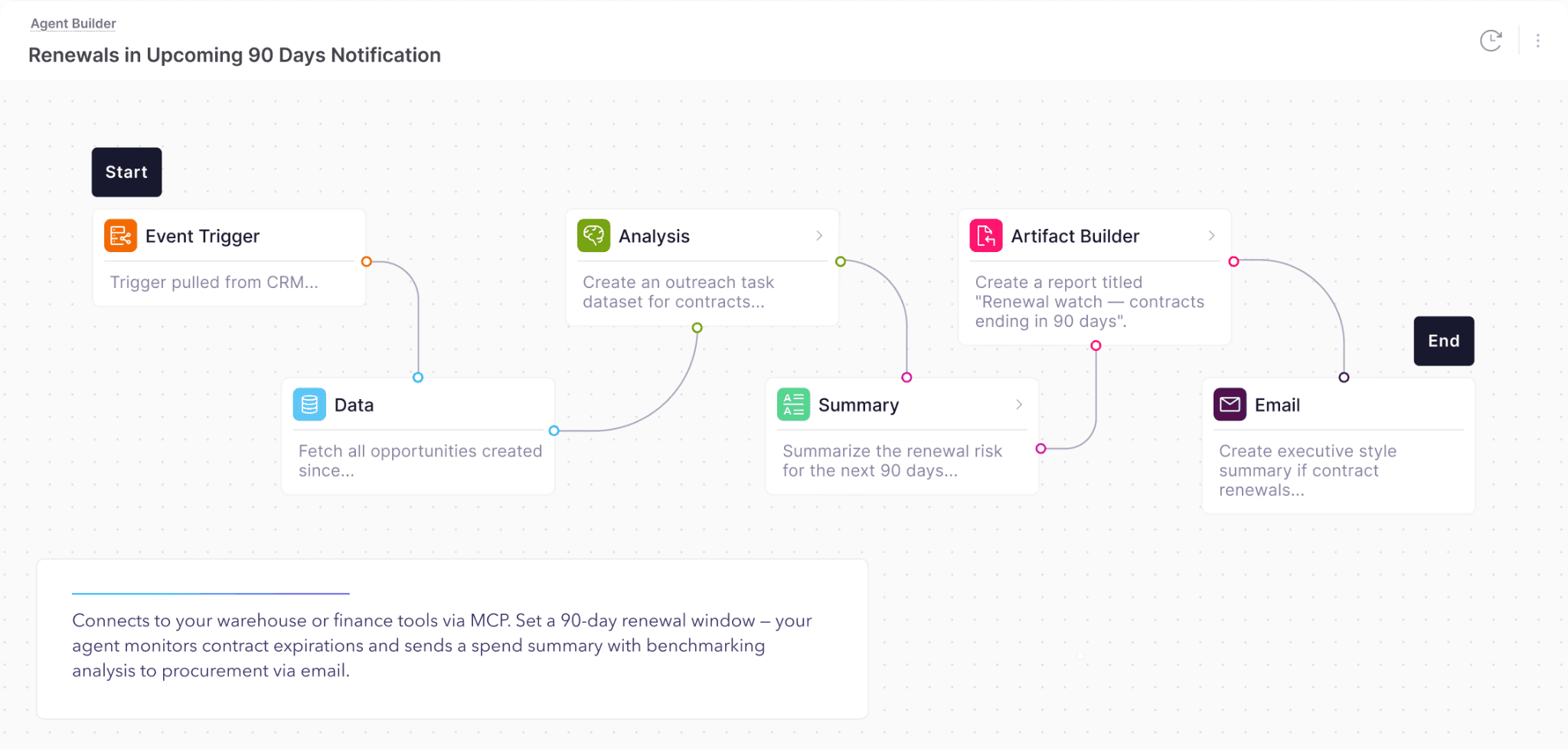
That's the difference between text generation and AI orchestration. A prompt hands your team a one-off answer to a single question. An orchestrated agent runs a multi-step task from start to finish, closing the loop between your data and the systems your team actually uses.
How to treat context as infrastructure
Keeping AI accurate and grounded across a real, enterprise data estate comes down to four questions:
How will your systems generate, update, and deliver context at scale, without constant re-engineering?
How is that context versioned, tested, and audited as requirements shift?
Do your tools and pipelines emit machine-readable summaries and input contracts, or do they lean on ad hoc docs and handoffs?
What monitors, traces, and improves workflow execution beyond prompt tweaking and retrieval tricks?
How WisdomAI’s Adaptive Context Engine works
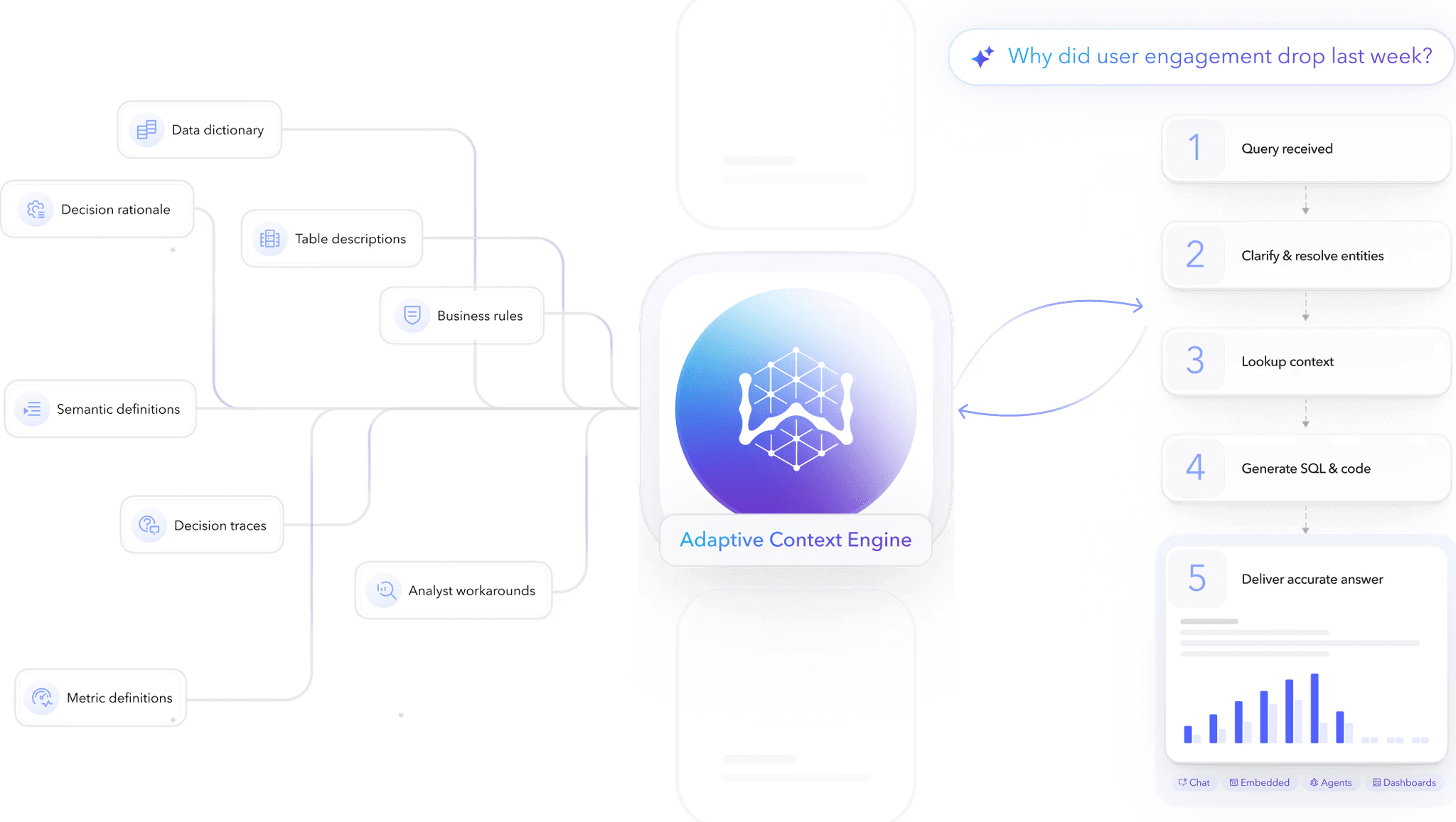
That's the bar. It's also why we built WisdomAI's Adaptive Context Engine. With a managed, integrated approach to managing enterprise context, you can confidently answer each of these questions.
Scale without constant re-engineering: Builds and refines context automatically from your live systems, including warehouses, docs, dashboards, and unstructured data, so definitions stay in sync as sources change. No one has to edit prompts or rebuild layers every time the business shifts.
Captures tribal knowledge: Codifies the operational knowledge that usually lives in Slack threads and analysts' heads, and turns it into structured context that Analytics Agents can consume.
Monitored and self-improving. Query behavior, feedback signals, domain health scores, and evolving business definitions all feed a continuous refinement loop. The engine learns which metrics your teams trust, how reporting logic works, and what interpretation each request needs, so accuracy compounds instead of decays.
Versioned, tested, and audited: Metric definitions and business rules live in a governed layer with full change history, so every retrieval and query is traceable back to the version that produced it.
The result: over 95% accuracy across enterprise deployments. For example, ConocoPhillips was able to improve the accuracy of conversation BI and AI-generated answers by 50% with WisdomAI over its incumbent solution — giving them the confidence to scale self-service, AI analytics to 2,000+ engineers across 14 countries. That's what infrastructure looks like when it's built to move with the business, not against it.
Codify AI accuracy with context engineering
Prompt engineering got a lot of teams off the ground, but it also led to a stall. As Gartner reports in their 2026 Agentic Analytics Market Guide, only one in five organizations has found significant value from GenAI tools.
The teams pulling ahead right now aren't the ones with the cleverest prompts or the biggest context windows. They're the ones treating context as infrastructure: versioned, governed, and continuously refined alongside the business.
Book a demo today and see what happens when AI has the right context.