Guide
7 AI marketing analytics tools to drive higher ROI
Everyone talks about customer obsession, but that intent means nothing when you're stuck analyzing where your buyer was instead of where they're going.
Right now, your dashboard might show you what a prospect is doing on one channel, while the actual narrative lives across four. By the time an analyst manually extracts, models, and stitches that fragmented picture together, your buyer has already made their move without you.
If your current marketing analytics stack is creating this exact latency bottleneck, it’s time to evaluate other options.
What does AI-powered marketing analytics do differently?
Most marketing dashboards are just historical reports. They tell you where your budget went last month, but they don't help you fix the campaign running right now. AI-powered platforms shift your team from reactive reporting to active optimization.
AI marketing analytics tools leverage machine learning to analyze your marketing data, identify patterns, and predict customer behavior. They also suggest ways to improve campaigns and optimize performance.
Here is how that changes your day-to-day:
Data from all your systems: You can finally stop downloading CSVs from LinkedIn, Google Ads, and HubSpot to calculate your true Customer Acquisition Cost. The platform automatically brings fragmented customer data from different channels into a single view.
Faster answers: You stop waiting in the analytics queue. If you need to know which specific ad creative drove the cheapest enterprise leads this week, you don't need to ask for a custom dashboard. You ask the platform in plain English and get an instant answer.
Proactive alerts: Traditional dashboards only tell you a campaign failed after the budget is already gone. AI monitors your live data in the background, pinging you the second your ad conversion rate drops, so you can pause the spend before it becomes an expensive problem.
Ready to move past traditional dashboards? Here are seven platforms worth considering:
7 best AI marketing analytics tools
WisdomAI
HubSpot’s Marketing Hub
Google Analytics
Salesforce Marketing Cloud Intelligence
Adobe Analytics
Mixpanel
Amplitude
Comparing 7 marketing analytics tools: features, pricing, and fit
Tool | Best for | AI and automation | Pricing | Why does it stand out? |
|---|---|---|---|---|
WisdomAI | Agentic intelligence across all marketing and sales data | Context-aware agents that automate data analysis and deliver real-time insights | Custom pricing | Ask questions about your customers, channels, pipelines, and spend, and get answers grounded in your business logic. |
HubSpot Marketing Hub | Inbound teams already running their marketing operations in HubSpot | AI content assistant, predictive lead scoring, and automated email workflows | $20–$3,600+/mo | Strong inside its own walls. Doesn't help much when the question crosses outside HubSpot |
Google Analytics | Teams that need to track web and app behavior | Free, predictive metrics, cross-platform tracking, and Google Ads integration | Free | Free at any traffic volume. Useful only if you're willing to do the configuration work — and it can't answer questions outside digital behavior. |
Salesforce Marketing Cloud Intelligence | Enterprise marketing orgs already deep in the Salesforce ecosystem | Einstein AI for data harmonization and cross-channel attribution | Custom pricing | Connectivity across multiple data sources. Good fit if you’re already using Salesforce CRM. |
Adobe Analytics | Large enterprises with complex customer journeys across digital and offline channels | Adobe Sensei for anomaly detection, segmentation, and attribution | Custom pricing | Good for customer segmentation and multi-touch attribution at scale, especially for teams already on the Adobe Experience stack. |
Mixpanel | Product and growth teams analyzing in-product user behavior | Behavioral event analytics, funnel and cohort analysis | Free to custom pricing tiers | Ideal for product analytics. But lacks support for marketing analytics across digital channels, attribution, or campaigns. |
Amplitude | Product-led growth teams with the engineering discipline to maintain event tracking | Behavioral cohorts, funnel analytics, AI-powered recommendations | Free to custom pricing tiers. | Behavioral analysis and AI-powered recommendations |
1. WisdomAI
WisdomAI's conversational agents answer marketing questions the way marketers actually ask them, in plain English, across every source at once.
Instead of building complex reports or waiting for data teams to pull insights, you query your data conversationally and get instant, visual answers. This autonomy removes the friction between seeing a metric and making a pivot. With real-time KPI tracking and proactive alerts, you catch shifts in customer behavior the moment they surface, giving you the lead time you need to personalize every touchpoint.
Key Features
Natural Language Querying: Ask questions like "Which email campaigns drove the most revenue last quarter?" in plain English without SQL or technical knowledge.
Cross-Channel Integration: Combines data from advertising platforms, email marketing tools, CRM systems, social media, and web analytics into one unified view.
Proactive Marketing Alerts: Automatically notifies you when campaigns underperform, conversion rates drop, or opportunities emerge based on your data patterns.
Tailored Dashboards: Create customizable dashboards that update instantly, showing current campaign performance and marketing KPIs.
Automated Data Ingestion: Connects directly to databases and accepts CSV uploads, making it easy to bring existing marketing data into the platform.
Pros
Eliminates the need for SQL knowledge or data science expertise to extract insights
Combines marketing data from multiple sources for comprehensive analysis
Proactive alerts catch issues and opportunities automatically
Highly customizable to match specific marketing workflows
Cons
Requires a direct sales conversation to understand the pricing structure
2. HubSpot Marketing Hub
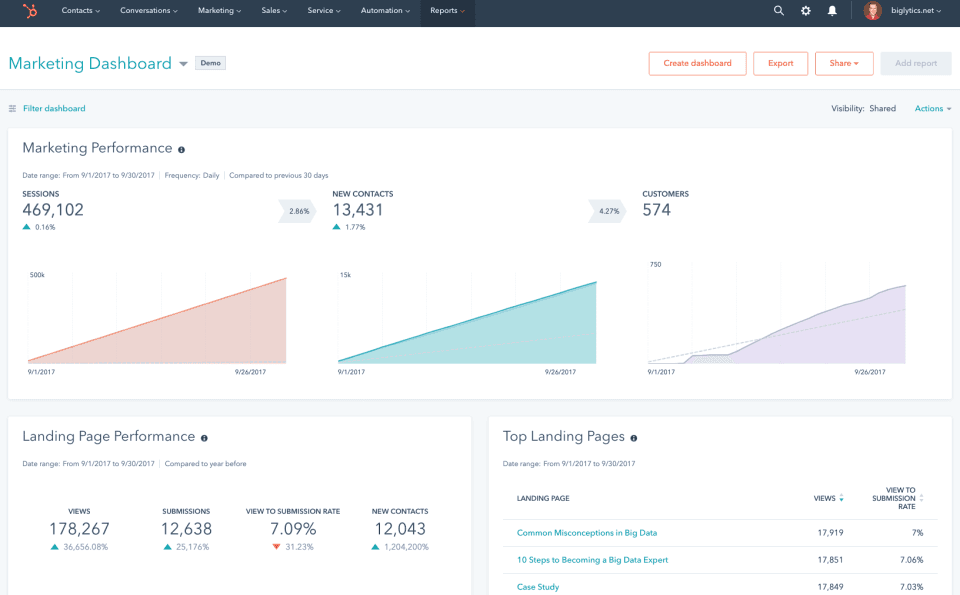
HubSpot’s Marketing Hub is an all-in-one inbound marketing platform that combines marketing automation, email marketing, landing pages, and analytics with an integrated CRM. Its AI features include content optimization suggestions, lead scoring predictions, and automated campaign recommendations.
The problem shows up when the question crosses HubSpot's walls. The platform reports on what happened inside HubSpot. It doesn't natively answer questions about data that lives in Salesforce, your ad platforms, or your warehouse. And its reporting is constrained to predefined models which makes it harder to customize.
Key Features
Unified Marketing Platform: Handles email, social media, content management, SEO, and advertising from one interface.
AI Content Assistant: Generates copy suggestions.
Predictive Lead Scoring: Uses machine learning for predictive lead scoring based on engagement patterns.
Marketing Automation: Creates workflows that nurture leads automatically based on behavior triggers.
CRM Integration: Native HubSpot CRM integration
Pros
Consolidates multiple marketing tools into one workspace.
Strong fit for inbound methodology.
Reduces ops overhead for small and mid-sized teams.
Cons
It can become expensive as you scale users and contacts.
Constrains reporting to predefined models.
Can't analyze data outside the HubSpot ecosystem without exports.
3. Google Analytics
Google Analytics 4 (GA4) is a web and app analytics platform built with AI-powered insights and predictive metrics..
Unlike its predecessor (Universal Analytics), GA4 uses an event-based data model that tracks user interactions across websites and apps. Where it runs out of room is everywhere outside digital behavior. GA4 tells you what users did on your site. It doesn't tell you whether those users came from the email campaign, whether they converted to paid, or whether marketing spend paid back. For those answers, you're either analyzing data in a warehouse or you're back in the analyst queue.

Key Features
Predictive Metrics: Uses AI to forecast purchase probability, churn probability, and potential revenue from specific user segments.
Cross-Platform Tracking: Unifies web and app data to show complete customer journeys across devices.
Automated Insights: Machine learning automatically identifies trends, anomalies, and opportunities in your data.
Event-Based Analytics: Tracks user interactions such as clicks, page views, scrolls, and conversions using a flexible, event-driven model.
Pros
Handles high-traffic volumes without additional licensing costs.
Handles detailed behavioral tracking across devices.
Built for teams with in-house data engineers who want to build their own custom data models.
Cons
Requires significant configuration before insights become actionable.
Limited in answering broader business questions beyond digital behavior.
Complex and unintuitive interface.
4. Salesforce Marketing Cloud Intelligence
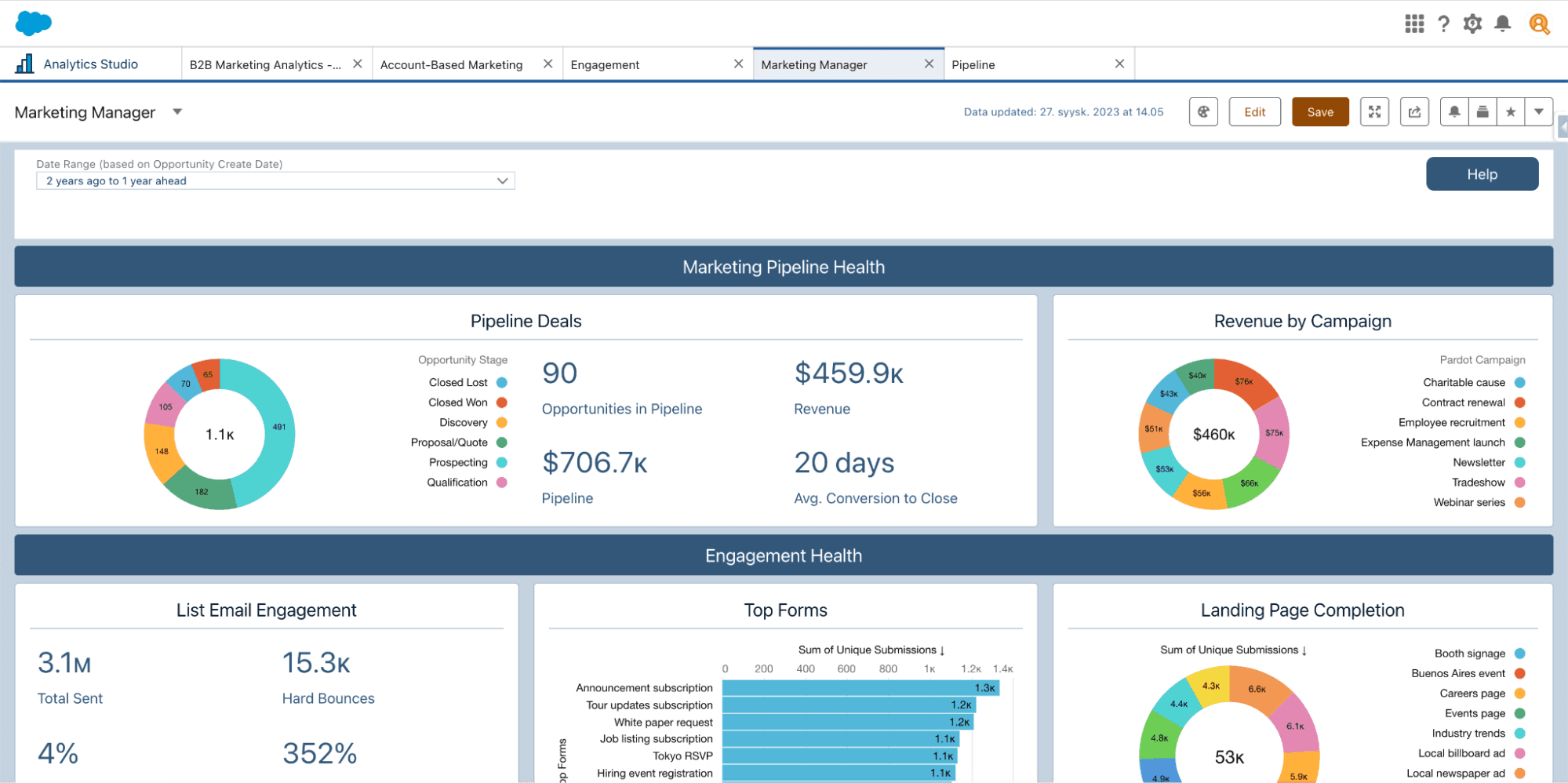
Salesforce Marketing Cloud Intelligence is built for enterprise marketing orgs managing campaigns across various sources. It collects data from ad platforms, social, web analytics, and CRM into unified dashboards, with Einstein AI surfacing optimization opportunities.
While the platform is undeniably useful, the barrier to entry is also high. Without a solid data foundation, the tool remains out of reach. In most cases, the setup process outlasts the very marketing cycles it’s meant to optimize.
Key Features
Marketing Data Unification: Automatically connects and harmonizes data from various advertising, social, web analytics, and CRM platforms.
AI-Powered Insights: Einstein AI identifies underperforming campaigns, budget allocation opportunities, and predictive trends.
Cross-Channel Attribution: Uses advanced modeling to attribute revenue and conversions.
Automated Reporting: Generates executive dashboards and detailed reports automatically with customizable templates.
Enterprise Governance Controls: Applies standardized metrics and access controls.
Pros
Broad integration across marketing data sources.
Supports standardized metrics across global teams and agencies.
Fits naturally into Salesforce-first enterprise tech stacks.
Cons
Implementation and setup require significant time and expertise.
Dependent on clean inputs, making upstream data quality critical.
The price tag is exclusively enterprise-level.
5. Adobe Analytics
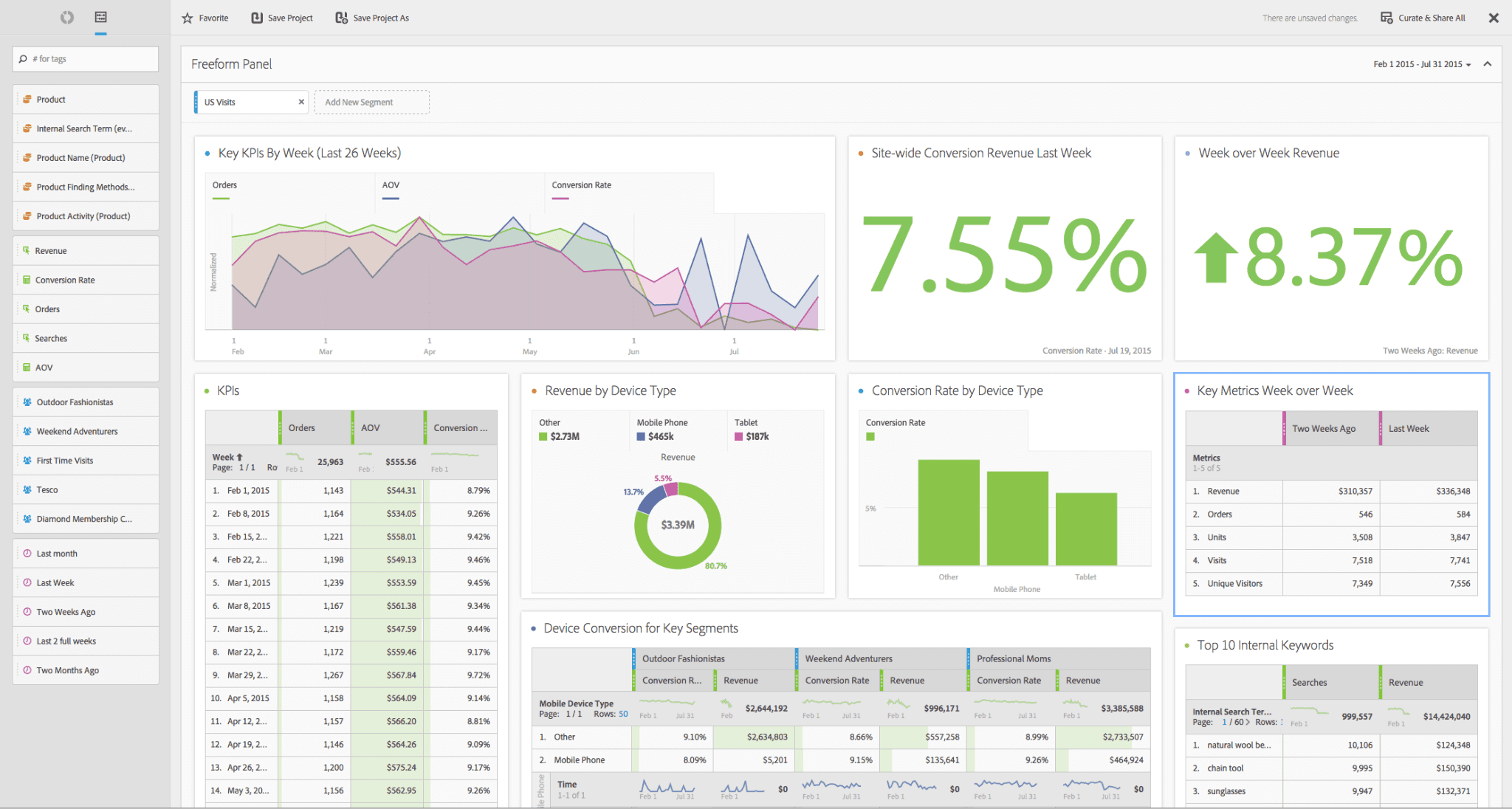
Adobe Analytics is an enterprise analytics platform that provides real-time, multi-channel data analysis with AI-powered insights through Adobe Sensei. It offers customer segmentation capabilities, predictive analytics, and sophisticated attribution modeling for organizations with complex customer journeys.
But here's the honest read: Adobe Analytics is built for analytics specialists, not marketers. Without that dedicated support, the tool is often too complex for a standard marketing workflow.
Key Features
Anomaly Detection: Adobe Sensei identifies unusual patterns and statistical anomalies in your data.
Advanced Segmentation: Create audience segments based on behavior, demographics, and predictive attributes.
Multi-Channel Attribution: Sophisticated modeling shows how marketing touchpoints contribute to conversions.
Real-Time Analytics: Get instant insights into campaign performance and customer behavior.
Customer Journey Analysis: Understand how users convert or drop off.
Pros
Chosen by enterprises for highly customizable analytics and data modeling.
Handles large-scale data volumes across multiple digital channels.
Strong integration with Adobe's marketing stack.
Cons
Requires trained analysts to operate.
Custom enterprise pricing, typically five to six figures annually.
Slow reporting times.
6. Mixpanel
Mixpanel is a product analytics platform focused on tracking user behavior and engagement rather than just page views. It uses event-based tracking to understand how users interact with products, which features drive retention, and where users drop off in conversion funnels.
While originally designed for software products, Mixpanel's approach applies well to understanding customer engagement across marketing touchpoints.

Key Features
Event-Based Tracking: Track specific user actions and behaviors rather than just page views.
User Journey Analysis: Visualize the paths users take through your product or website.s.
Cohort Analysis: Group users by shared characteristics or behaviors..
A/B Testing Integration: Test variations and measure impact on key metrics like conversion and retention.
Data Export & Integrations: Connects with data warehouses and third-party tools for extended analysis.
Pros
Strong for understanding in-product behavior.
Self-serve analysis without heavy SQL or engineering support.
Easier to adopt than traditional enterprise analytics tools
Cons
Requires technical implementation for event tracking.
Limited for broader business or cross-functional analytics.
Event-based pricing scales quickly.
7. Amplitude
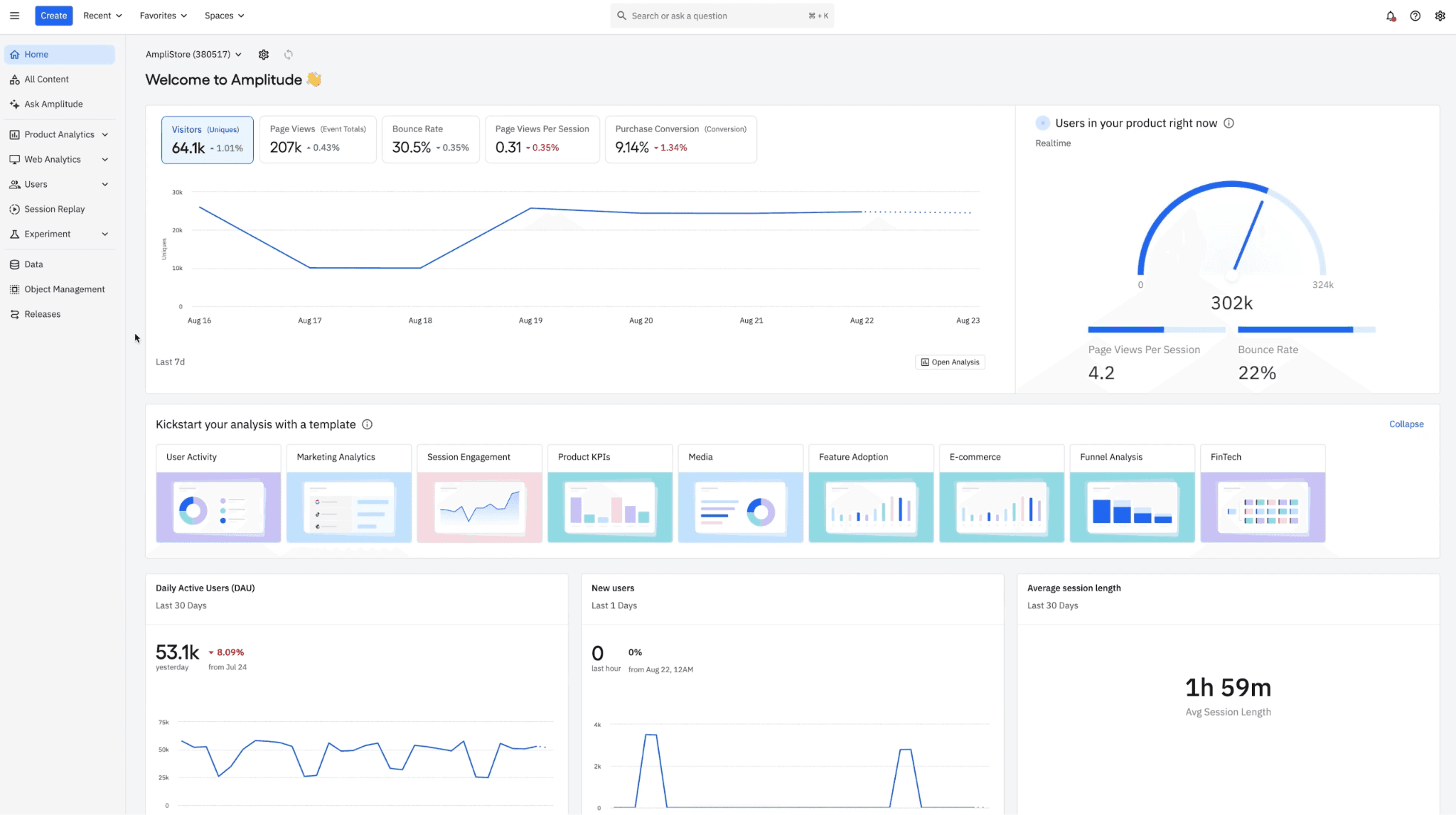
Amplitude is the other major player in product analytics, using cohorts and funnel mapping to show exactly how users move through your product. It's a good fit for product-led growth teams tracking retention and engagement.
The catch is instrumentation. Amplitude only produces useful output if your event tracking is carefully defined from the start, and that requires engineering support most marketing teams don't have on standby.
Key Features
Behavioral Cohorts: Groups users by actions they take, creating dynamic segments for analysis and targeting.
Funnel Analytics: Visualize conversion funnels to identify exactly where users drop off.
AI-Powered Recommendations: Suggests which features or campaigns to prioritize.
Retention Analysis: Track long-term user engagement.
Experimentation & Testing: Supports A/B testing and experimentation to validate product changes.
Pros
Sophisticated behavioral analysis capabilities.
AI-driven insight discovery reduces manual plumbing..
Strong focus on retention and long-term value.
Cons
Requires careful instrumentation to produce useful analytics.
Costs can scale significantly for high-volume teams.
Complex features often require analyst support.
Start moving at your customer’s speed
Most marketing teams have the data. What they don't have is a fast enough way to turn it into an answer.
With WisdomAI, every marketer can understand what happened last quarter, act on what's happening now, and plan confidently for what's next. Conversational agents pull insights from your entire marketing stack, so the answer that used to take three days takes three seconds.
Get started with WisdomAI today.