

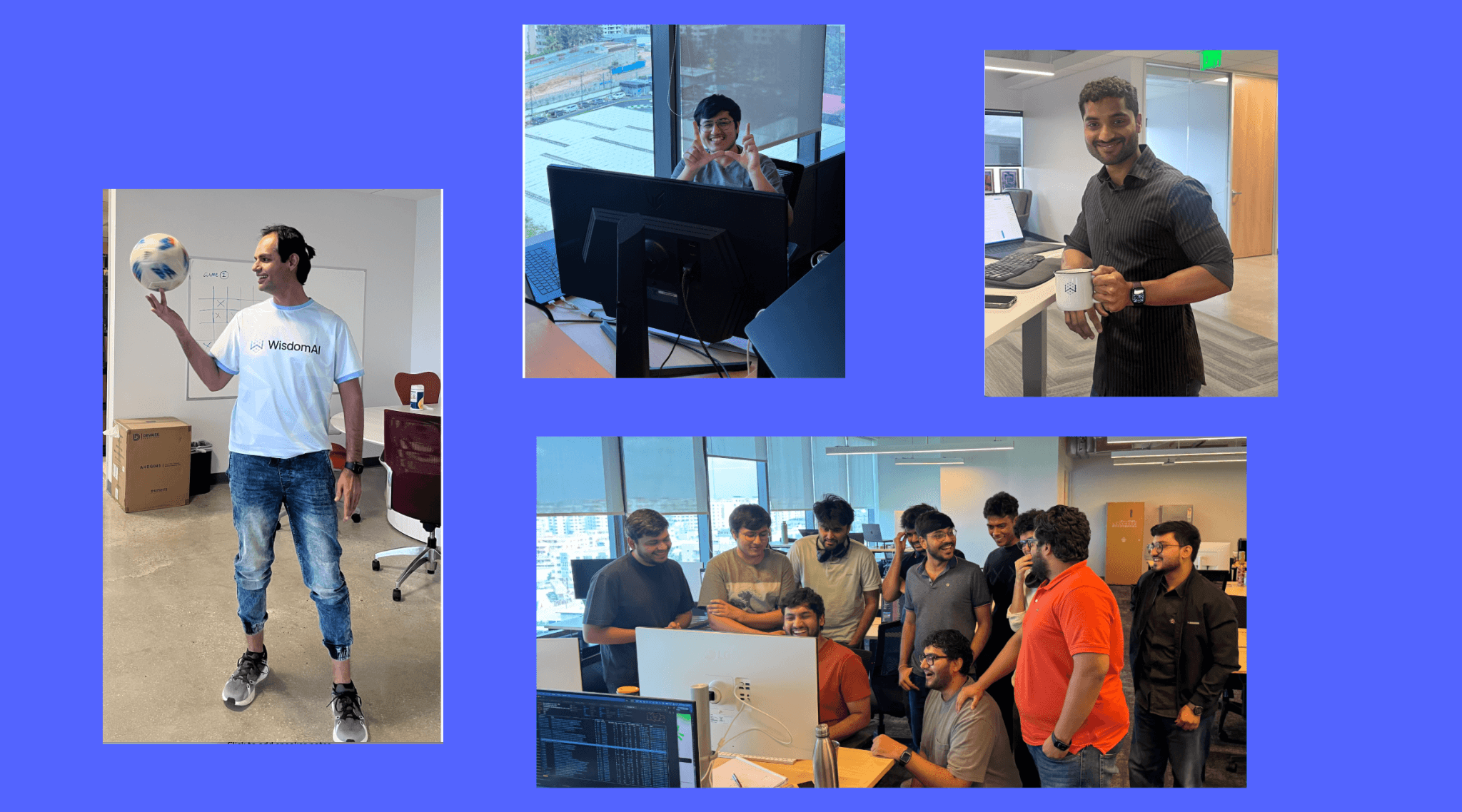
WisdomAI's third hackathon is officially one for the books! Over 48 hours, our team, spread across three different countries, worked together to collectively deliver 41 hackathon projects. The demos speak for themselves.
The core challenge is simple: find a point of friction in the platform, or a feature you'd want to improve, and hack up a solution or a new solution approach.
The WisdomAI engineering and product teams showed up in full force, with every corner of the stack represented. Some rewired the agentic control planes running behind the scenes. Many rethought the search and query experiences that developers and analysts use every day. And others came up with new ideas we’d yet to conceive of.
Huge credit to everyone who built and presented — the range of ideas, the speed of the prototypes, and the relentless focus on the user gave this year’s hackathon an invigorating spirit. Here’s a closer look at the event.
Thinking as users, not just developers
The whole hackathon leaned into one idea: solve user problems with clear logic and real empathy. We weren’t building for the sake of building, but fixing the exact things that had been quietly bugging the team as everyday users of the product.
For instance, Saksham Dhull, one of our engineers, built a chat branching feature because he'd hit a context wall in another tool months earlier. He wanted a way to explore a new direction without losing the conversation he'd already built.Another project started as a stray Slack message, "I would love to get data insights on my smartwatch," and became a working phone app by demo day.
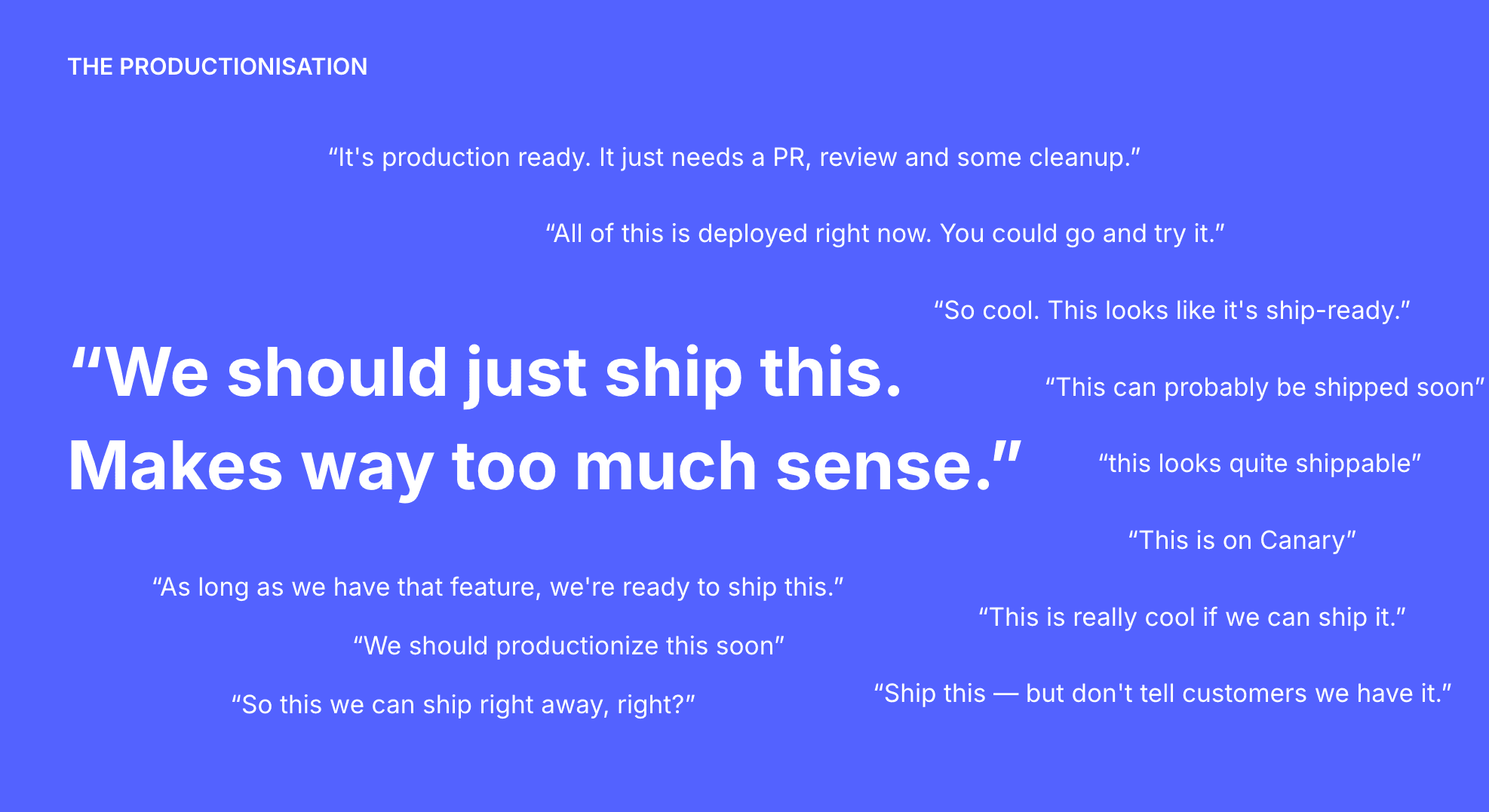
Other builds followed the same pattern: voice-delivered agent reports, a diagnose button for wrong answers, and personalized onboarding experience. Each demo traces back to a person picturing someone on the other side of the screen, and a genuine desire to help build a viable solution. Of the 41 projects, 12 have made it to production so far, and there are 12 more close behind.
Highlighting stand-out innovation
This year, we decided to fuel the competitive nature of the Hackathon by introducing award categories. That said, every project was built collaboratively — engineers helping each other, reusing what teammates previously shipped, and merging overlapping ideas mid-flight. The winners below stood out, but the way everyone built together mattered just as much.
And with that, we're proud to present the three hackathon presentations that took home the gold:
Most Innovative Hack: Wisdom Brain Agent
By Aman Bansal and Vidit Jain
Users need their AI tools to have minimum latency and deliver fast answers, especially when they answer a question that’s already been asked. A timely, reliable answer — not a system that rebuilds every query from scratch — is the goal Aman and Vidit delivered.
The idea came from watching how analysts work: ask a question they've seen before, and a data analyst can answer it faster than the first time. WisdomAI should do the same.
In their demo, Aman and Vidit showcased how our SQL generation engine handles these queries. Instead of forcing a total regeneration, their project now surfaces relevant past queries directly to the SQL generation engine, allowing the system to make rapid edits, building on the past context of a previous query.
The impact is immediate. In the demo, the generation time for a large SQL shrank by over 35%. Most of the remaining latency sits in orchestrator calls, which they're targeting next using the same approach.
Best Quality of Life Improvement: Feature flags
By Rohan Kejriwal and Kush T.
Before this team’s solution, rolling out a new feature or rotating a customer's API key was a multi-hop process. A customer would reach out to their Account Executive (AE), the AE loops in Engineering, who creates a new Kubernetes secret, and finally, the service restarts. What should take two clicks was taking a full ticket cycle.
Rohan from Customer Success and Kush from Engineering came at this problem from two different teams. But since they landed on nearly the same idea, they joined forces to pull the entire workflow directly into the platform.
In their demo, they showcase a new control panel that makes these operations instant. Without touching a single line of code, you can toggle a feature for one user, a specific role, or your entire user base. You can even swap a customer's OpenAI key live and watch the charts fail or recover in real time — zero restarts required.
Best of Show: Better Dashboards
By Prashant Kumar, Sayantan Jana, and Parth Jindal
Dashboards today are passive. A metric shifts, and nobody notices until someone opens the tab. If a filter needs tweaking, someone has to build an entirely new view. Prashant, Sayantan, and Parth teamed up to change that dynamic.
Instead of a static screen, they built an interactive assistant right into the platform. Dash-chat now applies filters and generates widgets on command. Proactive monitoring catches anomalies and drops the RCA straight into Slack. And the part that made the room lean in: A voice walkthrough that narrates what changed since your last visit, turning your WisdomAI feed into a personalized podcast for your Monday morning commute.
Honorable mentions
Picking three winners was hard because so much of the work deserved a spotlight. Here are the projects that didn't take a prize but still shaped the room's energy:
Debug Tools in Browser
By Tanish Lad
Some customers won't let WisdomAI into their cluster and won't let logs ship outside it. Tanish built a debug console that lives inside the cluster itself: K9s for pod inspection, ClickHouse for log queries, PG Admin for the database, and OpenSearch for crawl data. All accessible through the browser, with a read-only mode for production.
As Sharva Pathak, Head of Engineering, put it: "This is going to be very impactful. Let's figure out how to make it happen."
Diagnose Chat
By Anuj Mittal
When WisdomAI returns a wrong answer, there's no easy way for anyone to figure out why. Anuj built a "diagnose" button that exposes the prompts, context, and recent domain changes the system used to generate the answer, along with suggested actions to fix it.
The reaction in the room: "This will be useful, especially as we think about how to build trust in the answers with the users."
Dynamic Context + Context as a Filesystem
By Saksham Dhull and Mitanshu Mittal
Today, Domain context is spread across tables, columns, knowledge entries, and reviewed queries with no unified view. Mitanshu and Saksham reorganized context into a filesystem. It features an index file at the top, one file per table, and everything cross-referenced into a graph. This enables WisdomAI to load only the relevant context, instead of dumping thousands of tables into the prompt.
The result: query accuracy jumped from 61% to 74% on a large domain.
Voice as a Delivery Mode
By Gaurav Jain
Agent reports today land in Slack or email. Gaurav added voice as a third option. A 9 a.m. call that summarizes your report on the way to work, using ElevenLabs to generate the narration. He also prototyped a "dictate" button for chat responses, turning any output into audio you can easily listen to.
Inspired by what we're building?
If seeing what our team built has sparked your interest in Agentic Analytics, here's how to go deeper:
Book a demo: See WisdomAI in action. Launch Analytics Agents, spin up AI Dashboards, and watch the Adaptive Context Engine ground every answer in your enterprise context.
Subscribe to our newsletter: Get an inside look at how we're thinking about Agentic Analytics, the customer problems we're solving, and the features we're shipping next.
Join our team: We're hiring engineers, designers, and customer-facing folks who care about product innovation. Help us build the future of how enterprises work with their data.
Congratulations again to all our winners and participants. We can't wait to see what you build next!


