I've spent more than 20 years answering the same question for a living: is this customer healthy? For most of that career, answering it meant the same ritual. You'd go find a BI analyst , ideally a data person too, and hand them a wishlist of well-worn metrics: license utilization, ticket volume, response time, meeting cadence, sentiment, NPS. None of it was mysterious. Anyone who has run customer success knows this list by heart. The hard part was never deciding what to measure. It was the plumbing to go get it, and the weeks spent waiting in data analyst and data engineering queue while it got built
I joined WisdomAI a little over six months ago to run customer solutions: pre-sales solutions engineering, post-sales customer success, and support. So, one of my first moves was the same one I've made at every job for two decades: figure out how healthy our customers are. I asked WisdomAI for weekly active users by customer. I asked for license utilization by customer. It answered both, I stitched together an initial dashboard, and I felt good about it. It was also, I'd eventually realize, missing the entire point.
After looking at those metrics it became obvious that the real unit of value at WisdomAI is neither weekly activities nor license utilization. It's domain maturity. Think of a domain as the natural container of a business function: sales, marketing, finance, or in my case, our customer base. The WisdomAI domain is where the business context, certified metric definitions, and access controls live. A healthy domain is one that's accurate and gives people the right answer to the analytics question they asked. So I refined my target: instead of weekly actives and license utilization, I started monitoring domain health directly.
Old habits die hard
My first attempt still had the old habit baked in. Weekly active users. License utilization. Thumbs-up and thumbs-down ratings. Useful, but thin. I was still asking narrow, specific questions instead of focusing on the outcome I was actually trying to achieve.
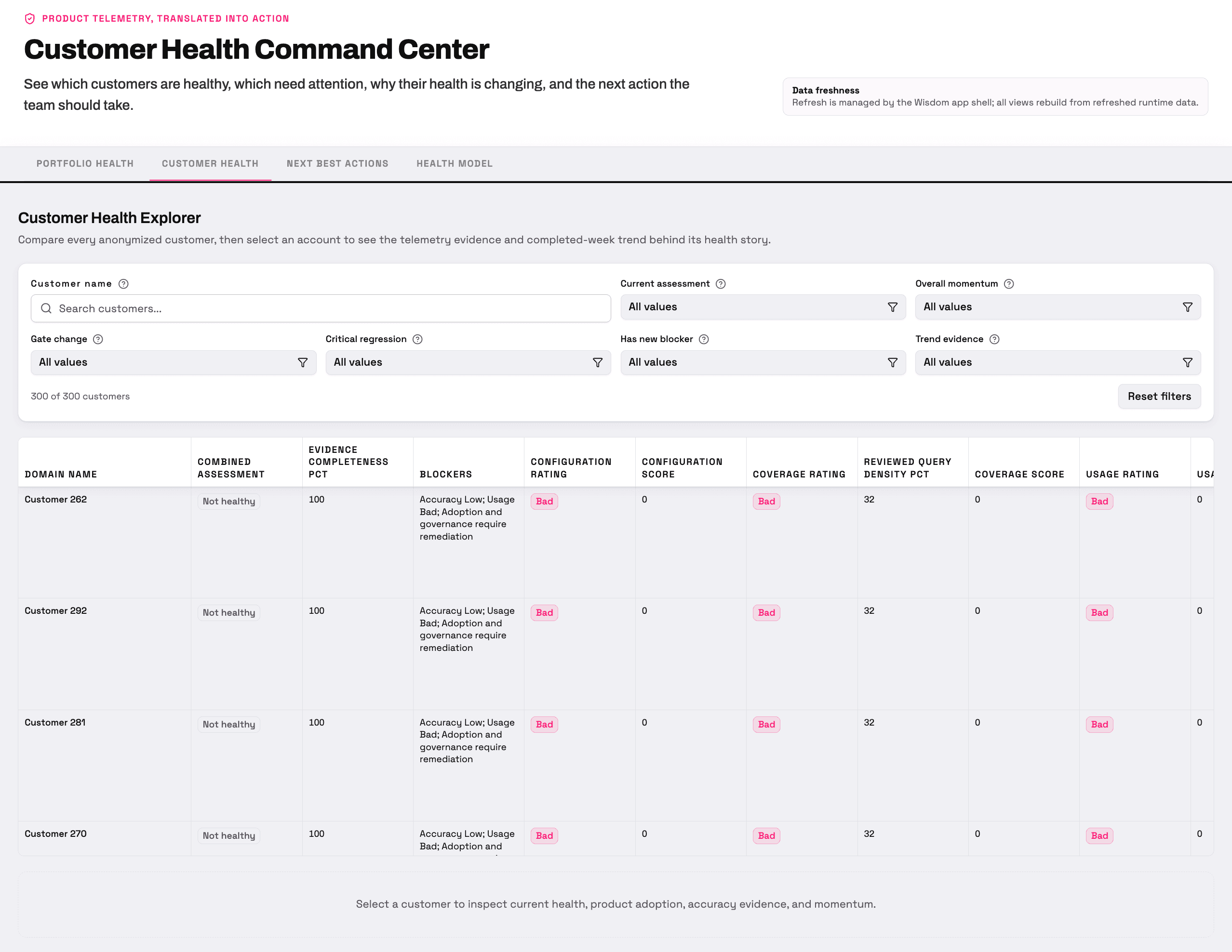
So I changed the ask. Instead of building a dashboard with traditional customer success metrics, I used WisdomAI's Live App product and prompted it, describing the outcome that matters to me as the Head of Customer Solutions:
Build an app that helps us understand customer health based on product telemetry. Show which customers are doing well, which need attention, why they may be struggling, and the actions our team should take next.
WisdomAI quickly built an interactive analytics app that tells me what's statistically significant in our product telemetry that indicates whether a customer’s domain is healthy, where healthy means broad adoption, accurate answers, and real use of product capabilities. A well-engineered domain with strong product adoption of Live Apps, chat, agents, and skills tells me the customer is healthy.

Six months of work in about four hours
That one change did more than I expected. WisdomAI analyzed the full breadth of our telemetry, and came back with dozens of metrics I would never have thought to check, not because they were exotic, but because no person sits down and manually tests every signal in the data for statistical significance. It also showed its reasoning: why each metric mattered, and how confident it was.
At my last company, building something this rigorous took six months, a full-time analyst, and a data engineering team behind them. This time it took about four hours of prompting and refining in chat, over a week, while I had other things going on. Now, tickets, data prep and rebuilds are not needed every time I follow a data hunch.
And because it was built on our governed domain, I never had to wonder whether the numbers were right. Anyone can get a chatbot to produce a convincing chart in seconds. What they can’t get is our unique and certified definition of “active user”, or the confidence that my CSMs and I are looking at the same number. Accuracy on a shared source of truth aligns my strategy and my team.
From health check to command center
I could have stopped there, but I didn’t. Once the metrics were grouped into themes, I asked for a scoring rubric. The themes covered:
Adoption: usage trend and momentum, use of the core experience like chat and Live Apps, and use of extended capabilities like our Slack agent and WisdomAI in Claude via MCP
Foundation: how much of the data has context behind it, and whether the account shows up properly in the CRM
Accuracy: whether people are getting the right answers
Now every domain across every customer has a health score my CSMs can act on instead of interpret.
Then I added one more layer: the judgment I'd apply myself if I saw a given theme decline. Now the same Live App doesn't just score health. It recommends the next action and names the specific metric that action should move. What started as a health check is now a closed loop that runs inside a single Live App. And, my whole team opens it at the same URL, and it’s always running on live data.
Give it your context
Here's what always gets missed. If you look at Live Apps and see only "I can build a dashboard faster," you're not wrong, but you're looking at the smallest part of it. There's a familiar ladder in analytics. You start with raw data, add semantics so people know what a column or join actually means, and eventually arrive at what people now call a data product: governed, fresh, and trustworthy.
Most data teams treat that as the finish line. It isn't. Ask anyone who has shipped a "final" data product what happens next. A business team submits a request with no process attached, no judgment criteria, and no stated outcome, and the data team fills it as literally as it can. Ask what that report is actually worth on its own, and nobody can tell you.
The shift happens when you stop handing over only the data and semantic layers and start handing over the rest of what's in your head: the context. Here's the process I'm running, here's the judgment I apply at each fork in it, and here's the outcome I'm accountable for. Give a Live App that much context and it stops being a faster way to get a dashboard. It becomes a command center, the place my team manages customer health day to day, not a report they check before going off to figure out what to do next.

Why I stopped asking for dashboards
That's the real distance between a dashboard and a Live App, and it's not really about speed. A dashboard tells you what happened. A Live App, given the process, the judgment, and the outcome you're chasing, tells you why it happened, what to do next, and which number should move if you're right.
I've since started building the same kind of command center for other parts of my org, because once you've done it for one process, you stop wanting a dashboard for any of them. You want something that runs the process improvement loop with you. My Customer Health Live App is available in the Live Apps Gallery. Let me know what you think at christos@wisdom.ai.
See what a Live App can do with your data. Book a demo today.